50/30/20 Budget Calculator — Free Budget Planning Tool (2025)
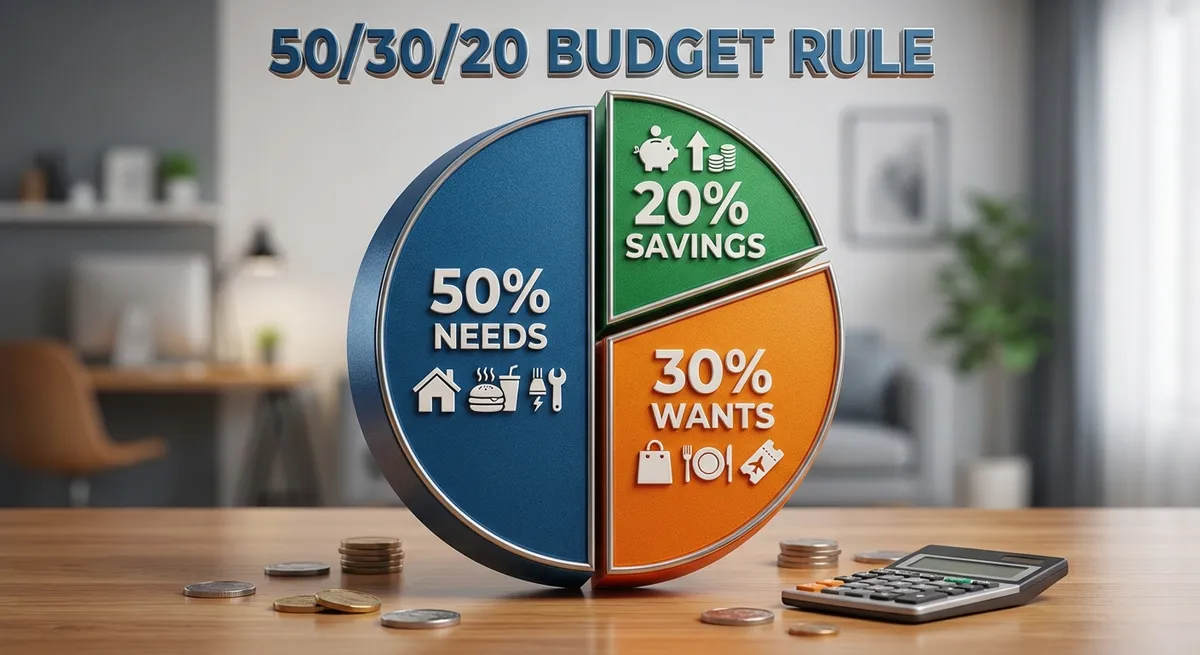
The 50/30/20 budget rule, popularized by Elizabeth Warren, is a simple yet powerful framework for managing your money. Our interactive calculator helps you visualize exactly how to divide your income into needs, wants, and savings—giving you clarity and control over your financial future.
Calculate Your 50/30/20 Budget
Enter your monthly take-home pay after taxes and deductions
Quick Presets
Budget Visualization
Needs (50%)
Wants (30%)
Savings (20%)
How to Use the 50/30/20 Budget Calculator
Step 1: Calculate Your After-Tax Income
Determine your monthly take-home pay after all taxes and deductions. If you're self-employed, subtract estimated taxes and business expenses from your gross income. Include all consistent income sources like salary, freelance work, and side hustles.
Step 2: Enter Your Monthly Income
Input your after-tax income into the calculator. The tool automatically calculates 50% for needs, 30% for wants, and 20% for savings. Watch the pie chart update in real-time as you adjust your income.
Step 3: Review Your Budget Breakdown
Examine the interactive pie chart and category breakdowns. See exactly how much you should allocate to housing, food, transportation, entertainment, and savings based on the 50/30/20 rule.
Step 4: Adjust for Your Situation
Use preset scenarios if you live in a high-cost area (60/20/20) or want to save more aggressively (40/20/40). Customize percentages to fit your financial goals while maintaining the rule's core principle.
Step 5: Export and Implement Your Plan
Export your budget plan and use it to track actual spending throughout the month. Set up automatic transfers for your 20% savings portion to ensure consistency and build wealth automatically.
Pro Tip: Start Simple
If you're new to budgeting, don't worry about perfection. Start with the standard 50/30/20 split and adjust after your first month based on what you learned about your actual spending patterns.
Key Features of Our 50/30/20 Calculator
Interactive Pie Chart Visualization
See your budget come to life with a dynamic pie chart that updates in real-time. Visual representations make it easier to understand your financial allocation at a glance.
Customizable Percentages
Not everyone's situation fits the standard 50/30/20 split. Adjust percentages for high-cost living areas or aggressive savings goals with one click.
Real-World Expense Categories
Get specific examples of what belongs in each category. We break down typical needs, wants, and savings to eliminate confusion about where expenses belong.
Export Functionality
Download your complete budget plan as JSON to track your progress throughout the month. Perfect for use with budgeting apps or spreadsheets.
Educational Tooltips
Learn as you calculate with helpful explanations and tips throughout the tool. Understand the 'why' behind each category and how to optimize your budget.
Scenario Planning
Test different income levels and percentage splits to see how changes affect your financial plan. Perfect for planning raises, moves, or major life changes.
What Is the 50/30/20 Budget Rule and Why It Matters?
The 50/30/20 budget rule is more than just a simple formula—it's a philosophy for financial balance that has helped millions of people take control of their money. Created by Elizabeth Warren and Amelia Warren Tyagi, this framework divides your after-tax income into three distinct categories, each serving a critical purpose in your financial life.
What makes this rule powerful is its simplicity and psychological insight. Unlike restrictive budgeting systems that focus solely on cutting expenses, the 50/30/20 rule acknowledges that sustainable financial health requires balance. It ensures your essential needs are met, builds consistent savings habits, and still allows guilt-free spending on things you enjoy.
Key Statistic: According to the U.S. Bureau of Labor Statistics, the average American household spends 61% of their income on needs, 18% on wants, and saves only 8%—falling short of the 50/30/20 ideal. Our calculator helps you bridge this gap with a clear, actionable plan.
Breaking Down the Three Categories: Needs, Wants, and Savings
Understanding what belongs in each category is crucial for successfully implementing the 50/30/20 rule. The boundaries between needs and wants can sometimes feel blurry, but having clear definitions helps you make consistent decisions and avoid overspending in any single category.
50% for Needs: The Foundation of Your Budget
Needs are the expenses you absolutely cannot live without—the non-negotiable costs that keep your life running smoothly. These include:
- Housing costs (rent or mortgage payments)
- Groceries and essential household supplies
- Transportation to work (car payment, gas, public transit)
- Utilities (electricity, water, gas, internet)
- Insurance premiums (health, auto, home)
- Minimum debt payments (credit cards, loans)
- Basic healthcare and medications
The challenge: In high-cost living areas, needs often exceed 50% of income. If your needs category is over 50%, don't panic. This is normal, especially in major cities. The key is to acknowledge it and adjust your wants and savings accordingly.
30% for Wants: Enjoying Life Today
Wants are the expenses that make life enjoyable but aren't essential for survival. This category recognizes that deprivation isn't sustainable. Examples include:
- Dining out and takeout meals
- Entertainment (movies, concerts, streaming services)
- Hobbies and recreational activities
- Travel and vacations
- Non-essential shopping and personal items
- Gym memberships and fitness classes
The psychology: The 30% allocation is psychologically important. Many budgeting systems fail because they're too restrictive. By allowing yourself to spend guilt-free within the 30% limit, you're more likely to stick with your budget long-term.
20% for Savings: Building Your Future
The 20% savings category is where you build long-term wealth and financial security. This isn't just about putting money in a savings account—it's about strategic allocation:
- Emergency fund (3-6 months of essential expenses)
- Retirement contributions (401k, IRA, Roth IRA)
- Debt repayment beyond minimum payments
- Investments in stocks, bonds, or mutual funds
- Down payment savings for a home
The priority order: Always build an emergency fund first, then tackle high-interest debt, then maximize retirement savings, and finally invest for other goals.
Real-World Success Stories
Sarah's Story: From Paycheck to Paycheck to Financial Confidence
Sarah, a 28-year-old marketing specialist in Seattle, was living paycheck to paycheck despite earning $65,000 annually. Her needs (rent, student loans, car payment) consumed 65% of her income.
Her solution: She started with a 65/20/15 split while aggressively attacking her debt. She got a roommate, reducing housing costs from 40% to 25% of income, and refinanced her student loans from 8% to 4.5% interest.
The result: Within 18 months, Sarah built a $10,000 emergency fund and transitioned to a true 50/30/20 budget.
Mike and Jennifer: Dual Income Family Success
This couple combined earns $140,000 in Austin, Texas. They use 40/20/40 because their needs only consume 38% of income due to paid-off cars and low housing costs.
Their strategy: They max out 401(k) contributions and save $1,500 monthly for a house down payment while still enjoying $2,800 for wants each month.
Common Challenges and Solutions
Problem: My Needs Exceed 50%
Solution: Start with 60/20/20 or 65/20/15 and focus on reducing needs over time through refinancing, negotiating bills, or increasing income.
Problem: I Can't Tell Needs from Wants
Solution: Use the 30-day rule—if you can delay a purchase for 30 days without consequences, it's likely a want. Basic needs are non-negotiable for survival.
Problem: My Income is Irregular
Solution: Base your budget on your average minimum monthly income over the past year. Save excess in high-income months to cover low-income periods.
Expert Tips from Jurica Šinko
1. Start Today, Not Tomorrow: Don't wait for the "perfect" time to implement the 50/30/20 rule. Even if you can only save 5% right now, start there and gradually increase as you pay off debt or increase income. The habit matters more than the exact percentages initially.
2. Automate Your Savings: Set up automatic transfers for your 20% savings on payday—before you can spend it. This "pay yourself first" approach removes temptation and makes saving effortless. Automation is the most powerful tool for building wealth consistently.
3. Review Quarterly, Track Monthly: Check your spending monthly to catch overspending early, but do a comprehensive budget review quarterly. Life changes quickly—raises, moves, new relationships—and your budget should evolve with your circumstances.
When to Modify the 50/30/20 Rule
Use this if you live in expensive cities where housing alone consumes 35-40% of income. Still prioritize the 20% savings to build financial security.
Perfect for high earners or those pursuing financial independence. When needs are covered with less than 40% of income, redirect the extra to investments.
Use this when you're focused on eliminating high-interest debt. Put the extra 10% toward debt repayment beyond minimum payments.
A moderate adjustment that gives more flexibility to wants while still maintaining strong savings habits. Good for mid-career professionals.
The Bottom Line: Making the 50/30/20 Rule Work for You
The 50/30/20 budget rule isn't about perfection—it's about progress. The goal isn't to hit these exact percentages immediately, but to use them as a target that guides your financial decisions over time. Some months you'll be spot on, others you'll be way off. That's completely normal and part of the learning process.
What matters most is that you're thinking intentionally about your money, building savings habits, and making conscious choices about needs versus wants. The calculator above gives you the tools to visualize your ideal budget, but the real work happens in your daily spending decisions and your commitment to long-term financial health.
Start where you are, use what you have, and gradually work toward the 50/30/20 ideal. Your future self will thank you for the financial foundation you're building today. Remember: the best budget is the one you can actually stick with, and the 50/30/20 rule's simplicity makes it one of the most sustainable approaches to personal finance.
Frequently Asked Questions
What is the 50/30/20 budget rule?
The 50/30/20 budget rule is a simple budgeting framework that divides your after-tax income into three categories: 50% for needs (essential expenses), 30% for wants (discretionary spending), and 20% for savings and debt repayment. This rule was popularized by Elizabeth Warren and Amelia Warren Tyagi in their book "All Your Worth: The Ultimate Lifetime Money Plan" as an easy-to-follow budgeting method that balances current needs with future financial security.
How do I calculate my 50/30/20 budget?
To calculate your 50/30/20 budget, start with your monthly after-tax income. Multiply this amount by 0.50 to get your needs budget, by 0.30 for wants, and by 0.20 for savings. For example, if your monthly take-home pay is $5,000, you'd allocate $2,500 for needs, $1,500 for wants, and $1,000 for savings and debt repayment. Use our calculator above to automatically compute these amounts and visualize your budget breakdown.
What counts as needs vs wants in the 50/30/20 rule?
Needs are essential expenses you can't live without: housing, groceries, utilities, transportation, insurance, minimum debt payments, and healthcare. Wants are discretionary expenses that enhance your lifestyle: dining out, entertainment, subscriptions, hobbies, travel, and non-essential shopping. The key is being honest about what's truly necessary. For example, basic groceries are needs, but gourmet coffee every morning is a want. A reliable car is a need, but a luxury vehicle is a want.
Can I modify the 50/30/20 percentages?
Yes, absolutely! The 50/30/20 rule is a guideline, not a strict law. Adjust based on your situation: If you live in a high-cost area, try 60/20/20. If you're aggressively saving for a house down payment, try 40/20/40. If you're paying off high-interest debt, try 50/20/30. The key is maintaining the principle of balancing needs, wants, and savings while adapting to your specific financial goals, income level, and cost of living.
Is the 50/30/20 rule realistic for low incomes?
The 50/30/20 rule can be challenging for low incomes where essential expenses may exceed 50% of earnings. In these cases, focus on the principle rather than exact percentages. Prioritize covering needs first, then save whatever you can (even 5-10%), and adjust wants accordingly. As your income grows, gradually work toward the ideal 50/30/20 split. The rule is a target to aspire to, not a requirement that should cause financial stress if you can't meet it immediately.
How does the 50/30/20 rule help with financial goals?
The 50/30/20 rule helps achieve financial goals by ensuring essential needs are always covered first, building consistent savings habits through the 20% allocation, preventing lifestyle inflation by limiting wants to 30%, and creating a balanced approach that allows enjoyment while prioritizing future security. It provides a simple framework that's easier to maintain than complex budgets, making it more likely you'll stick with it long enough to see real results in your financial life.
What should I do with the 20% savings portion?
Allocate your 20% savings in this priority order: 1) Build an emergency fund with 3-6 months of essential expenses. 2) Pay off high-interest debt beyond minimum payments. 3) Contribute to retirement accounts like 401(k) or IRA, especially if you get an employer match. 4) Save for specific goals like a house down payment or car. 5) Invest in diversified portfolios for long-term growth. Automate these savings to ensure consistency and remove the temptation to spend the money elsewhere.
How often should I review my 50/30/20 budget?
Review your 50/30/20 budget monthly when tracking expenses to catch overspending early, but do a comprehensive review quarterly or when major life changes occur (new job, move, marriage, baby). Monthly reviews help you stay on track, while quarterly reviews allow you to adjust percentages based on changing income or goals. Always revisit your budget after significant financial events like a raise, job loss, or major purchase.
Related Calculators
Explore more tools in Personal Finance Planning
Budget Calculator: Free Personal Budget Planner & Monthly Budget Calculator
Free budget calculator with 50/30/20 rule, zero-based budgeting, and real-time tracking. Create your monthly budget plan, track expenses, and achieve your financial goals in 2025.
COLA Calculator | Cost of Living Adjustment Estimator
Estimate Cost‑of‑Living Adjustments (COLA) to keep salary or benefits aligned with inflation. See compounding increases, totals, and a clear yearly breakdown.
Cost of Living Calculator | Compare Living Expenses by City
Thinking of moving? Use our cost of living calculator to compare expenses (housing, food, taxes) between cities and see how far your salary will go. Plan smart.
Emergency Fund Calculator | How Much Emergency Savings?
Determine your ideal safety net with our emergency fund calculator. Calculate how much you should save based on your monthly expenses (e.g., 3-6 months).
Expense Calculator: Free Monthly Budget & Expense Tracking Tool
Free expense calculator to track monthly expenses, analyze spending patterns, and optimize your budget. Includes automated categorization, budget health analysis, and personalized recommendations.
Financial Planning Calculator: Free Comprehensive Financial Plan & Net Worth Calculator
Free financial planning calculator with net worth tracking, goal setting, and scenario analysis. Create a comprehensive financial plan with interactive charts and projections.