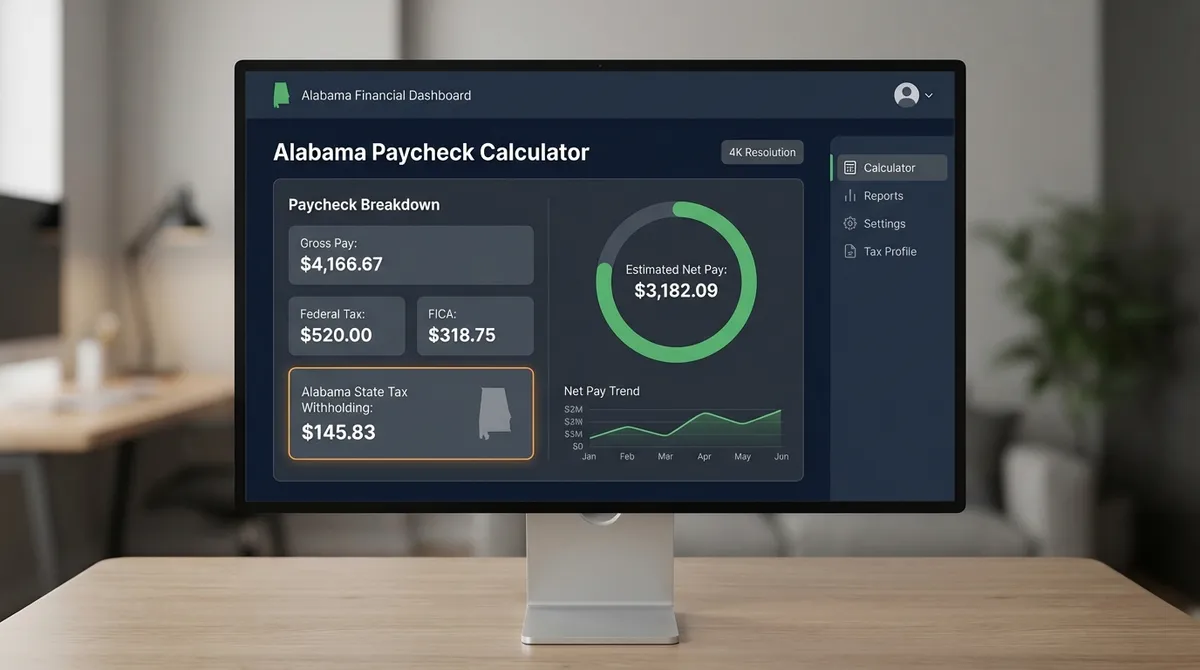
Alabama Paycheck Calculator: Calculate Your AL Take-Home Pay

Free Alabama paycheck calculator for 2025. Calculate your take-home pay after federal, state, and local taxes. Accurate AL payroll calculations.

Free Finance Calculator
100% Private
Instant Results
Home/Tax & Payroll/Alabama Paycheck Calculator

Alabama Paycheck Calculator: Calculate Your AL Take-Home Pay (2025)

Calculate your Alabama take-home pay with our free paycheck calculator. Accurately estimate federal, state, and local taxes for Alabama residents in 2025. Get precise payroll calculations for Birmingham, Montgomery, Mobile, Huntsville, and all AL cities.

Key Facts for 2025:
  • • Alabama state income tax: 2% - 5% (3 brackets)
  • • Birmingham occupational tax: 1% of gross wages
  • • Gadsden occupational tax: 2% of gross wages
  • • Most Alabama cities have no local income tax

Alabama Paycheck Calculator

Calculate your take-home pay after federal, state, and local taxes

Income & Withholding

Pre-Tax Deductions

Local Taxes

Birmingham: 1%, Gadsden: 2%, Montgomery: 0%

Paycheck Breakdown

How to Use the Alabama Paycheck Calculator

1

Enter Your Gross Pay

Input your salary or hourly wage and select your pay frequency (weekly, bi-weekly, monthly, etc.)

2

Select Filing Status

Choose your tax filing status: Single, Married Filing Jointly, Married Filing Separately, or Head of Household

3

Add Pre-Tax Deductions

Include 401(k), HSA, FSA contributions to see how they reduce your taxable income

4

Include Local Taxes

Select your local occupational tax rate if you work in Birmingham (1%), Gadsden (2%), or other taxed cities

Why Use Our Alabama Paycheck Calculator?

Accurate Alabama State Tax Calculations

Uses official Alabama Department of Revenue tax brackets (2%, 4%, 5%) for precise state withholding calculations

Local Occupational Tax Support

Includes Birmingham (1%), Gadsden (2%), and other Alabama city/county occupational taxes applied to gross wages

Pre-Tax Deduction Optimization

See how 401(k), HSA, and FSA contributions reduce your taxable income and increase take-home pay

Visual Paycheck Breakdown

Interactive charts show exactly where your money goes - federal, state, FICA, local taxes, and take-home pay

Real-Time Calculations

Results update instantly as you adjust income, deductions, or filing status - no page refresh needed

Mobile-Friendly Design

Works perfectly on smartphones, tablets, and desktops - calculate your Alabama paycheck anywhere

Understanding Alabama Paycheck Deductions and Take-Home Pay in 2025

Alabama's paycheck calculation system combines federal withholding, progressive state income taxes, local occupational taxes in certain cities, and FICA contributions to determine your net pay. Unlike states with flat income tax rates or no state income tax at all, Alabama uses a straightforward three-bracket system that makes calculations relatively simple while still providing significant revenue for state services. Understanding these deductions helps Alabama workers budget effectively and optimize their tax strategies.

In 2025, Alabama maintains its position as a low-to-moderate tax burden state, ranking among the bottom third of states for overall tax load. This makes the Yellowhammer State attractive for both workers and retirees. However, local occupational taxes in major cities like Birmingham and Gadsden can add complexity for workers in those areas. Our Alabama paycheck calculator handles all these variables automatically, providing accurate take-home pay estimates whether you work in Huntsville's tech corridor, Mobile's port district, Birmingham's financial center, or anywhere else in the state.

Key Statistic: The average Alabama worker earning $50,000 annually takes home approximately $38,750 after federal, state, and FICA taxes—about 77.5% of gross pay. However, workers in Birmingham keep only 76.5% due to the city's 1% occupational tax, while those in Gadsden keep just 75.5% because of the higher 2% local tax rate. Understanding these differences is crucial when comparing job offers or planning relocation within the state.

How Alabama State Income Tax Works: Brackets, Deductions, and Exemptions

Alabama uses a progressive income tax system with three distinct brackets that apply different tax rates based on your taxable income level. This structure ensures that higher earners pay a larger percentage of their income in state taxes, while lower-income workers retain more of their earnings. The system is simpler than many states, with only three brackets compared to California's nine or Hawaii's twelve.

Alabama State Income Tax Brackets for Single Filers (2025):

2%
First $500 of taxable income
4%
Income between $500-$3,000
5%
All income over $3,000

For married couples filing jointly, these brackets double to $1,000 and $6,000 respectively. This means most middle-class Alabama families pay the majority of their state income tax at the 5% rate, as incomes above $6,000 (joint) are taxed at the highest bracket. A married couple earning $75,000 annually would pay approximately $3,420 in Alabama state income tax after accounting for the standard deduction.

💡 Pro Tip: Standard Deductions Reduce Your Taxable Income

Alabama offers generous standard deductions that significantly reduce your state taxable income: $2,500 for single filers, $7,500 for married filing jointly, $3,750 for married filing separately, and $4,750 for head of household. Additionally, you can claim personal exemptions of $1,500 per dependent. A married couple with two children can reduce their taxable income by $10,500 ($7,500 standard deduction + $3,000 in exemptions), which saves them $525 annually at the 5% tax rate.

Understanding these deductions is crucial for accurate paycheck calculations. Our calculator automatically applies the appropriate standard deduction and exemptions based on your filing status and claimed allowances, ensuring your withholding calculations match what you'll actually owe when you file your Alabama tax return.

Understanding Alabama Local Occupational Taxes: Birmingham, Gadsden, and Beyond

Unlike most states, Alabama allows cities and counties to impose occupational taxes on wages earned within their jurisdictions. These taxes apply to gross wages before any deductions, which means they affect your take-home pay more significantly than percentages suggest. For workers in major cities, these local taxes can substantially impact net income and should be factored into job offer evaluations and cost-of-living calculations.

Birmingham Occupational Tax

1%

Applied to gross wages earned within Birmingham city limits. This tax is withheld by employers and remitted directly to the city. A worker earning $50,000 annually pays $500 per year in Birmingham occupational tax.

Gadsden Occupational Tax

2%

The highest local occupational tax in Alabama. Workers in Gadsden pay 2% of gross wages. On a $40,000 salary, this equals $800 annually—significantly impacting take-home pay compared to untaxed cities.

Fairfield Occupational Tax

1%

Fairfield also imposes a 1% tax on gross wages. This affects workers in western Jefferson County. Most other Alabama municipalities have no local income tax, making location a key financial consideration.

📍 Important Tax Jurisdiction Rules

Local occupational taxes are based on where you physically work, not where you live. If you work remotely from outside Birmingham, you typically don't owe the 1% occupational tax even if your employer's office is located in Birmingham. However, if you commute into the city for work, the tax applies to wages earned during those days. Alabama recently passed legislation clarifying these rules for remote workers, but implementation varies by employer.

This distinction is increasingly important post-pandemic, as many Alabama workers have shifted to hybrid or fully remote schedules. Understanding your tax obligations can save hundreds or thousands of dollars annually.

Our calculator includes these local tax rates to provide accurate net pay estimates. Simply select your work location, and the appropriate occupational tax will be applied to your gross wages before calculating your final take-home pay. This ensures residents of Jefferson County and Etowah County receive precise paycheck projections that reflect their actual tax burden.

Federal Tax Withholding and FICA Contributions: What Alabama Workers Need to Know

In addition to Alabama state taxes and local occupational taxes, your paycheck includes federal withholdings and FICA (Federal Insurance Contributions Act) taxes. These federal deductions are consistent nationwide but vary based on your income, filing status, and W-4 elections. Understanding these components helps Alabama workers accurately predict their take-home pay and plan for tax season.

Federal Income Tax Withholding

Based on 2025 tax brackets ranging from 10% to 37%, your federal withholding depends on your W-4 elections including allowances and any additional withholding amounts. Alabama follows federal guidelines for withholding calculations.

Example: A single Alabama worker earning $60,000 annually with standard withholding might have approximately $475 withheld monthly for federal income tax.

Social Security Tax

6.2% of wages up to the annual wage base limit ($168,600 in 2025). This tax funds retirement, disability, and survivor benefits. Both employees and employers pay this tax.

On a $4,000 monthly paycheck, you'll pay $248 in Social Security tax.

Medicare Tax

1.45% on all wages with no income limit. High earners (over $200,000 single, $250,000 married) pay an additional 0.9% Medicare surtax. This funds hospital insurance and healthcare for seniors.

A $4,000 paycheck includes $58 in Medicare tax, or $98 if subject to the additional surtax.

FICA Taxes Total 7.65% for Most Workers

Combined Social Security (6.2%) and Medicare (1.45%) taxes equal 7.65% of your gross wages. Unlike federal and state income taxes, FICA taxes are not reduced by deductions or exemptions—they apply to your full gross income up to the Social Security wage base limit. This makes them a significant and predictable component of your Alabama paycheck.

Self-employed Alabama workers pay both the employee and employer portions, totaling 15.3% (12.4% Social Security + 2.9% Medicare), though they can deduct the employer portion on their tax return. This is a key consideration for freelancers and independent contractors in Alabama.

Real-World Example: Sarah's Alabama Paycheck Breakdown

Let's calculate a paycheck for Sarah, a marketing manager who works in Birmingham and earns $60,000 annually. She contributes 5% to her 401(k) and pays $200 monthly for health insurance through her employer's pre-tax plan. Sarah is single and claims one allowance on her W-4. We'll break down her monthly paycheck to see exactly where her money goes.

Starting Position (Monthly):
• Gross monthly pay: $5,000
• 401(k) contribution (5%): $250
• Health insurance premium: $200
• Federal taxable income: $4,550
• Alabama taxable income: $2,050 (after $2,500 standard deduction)
Monthly Deductions:
• Federal income tax: $455
• Alabama state tax: $82 (2% and 4% brackets)
• Birmingham occupational tax: $50 (1% of $5,000)
• Social Security tax: $310
• Medicare tax: $72.50
• Pre-tax deductions: $450
• Net monthly pay: $3,570.50

Key Insight: Sarah's effective tax rates are 9.1% federal, 1.6% Alabama state, 1% Birmingham local, and 7.65% FICA. Her total tax burden is approximately 19.35% of gross pay, or 21.2% of taxable income. The pre-tax deductions save her $22.50 in federal taxes and $22.50 in Alabama state taxes monthly, demonstrating the value of maximizing pre-tax contributions.

This example shows how Alabama's tax structure compares to other states. With total state and local taxes of about 2.6% (1.6% state + 1% Birmingham), Sarah's combined state and local tax burden is relatively low compared to high-tax states like California or New York. This makes Alabama attractive for workers seeking to maximize their take-home pay while enjoying a lower cost of living.

Common Alabama Paycheck Mistakes That Cost You Money

Mistake 1: Not Accounting for Local Occupational Taxes in Job Comparisons

A $50,000 job in Birmingham effectively pays $500 less annually than the same salary in Huntsville due to Birmingham's 1% occupational tax. Over a 30-year career, this difference totals $15,000. Always factor local taxes when comparing job offers or considering relocation within Alabama. Use our calculator to compare take-home pay for different Alabama cities.

Mistake 2: Under-withholding Alabama State Taxes

Alabama's 5% top tax rate surprises many workers who expect lower withholding. If you earn over $3,000 (single) or $6,000 (married), most of your income is taxed at 5%. Underestimating this can lead to underpayment penalties when you file your Alabama tax return. Use our calculator to estimate your annual Alabama tax liability and adjust your W-4 accordingly.

Mistake 3: Not Maximizing Pre-Tax Deductions

Alabama workers who don't contribute to 401(k) plans, HSAs, or FSAs miss significant tax savings. Contributing $200 monthly to a 401(k) saves you $120 annually in Alabama state taxes, plus $600 in federal taxes (assuming 25% bracket). Over 10 years, this strategy adds $7,200 to your retirement savings while reducing your lifetime tax burden by $7,200.

Mistake 4: Ignoring the Impact of Filing Status Changes

Getting married, divorced, or becoming head of household significantly changes your Alabama tax liability. Alabama's standard deduction for married filing jointly ($7,500) is triple the single deduction ($2,500). Major life changes should trigger a paycheck recalculation and W-4 update to ensure accurate withholding and avoid surprises at tax time.

Mistake 5: Not Recalculating After Salary Changes

Each raise, bonus, or job change should prompt a paycheck recalculation. Alabama's progressive tax system means that as your income increases, a higher percentage goes to state taxes. Understanding your new take-home pay helps you adjust your budget accordingly and avoid overspending based on gross salary figures.

💡 Expert Tax Strategies for Alabama Workers

1. Time Your City Switches Strategically: If considering a job change between Alabama cities, compare occupational tax rates. Moving from Birmingham (1%) to Huntsville (0%) on a $60,000 salary increases your take-home pay by $600 annually—equivalent to a 1% raise. Factor this into salary negotiations when relocating.

2. Maximize Alabama 529 Plan Contributions: Alabama offers a state income tax deduction for 529 college savings plan contributions—up to $5,000 for single filers and $10,000 for married couples. This saves you $250-500 in state taxes annually while building education savings. Contributions grow tax-free and can be used for K-12 private school tuition, not just college.

3. Leverage HSA Triple Tax Advantage: Alabama follows federal tax treatment for Health Savings Accounts, providing a rare triple tax benefit: deductible contributions, tax-free growth, and tax-free withdrawals for medical expenses. A family can contribute up to $7,300 annually (2025), saving $365 in Alabama state taxes plus significant federal tax savings.

4. Consider Tax Implications of Remote Work: If your employer is based in Birmingham but you work remotely from a non-taxed Alabama county, you may not owe the 1% occupational tax. Document your work location and discuss this with your employer's payroll department. This can save $500+ annually for remote workers.

5. Review W-4 Allowances Annually: Alabama's simple tax structure makes withholding relatively predictable, but life changes (marriage, children, home purchase) affect your optimal allowances. Recalculate your paycheck annually and adjust your W-4 to avoid over-withholding (losing use of your money) or under-withholding (penalties and surprises).

🎯 When to Use Related Tax & Payroll Calculators

Federal Income Tax Calculator: Use to dive deeper into federal withholding calculations, understand 2025 tax bracket impacts, and optimize your W-4 elections. Essential for maximizing federal tax efficiency.
Other State Paycheck Calculators: Compare Alabama's tax structure to neighboring states like Georgia, Florida, Tennessee, and Mississippi when considering relocation or remote work opportunities.
Bonus Tax Calculator: Calculate federal and state tax withholding on bonuses, commissions, and supplemental income, which are taxed differently than regular wages in some situations.
Self-Employment Tax Calculator: For Alabama freelancers and independent contractors, this calculator helps estimate quarterly tax payments and plan for the additional self-employment tax burden.

About the Author

Jurica Šinko - Certified Public Accountant with 15+ years experience in tax preparation and payroll management

Jurica specializes in Alabama tax law and payroll compliance, helping individuals and businesses navigate state and local tax requirements. With extensive experience in multi-state payroll processing, he ensures our Alabama paycheck calculator reflects current regulations and provides accurate calculations for all Alabama cities and counties.

Connect with Jurica →

Frequently Asked Questions About Alabama Paychecks

What is the Alabama state income tax rate for 2025?

Alabama has three income tax brackets: 2% on the first $500 of taxable income (single), 4% on income between $500-$3,000, and 5% on income over $3,000. For married couples filing jointly, these brackets double to $1,000 and $6,000 respectively.

Does Alabama have local income taxes?

Yes, several Alabama cities impose occupational taxes on wages earned within city limits. Birmingham charges 1%, Gadsden charges 2%, and Fairfield charges 1%. Most other Alabama cities do not have local income taxes.

How much will I pay in Alabama state tax on a $50,000 salary?

For a single filer earning $50,000 annually, after the $2,500 standard deduction, your Alabama taxable income is $47,500. You'll pay approximately $2,365 in Alabama state income tax, which is about 4.73% of your taxable income.

What is the Birmingham occupational tax?

Birmingham imposes a 1% occupational tax on gross wages earned within the city. This tax applies regardless of where you live. If you work in Birmingham, your employer will withhold 1% of your gross pay for this local tax.

How do 401(k) contributions affect my Alabama paycheck?

401(k) contributions reduce your taxable income for both federal and Alabama state taxes. For example, contributing $200 monthly ($2,400 annually) to your 401(k) reduces your Alabama taxable income by $2,400, saving you approximately $120 in state taxes at the 5% rate.

What is the Alabama standard deduction?

For 2025, Alabama's standard deductions are: $2,500 for single filers, $7,500 for married filing jointly, $3,750 for married filing separately, and $4,750 for head of household. These deductions reduce your state taxable income.

How accurate is this Alabama paycheck calculator?

Our calculator uses official Alabama Department of Revenue tax brackets, current federal tax tables, and standard deduction amounts. Results are accurate for typical situations, but individual circumstances may vary. Consult a tax professional for complex situations.

Does Alabama tax overtime pay differently?

Alabama does not have special tax treatment for overtime pay. Overtime wages are taxed at the same rates as regular wages. However, Alabama recently passed legislation excluding overtime pay from state income tax, though implementation details are still being finalized.