Complete Guide to Auto Loans
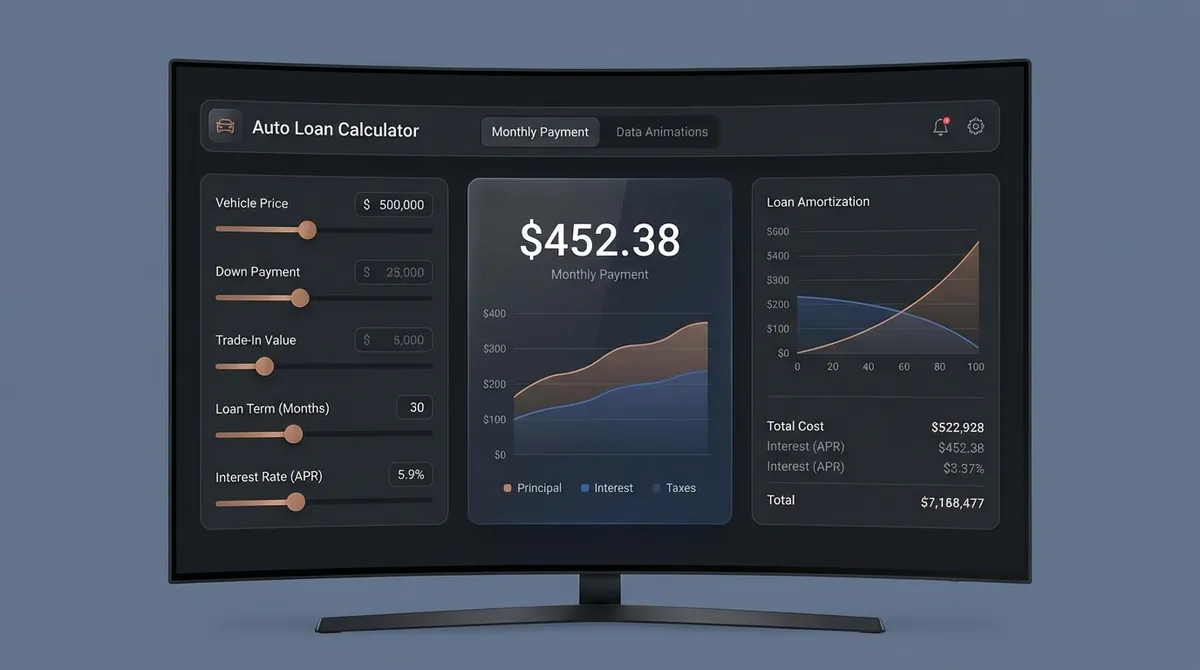
Navigating the world of auto financing can feel overwhelming, especially with fluctuating interest rates and complex dealer jargon. Whether you're eyeing a brand-new SUV or a reliable used sedan, understanding how auto loans work is the key to locking in a monthly payment that fits your budget—without overpaying thousands in interest.
In 2025, the auto market has stabilized, but rates remain higher than historical lows. This means a small difference in your APR or loan term can dramatically impact your total cost. Our guide breaks down everything from amortization schedules to the "20/4/10 rule," helping you drive away with confidence.
Did you know? A lower monthly payment doesn't always mean a better deal. Extending your loan term from 60 to 84 months might drop your payment by $100, but it could cost you an extra $3,000+ in interest over the life of the loan. Always look at the total cost, not just the monthly outflow.
How Auto Loan Interest Is Calculated
Most car loans use simple interest, which is great news for borrowers. Unlike credit cards that use compound interest, simple interest calculates financing charges based solely on your remaining principal balance on the day your payment is due.
The Principal
This is the total amount you borrow. It equals the car's price plus taxes and fees, minus your down payment and trade-in equity.
The APR
The Annual Percentage Rate includes your interest rate plus lender fees. It's the most accurate measure of your loan's cost.
The Term
How long you have to repay. Common terms are 36, 48, 60, and 72 months. Shorter terms have higher payments but lower interest rates.
Amortization
Your payments are "front-loaded" with interest. In the first year, a large chunk of your payment goes to the bank's profit. In the final year, it's mostly principal.
Because auto loans use simple interest, paying extra early in the loan is incredibly powerful. Even an extra $50 a month can shorten your loan term and save hundreds in interest, as it directly reduces the principal balance that interest is calculated on. Use our amortization calculator to visualize how payments affect your balance.
The Hidden "Total Cost of Ownership"
The monthly payment is just the tip of the iceberg. When budgeting for a car in 2025, you must account for the TCO (Total Cost of Ownership). A luxury SUV might have an affordable $600 payment, but the insurance, premium gas (impacted by inflation), and maintenance could double your monthly outlay.
What goes into TCO?
New vs. Used: The Financing Duel
Pros & Cons
- ✓ Lower Interest Rates (often subsidized)
- ✓ Full Warranty Coverage
- ✗ Steep Initial Depreciation
- ✗ Higher Insurance Premiums
Pros & Cons
- ✓ Slower Depreciation Curve
- ✓ Lower Purchase Price
- ✗ Higher Interest Rates
- ✗ Risk of Unknown Mechanical Issues
Smart Buying Strategies for 2025
Follow the 20/4/10 Rule
This classic rule helps keep you financially safe. Put 20% down, finance for no more than 4 years, and keep total car expenses (payment + insurance + gas) under 10% of your monthly income (check this with our debt-to-income calculator).
Get Pre-Approved First
Never walk into a dealership without financing in hand. Get pre-approved by a credit union or online bank. This makes you a "cash buyer" in negotiations and forces the dealer to beat your rate if they want your financing business.
Avoid "Gap" Traps
Dealers profit heavily from add-ons like Gap Insurance and extended warranties. If you put 20% down, you likely don't need Gap Insurance. If you do need it, your regular auto insurer can often add it for a few dollars a month—much cheaper than the dealer's lump sum.
The Trap of 84-Month Loans
As car prices have risen, dealerships have pushed longer loan terms (72, 84, or even 96 months) to keep monthly payments attractive. While a $400 payment sounds better than $600, these "long-term" loans are financially dangerous.
1. The Interest Explosion
Extending a $30,000 loan at 7% APR from 60 months to 84 months lowers your payment by only ~$90/month, but it doubles your total interest paid (from ~$5,600 to ~$8,000+).
2. Valid Warranty Expiration
Most warranties end at 3-5 years (36-60 months). With an 84-month loan, you will be making payments on a car for 2+ years after the warranty expires, meaning you could be paying for major repairs and car payments simultaneously.
Case Study: The Cost of Waiting
Let's look at how credit scores impact real costs. Two buyers, Alex and Jordan, both buy the same $35,000 car with a $5,000 down payment on a 60-month term.
| Borrower | Credit Score | APR | Monthly Payment | Total Interest |
|---|---|---|---|---|
| Alex | 750 (Excellent) | 5.5% | $573 | $4,380 |
| Jordan | 640 (Fair) | 11.5% | $660 | $9,600 |
Result: Jordan pays $87 more per month and over $5,200 more in interest simply due to a lower credit score.
Auto Loan FAQ
Should I finance through a dealer or a bank?▼
It's best to check both. Banks and credit unions often offer lower rates with pre-approval. However, dealers sometimes offer "subvented" rates (like 0% or 1.9% APR) from the manufacturer which are hard to beat if you have excellent credit.
What is a "upside down" car loan?▼
Being "upside down" (or having negative equity) means you owe more on the loan than the car is worth. This happens if you make a small down payment and the car depreciates faster than you pay off the principal. It puts you at risk if the car is totaled or if you need to trade it in.
Is a longer loan term ever a good idea?▼
Rarely. While it lowers your monthly payment, it drastically increases your total interest cost and keeps you "upside down" for longer. Only choose a term longer than 60 months if you are financing a very reliable vehicle that you plan to keep for 10+ years. Use our APR calculator to see the true cost of those longer terms.
Can I refinance my car loan later?▼
Yes, if your credit score improves or market rates drop, you can refinance. However, some lenders have restrictions on the age of the vehicle or the remaining mileage. Check our compound interest calculator to see how savings can grow over time.
How does a down payment affect my loan?▼
A larger down payment reduces the Amount Financed. This does three things: 1) Lowers your monthly payment, 2) Reduces total interest paid, and 3) Protects you from becoming "upside down" on the loan. We recommend at least 20%. You can also use our budget calculator to save up for a larger down payment.
What is the "Out the Door" price?▼
This is the final price you pay, including the car's sticker price plus sales tax, title & registration fees, and dealer documentation fees. Negotiate based on this number, not the monthly payment. For more details on auto loans, visit the CFPB's auto loan guide.
Can I negotiate the interest rate?▼
Yes! The rate a dealer offers you often includes a "markup" for their profit. If you have a pre-approval from a bank, you can ask the dealer to beat it. This simple step can often save you 1-2% on your APR, which translates to massive savings over the life of the loan.
A Note from Marko Šinko
"The most expensive car you'll ever buy is the one that stretches your budget to the breaking point. Use this calculator not just to find a payment you can survive, but to find a loan structure that lets you thrive. If your car payment prevents you from investing for retirement or saving for an emergency fund, it's too expensive—regardless of what the dealership says you 'qualify' for."