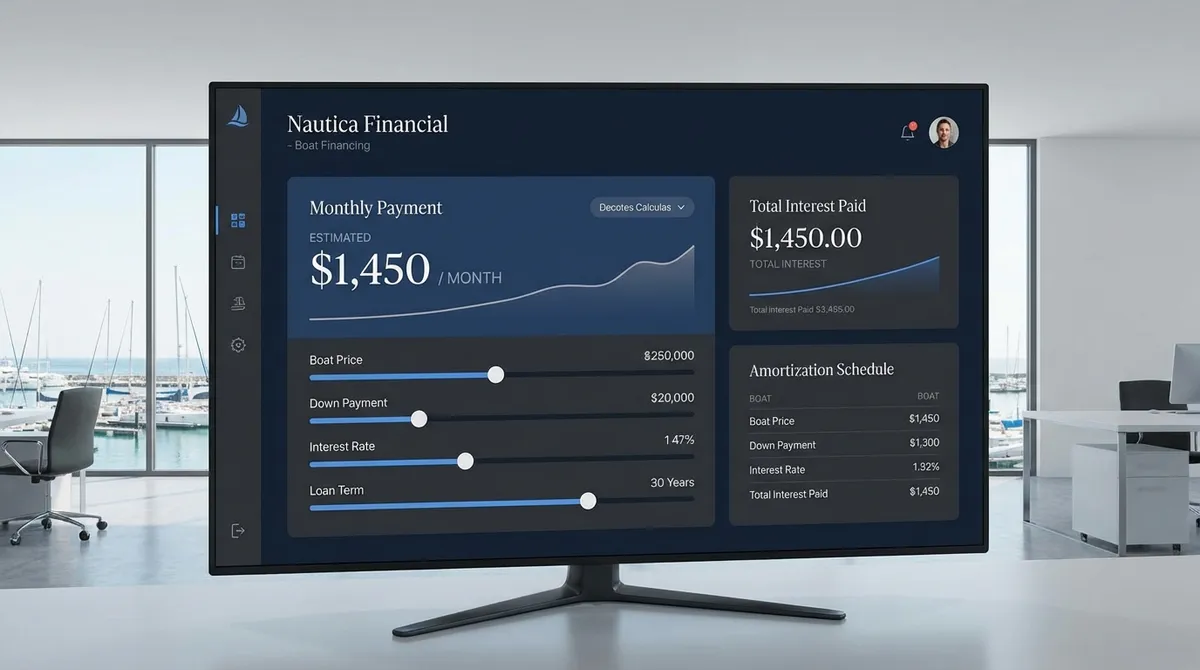
Boat Loan Calculator
Calculate monthly payments and total cost of boat ownership
Common Boat Financing Scenarios
Boat & Loan Details
Additional Marine Costs
2025 Boat Financing Requirements
• Credit Score: 680+ recommended (740+ for best rates)
• Down Payment: 10-30% typical (0% available for qualified buyers under $100K)
• Debt-to-Income: Most lenders require DTI ≤ 36%
• Marine Survey: Required for used boats ($20-25 per foot)
• Documentation: Coast Guard documentation for vessels > 5 net tons
• Loan Terms: 10-20 years typical (up to 20 years for larger vessels)
How to Use the Boat Loan Calculator
Enter Boat Details
Select boat type and enter purchase price. Include marine survey ($20-25/ft) and documentation fees for used boats.
Set Financing Terms
Input down payment (10-30% typical), interest rate (6.24-8.99% for 2025), and loan term (10-20 years).
Review Payment Breakdown
Analyze monthly payment, total interest, and complete cost of ownership with charts.
Export for Lenders
Download calculation details to include with loan applications to marine lenders.
Key Features of Our Boat Loan Calculator
Real-Time Marine Financing Calculations
Get instant monthly payment estimates with 2025 boat loan rates and marine-specific costs like surveys and documentation fees.
Interactive Payment Charts
Visualize your payment breakdown, interest vs. principal, and loan balance over time with dynamic charts.
Boat Type Preset Scenarios
Quick-load common boat financing scenarios for pontoons, center consoles, sailboats, and yachts with typical 2025 terms.
Complete Amortization Schedule
View detailed monthly breakdowns of principal, interest, and remaining balance throughout your entire loan term.
Marine-Specific Cost Inclusion
Factor in marine survey fees ($20-25/ft) and Coast Guard documentation costs for accurate total ownership calculations.
Export for Lender Applications
Download your complete calculation details in JSON format to include with marine lender applications and loan packages.
Complete Guide to Boat Loans and Marine Financing in 2025
Financing a boat is a significant financial decision that requires careful planning and understanding of marine lending requirements. Whether you're dreaming of a family pontoon for lake weekends, a center console for offshore fishing, or a luxury yacht for extended cruising, knowing the true cost of boat ownership is essential for making an informed decision.
What Is a Boat Loan and How Does Marine Financing Work?
A boat loan is a specialized type of secured financing designed specifically for purchasing marine vessels. Unlike auto loans, boat financing shares characteristics with both vehicle and mortgage lending, often requiring more extensive documentation and higher credit standards. Marine lenders evaluate applications based on credit score, debt-to-income ratio, down payment, and the specific vessel being purchased.
Boat loans can be secured (using the vessel as collateral) or unsecured, though most marine financing is secured to qualify for better rates and terms. The boat itself serves as collateral, meaning the lender can repossess it if you default on payments. This security allows lenders to offer longer terms and competitive rates compared to unsecured personal loans.
Current 2025 Boat Loan Rates and Market Conditions
As of 2025, boat loan interest rates have increased from historical lows but remain competitive for qualified buyers. Current rates start at 6.24% APR for borrowers with excellent credit (740+ scores) financing new boats. Most buyers with good credit (680-739) can expect rates between 6.99-8.99% APR.
Several factors influence your final interest rate:
- Credit Score: The most significant factor, with each 20-point increase potentially lowering your rate by 0.25-0.5%
- Boat Age: New boats qualify for the best rates; used boats add 0.5-1% to the rate
- Loan Amount: Larger loans ($100K+) often receive better rates due to increased lender competition
- Down Payment: Larger down payments (30%+) can reduce your rate by 0.25-0.5%
- Debt-to-Income Ratio: DTI below 36% qualifies for the best rates
- Economic Conditions: Federal Reserve policy and market conditions affect all lending rates
Understanding Boat Loan Terms and Duration Options
Boat loan terms typically range from 10-20 years, significantly longer than auto loans but shorter than mortgages. This extended term structure helps make boat ownership more affordable by spreading payments over many years, though it increases total interest paid.
Term Options by Boat Type:
- Personal Watercraft (Jet Skis): 5-7 years
- Small Fishing Boats & Pontoons: 10-12 years
- Center Consoles & Powerboats: 12-15 years
- Sailboats & Cruisers: 15-20 years
- Yachts: 15-25 years (for loans over $500K)
Down Payment Requirements and Strategies
Down payments for boat loans typically range from 10-30% of the purchase price, though some lenders offer specialized programs with lower requirements. Your down payment significantly impacts your loan terms and monthly payments.
Down Payment Strategies:
- Minimum Down (10-15%): Preserves cash but results in higher payments and interest costs
- Standard Down (20%): Most common option, balancing affordability and loan terms
- Large Down (30%+): Reduces monthly payments, improves approval odds, and may lower interest rates
- Trade-In Equity: Use your current boat's value as down payment on an upgrade
Marine Surveys: What They Are and Why They Matter
A marine survey is a comprehensive inspection of a boat's condition, safety, and market value, conducted by a certified marine surveyor. Lenders require surveys for all used boats to protect their investment and ensure the vessel is worth the loan amount.
Types of Marine Surveys:
- Condition & Value Survey: Most common for financing, includes hull inspection, systems check, and sea trial
- Insurance Survey: Required by insurance companies, focuses on safety and insurability
- Appraisal Survey: Determines market value for financing or legal purposes
- Damage Survey: Assesses damage after accidents or storms for insurance claims
Survey costs typically range from $20-25 per foot of boat length, meaning a 30-foot boat costs $600-750 to survey. This fee is paid by the buyer and can be included in the loan amount. Always use accredited surveyors from NAMS (National Association of Marine Surveyors) or SAMS (Society of Accredited Marine Surveyors).
Coast Guard Documentation and Registration Requirements
Vessels over 5 net tons (approximately 25 feet and larger) must be documented with the U.S. Coast Guard, creating a preferred ship mortgage that provides lenders with superior lien protection. Documentation costs $500-1,000 but offers several benefits:
- Clear Title: National registry provides definitive ownership evidence
- International Travel: Simplified customs and clearance in foreign ports
- Financing Benefits: Preferred ship mortgage gives lenders priority over other liens
- Resale Value: Documented boats typically command higher resale prices
- Privacy: Owner information is not publicly accessible like state registration
Debt-to-Income Ratio Requirements for Marine Financing
Marine lenders typically require a debt-to-income (DTI) ratio of 36% or less, though some may allow up to 45% for exceptionally qualified buyers. DTI is calculated by dividing total monthly debt payments by gross monthly income.
Example DTI Calculation:
Gross Monthly Income: $8,500
Existing Debt Payments: $2,800 (mortgage, car, credit cards)
Proposed Boat Payment: $485
DTI = ($2,800 + $485) ÷ $8,500 = 38.6%
This DTI might be approved by some lenders but could result in a higher interest rate. Reducing existing debt or increasing down payment can improve your DTI and loan terms.
Types of Boat Loans and Lender Options
Several financing options exist for boat purchases, each with different requirements and benefits:
- Marine Specialty Lenders: BoatUS, Trident Funding, and Boatzon specialize in boat loans with competitive rates and marine expertise
- Banks: Major banks offer boat loans but may have stricter requirements and less flexibility
- Credit Unions: Often provide better rates and personalized service, especially for members
- Dealer Financing: Convenient but may have higher rates; compare with other options
- Home Equity Loans: Can offer lower rates but put your home at risk as collateral
Common Boat Financing Mistakes to Avoid
Avoid these common pitfalls when financing your boat purchase:
- Underestimating Total Costs: Factor in insurance, maintenance, storage, fuel, and dock fees (typically 10-15% of boat value annually)
- Ignoring Age Restrictions: Some lenders won't finance boats older than 15-20 years
- Skipping the Survey: Never buy a used boat without a professional marine survey
- Not Shopping Lenders: Rates and terms vary significantly between marine lenders
- Overextending Financially: Keep total boat costs under 15-20% of your monthly income
Tax Benefits and Deductible Boat Expenses
Some boat expenses may be tax-deductible if the boat qualifies as a second home. To qualify, your boat must have sleeping, cooking, and toilet facilities. If eligible, you can deduct mortgage interest on loans up to $750,000, similar to a second home mortgage.
Additionally, if you use your boat for business purposes (charter fishing, tours, etc.), you may be able to deduct operating expenses, depreciation, and other costs. Consult with a tax professional to understand your specific situation.
Boat Loan Pre-Approval Process
Getting pre-approved for a boat loan strengthens your negotiating position and helps you shop within your budget. The pre-approval process typically involves:
- Completing a loan application with personal and financial information
- Providing income verification (tax returns, pay stubs, W-2s)
- Submitting to a credit check (hard inquiry)
- Receiving a conditional approval letter with maximum loan amount and terms
Pre-approval is typically valid for 30-90 days and shows sellers you're a serious, qualified buyer. Note that marine lenders don't offer traditional pre-approvals like mortgage lenders, but they can provide rate quotes and conditional approvals.
Refinancing Your Boat Loan
If interest rates drop or your credit improves, refinancing your boat loan can save thousands in interest. Most lenders allow refinancing after 12-24 months of on-time payments. The process is similar to initial financing but typically faster since you already own the boat.
Consider refinancing if you can reduce your rate by at least 1% or need to lower monthly payments by extending the term. Be aware that extending the term increases total interest paid, even with a lower rate.
Final Thoughts: Making Your Boating Dreams Affordable
Boat ownership is more attainable than many people realize, with monthly payments starting around $250-400 for entry-level boats. The key is understanding all costs involved and choosing financing that fits your budget without overextending your finances.
Use our boat loan calculator to explore different scenarios, understand the true cost of ownership, and make an informed decision. Remember to factor in ongoing costs like insurance, maintenance, storage, and fuel when determining what boat you can afford.
With proper planning and realistic expectations, you can join the millions of Americans enjoying the boating lifestyle while maintaining financial stability. Start with our calculator, get pre-approved, and work with reputable marine lenders who understand the unique aspects of boat financing.
Frequently Asked Questions About Boat Loans
What credit score is needed for a boat loan in 2025?
Most marine lenders require a minimum credit score of 680, though 740 or higher will qualify you for the best rates starting at 6.24% APR. Borrowers with scores below 680 may still qualify but will face higher interest rates and may need larger down payments. Some specialized marine lenders work with credit scores as low as 600, but rates can exceed 12% APR.
How much down payment is required for boat financing?
Typical down payments range from 10-30% of the purchase price. However, some lenders offer 0% down for qualified buyers on loans under $100,000. Larger boats and yachts often require 20-30% down. Your down payment affects your loan-to-value ratio, which is a key factor in loan approval and interest rate determination.
What is a marine survey and when is it required?
A marine survey is a professional inspection of a boat's condition, safety, and market value, typically costing $20-25 per foot. It's required by lenders for all used boats to protect their investment. The survey includes hull inspection, systems check, engine evaluation, and sea trial. Surveyors must be accredited by organizations like NAMS or SAMS. New boats under warranty usually don't require surveys.
How long can you finance a boat in 2025?
Boat loan terms typically range from 10-20 years, depending on the boat type, age, and loan amount. Personal watercraft and smaller boats may have terms of 5-10 years, while larger powerboats and yachts can be financed up to 20 years. Some lenders offer terms up to 25 years for luxury yachts exceeding $500,000. Longer terms mean lower monthly payments but more total interest paid.
What are current boat loan interest rates?
As of 2025, boat loan rates start at 6.24% APR for borrowers with excellent credit (740+ scores) financing new boats. Rates typically range from 6.99-8.99% for good credit (680-739), and 9.99-12.99% for fair credit. Used boat rates are generally 0.5-1% higher than new boat rates. Rates vary by lender, boat type, loan amount, and economic conditions.
Do I need Coast Guard documentation for my boat loan?
Coast Guard documentation is required for vessels over 5 net tons (approximately 25+ feet) and creates a preferred ship mortgage that protects the lender's lien. Documentation costs $500-1,000 and provides clear title evidence, easier international travel, and better resale value. For smaller boats, state title and registration are sufficient. Your lender will require documentation on eligible vessels.
Can I finance a used boat older than 20 years?
Financing older boats is challenging but possible. Most lenders have age limits of 15-20 years at loan maturity. For example, if you're financing for 15 years, the boat shouldn't be older than 5 years at purchase. Some specialized lenders finance classic or restored boats up to 30-40 years old, but these require excellent credit, larger down payments (30-40%), and higher interest rates.
What debt-to-income ratio do boat lenders require?
Most marine lenders require a debt-to-income ratio of 36% or less, though some may allow up to 45% for well-qualified buyers. DTI includes all monthly debt payments (mortgage, car loans, credit cards, student loans) plus your proposed boat payment, divided by gross monthly income. Lower DTI ratios qualify for better rates and improve approval chances.
About the Author
Jurica Šinko, Finance Expert and Founder of EFinanceCalculator. With over 15 years of experience in marine financing and recreational lending, he specializes in helping boat buyers navigate the complex world of marine loans and make informed financial decisions.
Related Calculators
Explore more tools in Loans & Mortgages
Auto Loan Calculator: Monthly Payment & Total Cost (2025)
Free auto loan calculator estimates monthly payments, total interest, and amortization. Compare new vs used cars, down payment impacts, and current 2025 rates.
Auto Loan Payoff Calculator: Calculate Early Payoff Savings & Interest Reduction
Free auto loan payoff calculator shows how much you'll save by paying off your car loan early. See interest savings, months reduced, and new payoff date. Includes prepayment penalty considerations.
Auto Loan Refinance Calculator: Free Car Loan Refinancing Tool & Savings Estimator
Use our auto loan refinance calculator to see how much you can save by refinancing your car loan. Compare current vs new rates, calculate monthly savings, and determine if refinancing makes financial sense.
Bridge Loan Calculator: Estimate Monthly Costs and Rates
Use our bridge loan calculator to estimate interest‑only payments and total cost for short‑term financing. Model rate, fees, and term. Get instant results.
Cash-Out Refinance Calculator: Estimate Your Home Equity & New Payment (2025)
Free cash-out refinance calculator estimates how much equity you can access, new monthly payment, and total costs. Includes LTV limits, closing costs, and 2025 guidelines.
Closing Costs Calculator: Itemized Fees, Prepaids, and Cash to Close (2025)
Estimate buyer closing costs in minutes. Itemize lender fees, title, government recording, and prepaids (taxes, insurance, interest). See credits and cash to close.