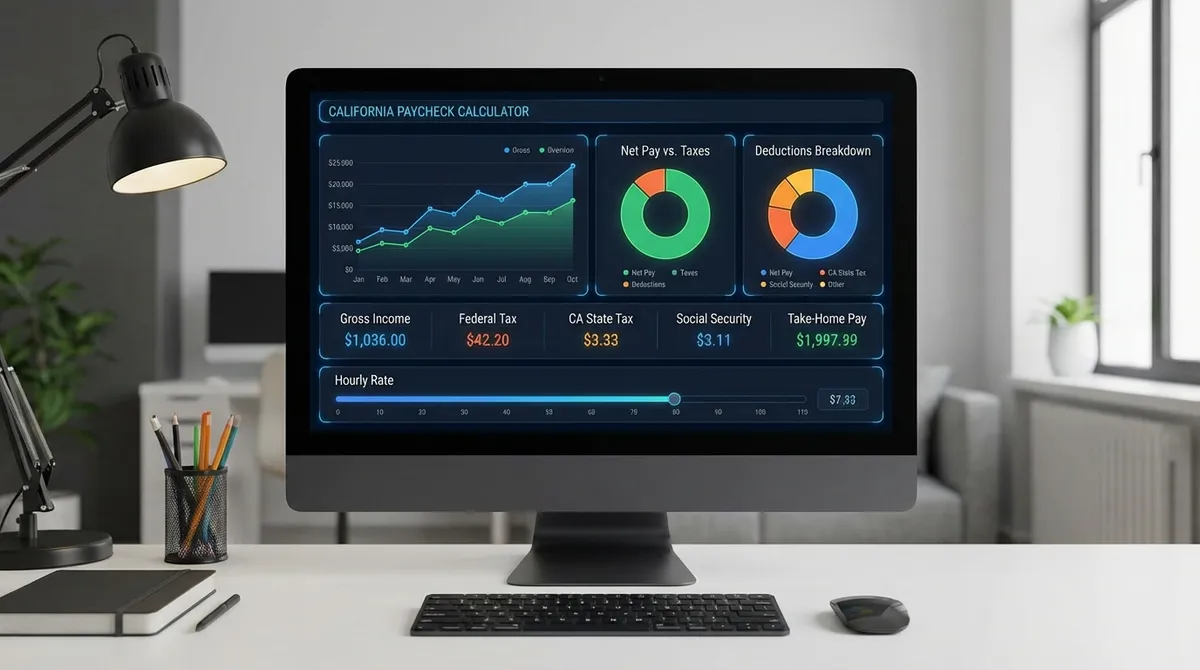
California Paycheck Calculator: Calculate Your CA Take-Home Pay (2025 Tax Rates)
Accurate California paycheck calculator for 2025. Calculate net pay with federal tax, California state tax, SDI (1.2%), FICA, and all deductions.
California Paycheck Calculator: Calculate Your CA Take-Home Pay (2025 Tax Rates)
Enter your details below to calculate your California take-home pay with 2025 tax rates
California Paycheck Calculator
Paycheck Information
Paycheck Breakdown
Accurate Calculations
Uses 2025 California tax rates and brackets
State-Specific
Includes CA SDI and state-specific deductions
Real-Time Updates
Calculations update instantly as you type
How to Use California Paycheck Calculator
Enter Your Gross Pay
Input your gross salary or hourly wages before any deductions. Include overtime, bonuses, or commissions you expect to receive.
Select Pay Frequency
Choose how often you get paid: weekly (52 paychecks), biweekly (26 paychecks), semimonthly (24 paychecks), or monthly (12 paychecks).
Choose Filing Status
Select your California filing status: Single/Married Filing Separately, Married Filing Jointly, or Head of Household. This significantly impacts your tax calculation.
Add Pre-tax Deductions
Include your 401(k), HSA, and FSA contributions. These reduce your taxable income and lower both federal and California state taxes.
Review Detailed Breakdown
Analyze your results showing federal tax, California state tax (1.1%-14.63%), SDI (1.2%), FICA (6.2%), Medicare (1.45%), and your final net pay.
Try Different Scenarios
Adjust your inputs to see how increasing 401(k) contributions or changing your filing status impacts your take-home pay and tax liability.
Key Features
Accurate 2025 California SDI Rate (1.2% with No Income Limit)
Calculates Federal Tax, CA State Tax, FICA, and Medicare
Supports All Filing Statuses (Single, Married, Head of Household)
Pre-tax Deductions for 401(k), HSA, and FSA Contributions
Real-time Calculations with Detailed Breakdowns
Annual and Per-Period Pay Views
Complete Guide to California Paycheck Calculations in 2025
Understanding California's Complex Payroll Tax System
California operates one of the most comprehensive payroll tax systems in the United States, with multiple layers of deductions that significantly impact your take-home pay. With state income tax rates reaching up to 14.63% for high earners, plus mandatory contributions to State Disability Insurance (SDI) and other programs, understanding your California paycheck is crucial for effective financial planning.
What Is a California Paycheck Calculator?
A California Paycheck Calculator is a specialized financial tool designed to estimate your net take-home pay after all federal, state, and local deductions. Unlike generic paycheck calculators, California's version must account for the state's progressive income tax system, mandatory State Disability Insurance (SDI) contributions, and other California-specific deductions that can significantly impact your earnings.
In 2025, California's payroll tax landscape has evolved with the complete elimination of the SDI taxable wage limit, meaning high earners now contribute SDI taxes on their entire income. This change, implemented through Senate Bill 951, represents a fundamental shift in California's approach to funding disability and paid family leave benefits.
How California Paycheck Calculations Work in 2025
The Multi-Layer Deduction System
Your California paycheck goes through several layers of calculations before reaching your bank account. Understanding each layer helps you predict your actual take-home pay and plan your budget effectively.
Federal Income Tax
Progressive rates from 10% to 37% based on your income level and filing status. California employees complete both federal Form W-4 and state DE-4 for withholding.
California State Income Tax
Progressive rates ranging from 1.1% to 14.63% for 2025. California has one of the highest top marginal tax rates in the nation.
FICA - Social Security
6.2% of gross wages up to the annual wage base limit of $168,600 for 2025. This funds your future Social Security benefits.
FICA - Medicare
1.45% of all gross wages with no income limit. High earners may pay an additional 0.9% Medicare surtax.
CA State Disability Insurance (SDI)
1.2% of all wages with no maximum limit as of 2024. This funds California's disability and paid family leave programs.
Pre-tax Deductions
401(k), HSA, and FSA contributions reduce your taxable income for both federal and state taxes, lowering your overall tax burden.
2025 California Tax Brackets and Rates
California's progressive tax system means your income is taxed at different rates as it moves through the brackets. For 2025, the rates for single filers are:
| Taxable Income Range | Tax Rate | Tax Amount |
|---|---|---|
| $0 - $10,756 | 1.10% | $0 + 1.10% of amount over $0 |
| $10,756 - $25,499 | 2.20% | $118.32 + 2.20% of amount over $10,756 |
| $25,499 - $40,245 | 4.40% | $442.67 + 4.40% of amount over $25,499 |
| $40,245 - $55,866 | 6.60% | $1,091.49 + 6.60% of amount over $40,245 |
| $55,866 - $70,606 | 8.80% | $2,122.48 + 8.80% of amount over $55,866 |
| $70,606 - $360,659 | 10.23% | $3,419.60 + 10.23% of amount over $70,606 |
| $360,659 - $432,787 | 11.33% | $33,092.02 + 11.33% of amount over $360,659 |
| $432,787 - $721,314 | 12.43% | $41,264.12 + 12.43% of amount over $432,787 |
| $721,314 - $1,000,000 | 13.53% | $77,128.03 + 13.53% of amount over $721,314 |
| $1,000,000+ | 14.63% | $114,834.25 + 14.63% of amount over $1,000,000 |
Key Factors Affecting Your California Paycheck
1. State Disability Insurance (SDI) Changes in 2025
The most significant change affecting California paychecks in 2025 is the continued implementation of Senate Bill 951, which permanently removed the taxable wage limit for State Disability Insurance contributions. Historically, SDI contributions were capped at a certain income level ($153,164 in 2023), but starting in 2024, all wages are subject to the SDI tax.
Impact on High Earners: An employee earning $500,000 in 2025 will pay $6,000 in SDI taxes (1.2% of $500,000), compared to just $1,378 in 2023 when the tax was capped. This represents a 336% increase in SDI contributions for high-wage earners.
2. California's Progressive Tax Structure
California's income tax system is highly progressive, meaning higher earners pay a larger percentage of their income in taxes. For 2025, the top marginal tax rate of 14.63% applies to income over $1 million for single filers. However, it's important to understand that you only pay the highest rate on the portion of income that falls into that bracket.
For example, if you earn $80,000 annually as a single filer, your California state income tax calculation would look like this:
- 1.10% on the first $10,756 = $118.32
- 2.20% on income between $10,756 and $25,499 = $322.35
- 4.40% on income between $25,499 and $40,245 = $648.82
- 6.60% on income between $40,245 and $55,866 = $1,031.99
- 8.80% on income between $55,866 and $70,606 = $1,297.92
- 10.23% on income between $70,606 and $80,000 = $961.40
After applying the standard deduction of $5,401 and personal exemption credits, your actual California state tax liability would be approximately $3,200-$3,500 annually, or about 4-4.4% of your gross income.
3. The Importance of Proper Withholding Allowances
Since 2020, California has required employees to complete both federal Form W-4 and state Form DE-4 for payroll withholding. The number of allowances you claim directly impacts how much tax is withheld from each paycheck. Claiming too few allowances results in over-withholding (smaller paychecks, larger tax refund), while too many allowances can lead to under-withholding (larger paychecks, potential tax bill).
For 2025, each allowance reduces your annual California tax withholding by approximately $420. If you consistently receive large refunds, consider increasing your allowances. If you owe taxes each year, decrease your allowances or specify additional withholding amounts.
Common Mistakes to Avoid with California Paychecks
Critical Errors That Can Cost You Thousands
Mistake #1: Not Accounting for California's High Tax Burden
Many workers moving to California from lower-tax states experience significant sticker shock when they see their first paycheck. A $100,000 salary in Texas or Florida translates to much higher take-home pay than the same salary in California. Always use a California-specific calculator when evaluating job offers or planning your budget.
Mistake #2: Underestimating SDI Contributions
With the elimination of the SDI wage cap, high earners must now budget for substantial SDI deductions. An executive earning $300,000 will pay $3,600 annually in SDI taxes alone—an expense that didn't exist in the same magnitude before 2024.
Mistake #3: Incorrect Filing Status
Your filing status significantly impacts your California tax calculation. Single filers reach higher tax brackets much faster than married couples filing jointly. For example, the 10.23% bracket begins at $70,606 for single filers but at $141,212 for married couples—potentially saving thousands in taxes.
Mistake #4: Missing Pre-tax Opportunities
California taxes are calculated after pre-tax deductions like 401(k) contributions, HSA deposits, and FSA allocations. Maximizing these contributions not only builds your savings but also reduces your current tax burden. A $5,000 401(k) contribution could save you $500-$700 in California taxes alone.
Mistake #5: Not Updating Withholding After Life Changes
Marriage, divorce, having children, buying a home, or changing jobs all affect your optimal withholding. Review your DE-4 form annually and after major life events to ensure you're not significantly over or under-withholding.
How to Optimize Your California Paycheck
Strategy 1: Maximize Pre-tax Contributions
The most effective way to reduce your California tax burden is through pre-tax deductions. For 2025, consider:
- 401(k) contributions: Up to $23,000 annually ($30,500 if age 50+)
- Health Savings Account (HSA): Up to $4,150 for individuals, $8,300 for families
- Flexible Spending Account (FSA): Up to $3,200 for healthcare expenses
- Dependent Care FSA: Up to $5,000 for qualified childcare expenses
These contributions reduce your taxable income dollar-for-dollar, lowering both federal and California state taxes while building your savings.
Strategy 2: Review Your Filing Status
If you're married, compare the tax implications of filing jointly versus separately. While California generally follows federal rules for filing status, there can be situations where married filing separately makes sense, particularly if one spouse has significant medical expenses or if you're trying to manage income-based student loan payments.
Strategy 3: Time Your Income and Deductions
If you're close to a tax bracket threshold, consider timing when you receive bonuses or exercise stock options. Delaying income to the following year or accelerating deductions into the current year can keep you in a lower tax bracket. This is particularly impactful in California's progressive system.
Strategy 4: Leverage California's Paid Family Leave Program
Your SDI contributions fund California's Paid Family Leave program, which provides up to 8 weeks of partial wage replacement at 70-90% of your income. Understanding and utilizing this benefit when you have a new child or need to care for a family member ensures you're getting maximum value from your SDI contributions.
California vs. Other States: Tax Comparison
California's tax burden is among the highest in the nation, but this funds extensive public services. Here's how California compares to other major states for a worker earning $75,000 annually:
| State | State Income Tax Rate | Annual State Tax (est.) | SDI/Disability Tax | Total State Burden |
|---|---|---|---|---|
| California | 4.55% (effective) | $3,413 | $900 (1.2%) | $4,313 |
| New York | 5.97% (effective) | $4,478 | $0 | $4,478 |
| Texas | 0% | $0 | $0 | $0 |
| Florida | 0% | $0 | $0 | $0 |
| Washington | 0% | $0 | $0 | $0 |
When to Recalculate Your California Paycheck
Your California paycheck calculation should be reviewed at least annually and whenever you experience major life changes. Recalculate when:
- You receive a raise or bonus
- You change your 401(k) or other pre-tax contributions
- You get married, divorced, or your spouse changes employment
- You have a child or your dependent situation changes
- You move to a different California city (some have local taxes)
- California tax rates or SDI rates change (typically announced in December)
- You start a side business or have additional income sources
- You purchase a home or have major changes in itemized deductions
Special Considerations for 2025
Remote Work Complications
The rise of remote work has created complex tax situations for California workers. If you live in California but work remotely for an out-of-state employer, you still owe California income taxes on your wages. Conversely, if you live out-of-state but work for a California employer, you may owe California taxes on the portion of income earned while physically in California.
Gig Economy and Independent Contractors
If you're an independent contractor or gig worker in California (Uber, Lyft, DoorDash, etc.), your tax situation is different. You don't have taxes withheld from your pay and must make quarterly estimated tax payments to both the IRS and California Franchise Tax Board. The self-employment tax rate is 15.3% (covering both employee and employer portions of FICA), plus California income taxes.
Stock Options and Equity Compensation
California taxes stock options and equity compensation differently than many states. The spread on incentive stock options (ISOs) may be subject to California's Alternative Minimum Tax (AMT), and California collects taxes on stock options even if you move out of state before exercising them. If you receive equity compensation, consult a tax professional familiar with California's specific rules.
Key Takeaways for California Workers in 2025
- •California has one of the highest tax burdens in the nation, with progressive state income tax rates up to 14.63%
- •SDI tax is now 1.2% of all wages with no income limit, significantly impacting high earners
- •Pre-tax deductions like 401(k) contributions are the most effective way to reduce California tax liability
- •Review your withholding (DE-4 form) annually and after major life changes
- •Use a California-specific calculator to accurately estimate your take-home pay
- •Your SDI contributions fund valuable benefits—make sure you understand and use them when needed
Disclaimer: This calculator provides estimates based on 2025 California tax rates and federal tax brackets. Actual withholdings may vary based on your specific situation, local taxes, and other factors. Consult with a qualified tax professional for personalized advice. Tax laws change frequently, and you should verify current rates with the California Employment Development Department (EDD) and Franchise Tax Board (FTB).
About the Author
Jurica Šinko
Finance Expert, CPA, MBA with 15+ years in corporate finance and investment management
Connect with JuricaFrequently Asked Questions
What is California State Disability Insurance (SDI) and why is it deducted from my paycheck?
California SDI is a mandatory state program that provides short-term wage replacement benefits (up to 52 weeks) for workers who cannot work due to pregnancy or non-work-related illness/injury. As of 2025, the SDI rate is 1.2% of all wages with NO income limit. This also funds California's Paid Family Leave program, which provides up to 8 weeks of benefits to care for a seriously ill family member or bond with a new child.
How do California's 2025 tax brackets affect my take-home pay?
California has 10 progressive tax brackets ranging from 1.1% to 14.63% for 2025. Your income is taxed at increasing rates as it moves through the brackets. For example, if you earn $80,000 as a single filer, portions of your income are taxed at 1.1%, 2.2%, 4.4%, 6.6%, 8.8%, and 10.23%. Your effective tax rate (actual percentage paid) will be lower than your top marginal rate.
Why did my SDI deduction increase significantly in 2024 and 2025?
Prior to 2024, SDI contributions were capped at a specific wage limit ($153,164 in 2023). Senate Bill 951 permanently removed this cap starting in 2024. Now all wages are subject to the 1.2% SDI tax. If you earn $200,000, you'll pay $2,400 in SDI taxes annually, compared to approximately $1,378 before the change—a 74% increase for high earners.
How can I reduce my California paycheck deductions?
The most effective strategy is maximizing pre-tax contributions: 401(k) up to $23,000 ($30,500 if 50+), HSA up to $4,150 (individual) or $8,300 (family), and FSA up to $3,200. These reduce your taxable income dollar-for-dollar. Also, ensure your DE-4 form has the correct filing status and allowances—too few allowances mean over-withholding and smaller paychecks.
Does California have local or city income taxes in addition to state tax?
No, California does not have local or city income taxes. However, some cities have payroll taxes that employers pay (like San Francisco's payroll expense tax), but these don't directly affect employee paycheck deductions. Your California paycheck deductions consist only of federal taxes, state income tax, FICA, Medicare, and SDI.
How accurate is this California paycheck calculator for 2025?
This calculator uses official 2025 California tax brackets (published by the FTB), the current 1.2% SDI rate (from EDD), and 2025 federal tax tables. It accounts for standard deductions, personal exemption credits, and FICA wage base limits. While highly accurate for estimation purposes, your actual paycheck may vary slightly due to rounding, local circumstances, or additional voluntary deductions.
What is the difference between my marginal tax rate and effective tax rate?
Your marginal rate is the highest tax bracket your income reaches (e.g., 10.23% if you earn $80,000 as a single filer). Your effective rate is your total California tax divided by total income—in our example, approximately 4.5%. When budgeting, focus on your effective rate, not your marginal rate. Our calculator shows both rates for clarity.
I work remotely for a California company but live in another state. Do I pay California income tax?
Generally, you only pay California income tax on income earned while physically working in California. If you perform all your work in another state, you typically don't owe California income tax, even if your employer is based in California. However, if you occasionally work from California, those days are subject to California taxation. Remote work tax rules are complex—consult a tax professional for your specific situation.
Related Calculators
Explore more tools in Tax & Payroll
ADP Paycheck Calculator | Free Salary & Hourly Estimator
Estimate your net pay with our ADP paycheck calculator. Calculate federal, state, and local withholdings for both salary and hourly employees accurately.
After Tax Income Calculator | Calculate Net Income
Determine your actual earnings with our after tax income calculator. Convert gross salary into net income by accounting for federal, state, and local taxes.
AGI Calculator: Calculate Adjusted Gross Income Accurately (2025 Tax Year)
Free AGI calculator for 2025 tax year. Calculate Adjusted Gross Income accurately with above-the-line deductions. Determine tax credits, ACA subsidies, and IRA eligibility.
Alabama Paycheck Calculator: Calculate Your AL Take-Home Pay
Free Alabama paycheck calculator for 2025. Calculate your take-home pay after federal, state, and local taxes. Accurate AL payroll calculations.
Arizona Paycheck Calculator: Calculate Your AZ Take-Home Pay
Free Arizona paycheck calculator for 2025. Calculate your take-home pay after federal, state, and FICA taxes. Accurate AZ payroll calculations with flat 2.5% state tax rate.
Arizona Income Tax Calculator 2025 | AZ Tax Estimate
Calculate your AZ liability with our 2025 Arizona income tax calculator. Uses the current AZ flat tax rate for accurate estimation. Free AZ tax calculator.