Understanding Debt to Equity Ratio: A Complete 2025 Guide for Business Owners
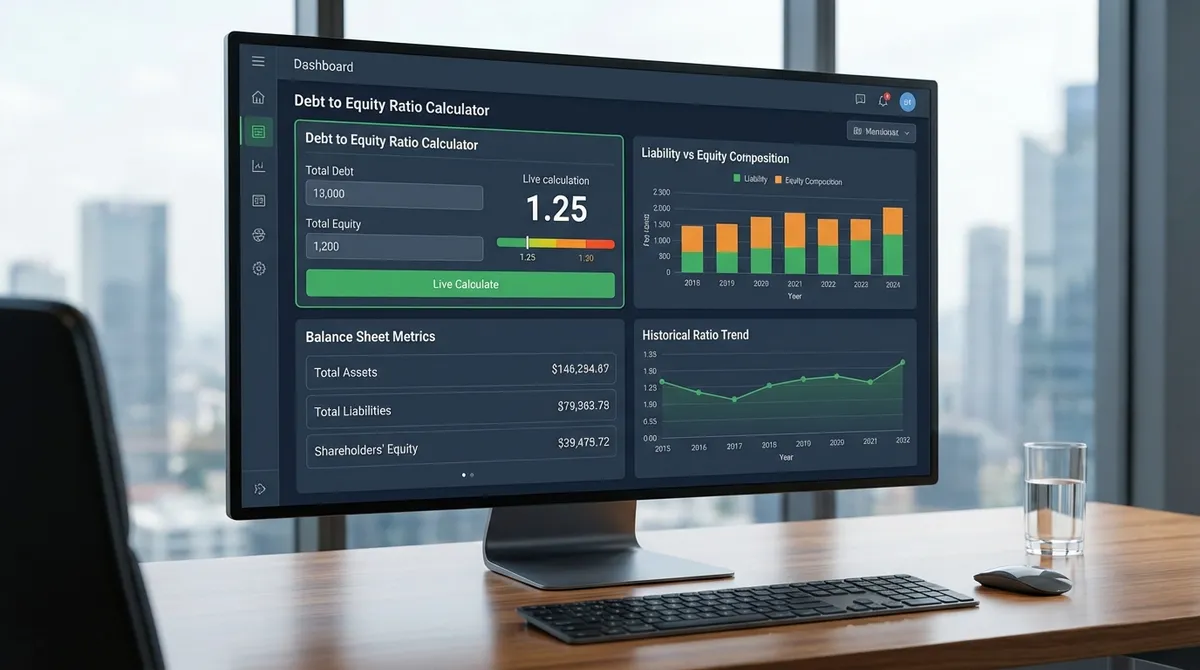
The debt-to-equity (D/E) ratio stands as one of the most critical financial metrics in corporate finance, offering a clear window into a company's capital structure and financial health. As we navigate through 2025's economic landscape of fluctuating interest rates and evolving business models, understanding this fundamental ratio becomes increasingly important for business owners, investors, and financial professionals.
What is the Debt to Equity Ratio?
The debt-to-equity ratio measures the relationship between a company's total debt and its shareholders' equity. This powerful financial leverage ratio reveals how much debt a company uses to finance its operations compared to the money invested by its owners. The formula is elegantly simple:
Debt-to-Equity Ratio = Total Debt ÷ Shareholders' Equity
A ratio of 1.0 indicates that creditors and shareholders have equal stakes in the company's assets. Ratios below 1.0 signal a conservative approach with more equity financing, while ratios above 1.0 suggest aggressive use of debt leverage. However, the interpretation depends heavily on industry context, business model, and economic conditions.
Industry Benchmarks in 2025
Debt-to-equity ratios vary dramatically across industries, making peer comparison essential for meaningful analysis. Here are the current benchmarks for 2025:
Manufacturing
D/E Ratio: 0.8 - 2.0
Capital-intensive operations require substantial equipment financing
Retail
D/E Ratio: 0.5 - 1.5
Inventory financing mixed with equity investment
Technology
D/E Ratio: 0.2 - 0.8
Equity-heavy funding, especially for growth-stage companies
Real Estate
D/E Ratio: 1.5 - 4.0
Property-heavy assets justify higher debt levels
Why Debt to Equity Ratio Matters for Your Business
The debt-to-equity ratio influences critical business decisions and stakeholder perceptions in multiple ways:
Creditworthiness Assessment
Lenders scrutinize this ratio when evaluating business loan applications. Higher ratios suggest greater default risk, potentially leading to loan rejections or higher interest rates. The U.S. Small Business Administration (SBA) often requires healthy ratios for their loan guarantees.
Investor Attraction
Equity investors assess this metric to understand ownership dilution and potential returns. Venture capitalists often accept higher ratios in exchange for growth potential, while angel investors typically prefer more conservative structures.
Financial Flexibility
Companies with lower D/E ratios maintain greater borrowing capacity for strategic opportunities. During economic downturns, conservative capital structures provide resilience against cash flow volatility.
Cost of Capital Optimization
Strategic use of debt can lower your Weighted Average Cost of Capital (WACC) due to tax-deductible interest. However, excessive leverage increases both debt and equity costs, potentially harming your company's valuation.
Calculating Your Ratio: Common Pitfalls to Avoid
While our calculator ensures accuracy, understanding calculation nuances helps you interpret results correctly:
Common Mistakes:
- Including operating liabilities: Accounts payable and accrued expenses are working capital, not financing debt
- Ignoring off-balance-sheet items: Operating leases and contingent liabilities should often be included
- Using book vs market values: Market values provide more accurate economic assessment for equity
- Inconsistent time periods: Ensure debt and equity values come from the same reporting date
- Neglecting industry context: Comparing a tech startup to a manufacturing firm creates misleading conclusions
How to Improve Your Debt-to-Equity Ratio
If your ratio is too high (indicating excessive risk) or too low (indicating inefficient capital use), you can actively manage it. Here are proven strategies for 2025:
To Lower the Ratio (Reduce Risk)
- 1.Retain Earnings: Reinvest profits back into the company rather than paying dividends. This increases the "Equity" denominator directly.
- 2.Issue New Shares: Sell stock to raise capital. This increases equity and can be used to pay down debt, hitting the ratio from both sides.
- 3.Debt-for-Equity Swap: Negotiate with creditors to convert owed debt into equity stakes (common in restructuring).
- 4.Inventory Management: Improve inventory turnover to generate cash flow for debt repayment.
To Raise the Ratio (Increase Leverage)
- 1.Debt-Financed Expansion: Borrow to fund new projects or acquisitions if the ROI exceeds the cost of debt.
- 2.Share Buybacks: Use cash reserves or borrowed funds to buy back shares. This reduces equity and increases the ratio, often boosting Share Price.
- 3.Dividend Payouts: Retain less earnings and pay more to shareholders, reducing the equity base.
Limitations of the Ratio
No single metric is perfect. The Debt-to-Equity ratio has distinct blind spots that savvy analysts must recognize:
- Industry Variance: Comparing a Utility company (D/E 2.0) to a Tech company (D/E 0.1) is meaningless. Always compare within the same sector.
- Accounting Methods: Different depreciation methods (LIFO vs FIFO) or intangible asset valuations can skew the "Equity" number significantly.
- Temporal Nature: It's a snapshot in time. A seasonal business might look highly leveraged in Q3 while stocking up for Q4 holidays, but cash-rich in Q1.
- "Off-Balance Sheet" Financing: Some lease obligations or partnership debts might not appear in the primary D/E calculation depending on accounting standards used.
Case Studies: D/E in Action
Real-world examples help illustrate how this ratio plays out in corporate strategy:
Case A: The Aggressive Start-up
A software company seeks aggressive growth. They issue convertible notes (Debt) rather than giving up more equity early on. Their D/E spikes to 3.5. Investors accept this high risk because the potential revenue growth is exponential. As they mature and go IPO, they use proceeds to pay off debt, normalizing the ratio to 0.5.
Case B: The Stable Manufacturer
A factory owner has a D/E of 0.8. They want to buy a new $5M machine. They could use cash (Equity) but choose a loan (Debt) at 6% interest. Since the machine generates a 12% return, this "positive leverage" increases the owners' return on equity without diluting their ownership.
Strategic Implications of Your Ratio
Understanding what your ratio means for business strategy helps you make informed capital structure decisions:
Low Ratio (<0.5)
Conservative but potentially under-leveraged
- • Strong financial stability
- • Limited tax shield benefits
- • Potential for enhanced ROE
- • Consider strategic debt for growth
Moderate Ratio (0.5-1.5)
Balanced approach for most businesses
- • Optimal risk-return balance
- • Good financial flexibility
- • Attractive to most investors
- • Maintain current structure
High Ratio (>2.0)
Aggressive financing with elevated risk
- • Higher bankruptcy risk
- • Limited borrowing capacity
- • Increased cost of capital
- • Prioritize debt reduction
Economic Context in 2025
Current economic conditions significantly impact optimal debt-to-equity decisions. With interest rates stabilizing around 5-6% in 2025 following Federal Reserve policy adjustments, businesses face important capital structure choices:
Key Consideration: At current rates, debt financing remains attractive for creditworthy businesses, but rising rates over the past 24 months have made excessive leverage particularly risky. Companies that over-leveraged during the low-rate environment of 2020-2021 are now facing refinancing challenges, making ratio management even more critical.
Beyond the Ratio: Complementary Metrics
While powerful, the debt-to-equity ratio doesn't tell the complete story. Savvy business owners examine it alongside these complementary metrics:
Interest Coverage Ratio
Measures your ability to service debt: EBIT ÷ Interest Expense. A ratio above 3.0 indicates comfortable debt service capacity. It pairs well with the current ratio for a full liquidity picture.
Debt-to-Assets Ratio
Total Debt ÷ Total Assets. Provides perspective on asset collateralization, ensuring you have enough working capital to sustain operations.
Current Ratio
Current Assets ÷ Current Liabilities. Like the quick ratio, it assesses short-term liquidity and ability to meet near-term obligations.
Return on Equity (ROE)
Net Income ÷ Shareholders' Equity. Shows how effectively you're generating returns on equity investment, which you can calculate with our ROI calculator.
Regular monitoring of your debt-to-equity ratio, combined with these additional metrics, provides a comprehensive view of your financial health. Use our calculator monthly or quarterly to track trends, assess the impact of financing decisions, and ensure your capital structure supports your strategic objectives while maintaining appropriate risk levels.