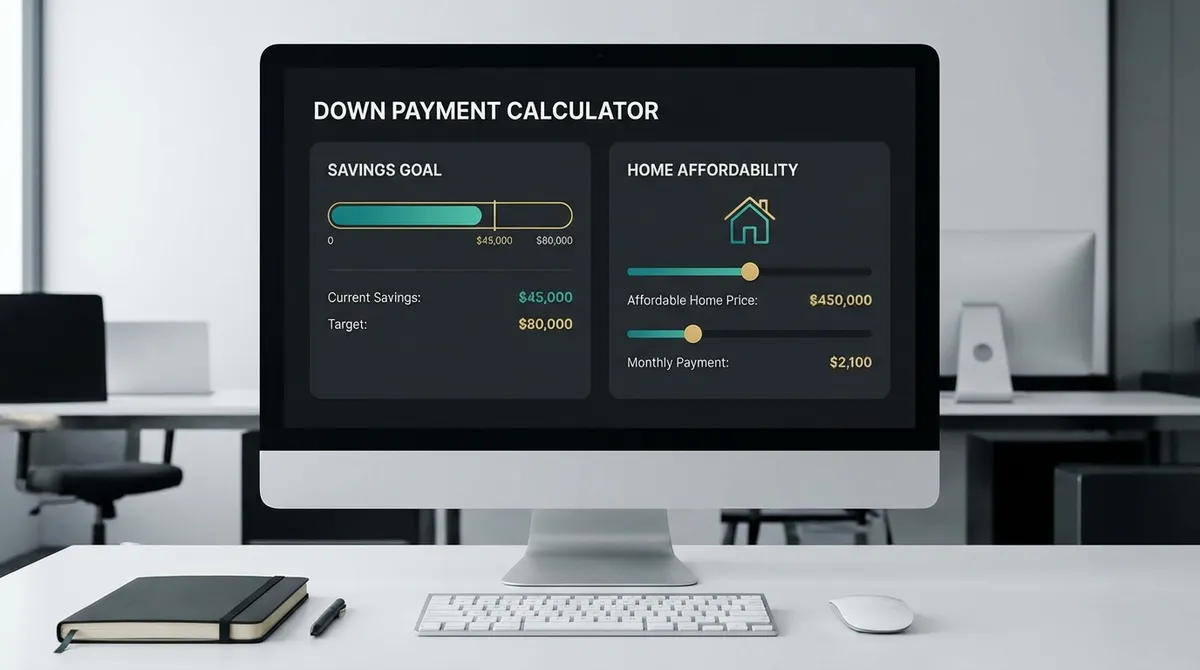
Down Payment Calculator: Free Home Down Payment Calculator

Free down payment calculator for 2025. Calculate home down payments, PMI costs, and compare loan options including FHA, VA, and conventional loans.

Free Finance Calculator
100% Private
Instant Results

Down Payment Calculator

$
$
20.0% of home price
$
Down Payment
$80,000
20.0%
Loan Amount
$320,000
Monthly PMI
$0
0.0%% annually
Total Monthly
$2,754
P&I + PMI + Tax + Insurance

Loan Type Comparison for Your Home Price

Loan TypeMin Down PaymentLoan AmountMonthly PMIEst. Monthly Payment
Conventional (3%)
$12,000$388,000$307$3,537
FHA (3.5%)
$14,000$386,000$306$3,521
VA (0%)
$0$400,000$317$3,630
USDA (0%)
$0$400,000$317$3,630
Jumbo (20%)
$80,000$320,000$0$2,754
Key Insight: VA and USDA loans offer 0% down payment options for eligible buyers. Conventional loans require as little as 3% down for qualified first-time buyers.

Monthly Payment vs. Down Payment Amount

3%
Minimum Conventional
First-time buyers eligible
20%
No PMI Required
Avoid mortgage insurance
25%+
Best Rates
Lower interest rates

Down Payment Strategies for 2025

First-Time Buyer Programs
Many states offer down payment assistance with grants up to $25,000 for qualified buyers.
Gift Funds Allowed
Most loan programs allow 100% of down payment to come from family gifts.
401(k) Loans
Borrow up to $50,000 from your 401(k) for down payment without penalty.
Seller Concessions
Negotiate for seller to pay 2-6% toward closing costs and prepaid items.

Your Home Purchase Summary

Based on a $400,000 home

$80,000
Down Payment
20.0%
$320,000
Loan Amount
30 years
$2,237
Principal & Interest
7.5% APR
$2,754
Total Monthly
P&I + PMI + Tax + Ins

How to Use Our Down Payment Calculator

Step 1: Enter Home Details

Input your target home price and your available down payment amount. The calculator automatically calculates your down payment percentage and shows loan scenarios for 3% to 25% down.

Step 2: Adjust Loan Terms

Set your expected interest rate (2025 average: 7-8%) and loan term. Most buyers choose 30-year terms for lower monthly payments, but 15-year terms save significant interest.

Step 3: Compare Loan Types

Review the loan comparison table showing minimum down payments for conventional (3%), FHA (3.5%), VA (0%), USDA (0%), and jumbo (20%) loans with estimated monthly costs.

Step 4: Analyze PMI Impact

If your down payment is under 20%, the calculator shows PMI costs and estimates when you'll reach 20% equity to eliminate PMI, potentially saving thousands annually.

Key Features of Our Calculator

Compare All Loan Types

Side-by-side comparison of conventional, FHA, VA, USDA, and jumbo loan down payment requirements and monthly costs to find your best option.

PMI Cost Calculator

Accurate PMI calculations based on down payment percentage. See exactly how much mortgage insurance costs and when you can eliminate it.

Visual Payment Breakdown

Interactive chart showing how monthly payments change with different down payment amounts, helping you optimize your down payment strategy.

State-Specific Insights

Median down payment data by state shows realistic expectations—ranging from $15,800 (Mississippi) to $820,000 (Hawaii) based on 2025 market data.

Equity Timeline Tracker

See exactly when you'll hit 20% equity to eliminate PMI, including strategies like extra payments to reach this milestone faster and save thousands.

Total Cost Analysis

Understand the true cost of different down payment scenarios, including interest over loan life, PMI costs, and opportunity cost analysis.

Understanding Down Payments: The Real 2025 Numbers

Forget the outdated "20% down" myth. In 2025, the median down payment for a home in the United States is $62,000 — representing just under 16% of the median home purchase price, according to July 2025 data from ATTOM, a leading real estate data firm.

The numbers vary dramatically based on buyer experience. First-time homebuyers are putting down a median of 9% (around $31,000 for a typical $350,000 home), while repeat buyers who can sell previous homes contribute a median of 18% ($78,000 on the same home).

5 Reasons the 20% Down Payment is No Longer Standard:

  • Low down payment loan programs: Conventional loans now accept 3% minimum
  • PMI is temporary: Can be removed once you reach 20% equity
  • Rising home prices: Waiting to save 20% means higher purchase prices
  • Opportunity cost: Money tied in down payment vs. other investments
  • Assistance programs: Grants and forgivable loans available in most areas

The key is choosing a down payment that makes financial sense for your specific situation while considering PMI costs, monthly payments, and your long-term financial goals. Our calculator helps you model different scenarios to find your optimal strategy.

Loan Type Comparison: Which Requires the Least Down?

Not all mortgages are created equal when it comes to down payment requirements. Understanding the minimums for each loan type can save you tens of thousands in upfront costs.

Loan TypeMinimum DownPMI Required?Best For
Conventional 973%Yes, until 20% equityFirst-time buyers with good credit
FHA Loan3.5%Yes, life of loanLower credit scores, first-time buyers
VA Loan0%No PMIVeterans, active-duty military, eligible spouses
USDA Loan0%No PMIRural area buyers, moderate income
Jumbo Loan10-20%Varies by lenderHigh-value homes above conforming limits

Pro Tip: VA and USDA loans offer the best terms with zero down payment and no PMI, but they have specific eligibility requirements. If you qualify for either program, they should be your first choice for minimizing upfront costs.

Conventional vs. FHA: Which is Better for Low Down Payments?

Conventional loans with 3% down typically have better long-term costs because PMI can be removed. FHA loans require 3.5% down but include mortgage insurance for the entire loan life (unless you refinance). For buyers with credit scores above 620, conventional is usually the better choice.

PMI Costs Demystified: How Much and When It Disappears

Private Mortgage Insurance (PMI) is often the hidden cost of low down payments, but it's not as expensive or permanent as many buyers fear. Understanding PMI rates and elimination timelines is crucial for total cost comparison.

PMI Rates by Down Payment (Annual)

  • 3.0% - 4.9% down:0.90% - 0.95%
  • 5.0% - 9.9% down:0.78% - 0.85%
  • 10% - 14.9% down:0.59% - 0.65%
  • 15% - 19.9% down:0.44% - 0.50%
  • 20%+ down:No PMI Required

PMI Elimination Milestones

Request Removal: 80% LTV
You can request PMI removal when your loan balance reaches 80% of original home value
Auto Termination: 78% LTV
Federal law requires lenders to automatically remove PMI at 78% loan-to-value
Requirements
Good payment history (no 30-day late payments in past 12 months) and current on loan

PMI Cost Example: $400,000 Home

Down PaymentLoan AmountPMI RateMonthly PMIEst. PMI DurationTotal PMI Cost
3% ($12,000)$388,0000.95%$3078.1 years$29,800
5% ($20,000)$380,0000.78%$2476.2 years$18,400
10% ($40,000)$360,0000.59%$1774.8 years$10,200
20% ($80,000)$320,0000%$0$0

*Duration estimates assume 3% annual home appreciation. Actual results may vary.

Key Takeaway: While 20% down eliminates PMI, the "cost" of PMI for a 5% down payment on a $400,000 home is only about $18,400 over 6.2 years. This is often less than the appreciation you'd miss waiting years to save an extra $60,000 down payment.

Down Payment Assistance Programs: Free Money for Buyers

In 2025, thousands of down payment assistance (DPA) programs exist nationwide, offering grants, forgivable loans, and matched savings to help buyers afford home purchases. Most buyers don't know these programs exist or assume they won't qualify.

Grants

Free money, no repayment required
Typically $5,000-$25,000 depending on area and income limits. Must be used for down payment and closing costs.

Example: Colorado's CHFA offers $10,000 grants for first-time buyers

Forgivable Loans

Second mortgage with 0% interest
Completely forgiven after 3-10 years of living in the home. Leave early, repay portion.

Example: California's CalHFA MyHome provides 3.5% of purchase price

Matched Savings

Save $1, get $3-$5 match
IDA programs match your savings 3:1 or 5:1 to build down payment faster.

Example: Save $2,000, receive $8,000 match = $10,000 down payment

Who Qualifies for Down Payment Assistance?

Common Requirements:
  • • First-time homebuyer (3 years since owning)
  • • Income below 80-120% of area median
  • • Complete homebuyer education course
  • • Minimum credit score (usually 620-640)
  • • Occupy home as primary residence
Where to Find Programs:
  • • State Housing Finance Agencies (HFAs)
  • • City and county housing departments
  • • Nonprofit organizations (NeighborhoodLIFT)
  • • Employer-assisted housing programs
  • • Federal Home Loan Bank member banks

This is why researching DPA programs is crucial before deciding you can't afford a home. Many buyers discover they qualify for assistance that makes homeownership immediately achievable instead of years away.

State-by-State Down Payment Reality Check

Down payment expectations vary dramatically based on where you're buying. A "typical" down payment in California ($160,600) could buy an entire home outright in West Virginia. Understanding your local market is essential for realistic planning.

July 2025 Median Down Payments by State (ATTOM Data)

Highest Down Payments:
Hawaii:$820,000
California:$160,600
Washington:$126,000
Colorado:$118,544
Massachusetts:$139,750
Lowest Down Payments:
Mississippi:$15,800
Texas:$15,000
West Virginia:$20,944
Louisiana:$21,825
Alabama:$37,300
National Average:
Median (US):$62,000
% of price:16%
First-time buyers:9%
Repeat buyers:18%

What This Means for Your Strategy:Buyers in high-cost states like California and Hawaii often feel discouraged by massive down payment requirements. But even in these markets, low down payment options exist. A 3% down payment on a $800,000 California home is still only $24,000—achievable with DPA programs and disciplined saving.

The 2025 Down Payment Decision: What Financial Experts Actually Recommend

After analyzing current market conditions, interest rates, and home appreciation trends, most financial experts in 2025 recommend a counterintuitive approach: put less down, buy sooner.

The New 2025 Down Payment Philosophy:

Old Thinking (Pre-2020):
  • ✗ Save 20% to avoid PMI
  • ✗ Wait years to buy
  • ✗ Lower monthly costs
  • ✗ Less risk assumed
  • ✗ Miss market appreciation
2025 Reality:
  • ✓ PMI is temporary (avg $120-200/month)
  • ✓ Buy now with 3-5% down
  • ✓ Home values rising 5-8% annually
  • ✓ Build equity faster than savings
  • ✓ Refinance when rates drop

The Math is Clear: Time in Market Beats Timing the Market

The buyer who purchases with 5% down immediately gains significantly more equity over time compared to waiting to save 20% down. Even after accounting for PMI costs, the advantage is overwhelming. Plus, you get to live in your home instead of waiting.

When to Put More Down (15-20%):

  • You have substantial cash reserves (12+ months expenses)
  • You're buying in a declining or volatile market
  • Interest rates are exceptionally high and likely to fall
  • You're close to retirement and prioritizing cash flow

When Minimum Down Payments Make Sense (3-5%):

  • Rising home prices (most markets in 2025)
  • You qualify for down payment assistance
  • You have good investment opportunities for extra cash
  • You need cash reserves for renovations or emergencies

Frequently Asked Questions About Down Payments

How much down payment do I need for a $400,000 house in 2025?

The minimum down payment depends on your loan type: Conventional loans require as little as 3% ($12,000) for qualified first-time buyers, FHA loans need 3.5% ($14,000), and VA/USDA loans offer 0% down ($0) for eligible buyers. However, you'll pay PMI with less than 20% down ($80,000), which typically costs $180-250/month until you reach 20% equity.

Is it better to put 20% down or just 5% in today's market?

In 2025's rising market, 5% down is often betterbecause home appreciation (5-8% annually) typically outpaces PMI costs. Buying sooner builds equity faster. The PMI on a 5% down payment averages $12,000-18,000 over 5-7 years, while waiting to save 20% could cost you $60,000-80,000 in missed appreciation. Plus, you can remove PMI once you hit 20% equity through payments and appreciation.

How long do I have to pay PMI with a low down payment?

PMI typically lasts until you reach 20% equityin your home. You can request removal at 80% loan-to-value (LTV), and lenders must automatically remove it at 78% LTV. For a 5% down payment, this usually takes 6-8 yearswith regular payments, or 4-5 years with extra principal payments. Home appreciation can accelerate this timeline significantly.

Can I use gift money for my entire down payment?

Yes, most loan programs allow 100% gift fundsfor down payments. Conventional loans require a gift letter documenting the relationship and confirming the money doesn't need to be repaid. FHA loans also allow 100% gifts from family members. However, some lenders may require you to contribute at least 5% from your own funds if your credit score is below 620. The gift must be properly documented with a gift letter and paper trail.

What credit score do I need for a 3% down conventional loan?

Conventional 97 loans (3% down) typically require a minimum credit score of 620-640. However, you'll get much better interest rates with scores above 680. For every 20-point increase in your credit score above 640, you can expect approximately 0.125% better interest rates. PMI rates are also credit-score based—a 740+ score can cut PMI costs by 30-40% compared to a 620 score.

Are there down payment assistance programs for repeat buyers?

Yes, many programs help repeat buyers too.While most DPA programs prioritize first-time buyers, "first-time" is defined as not owning a home in the past 3 years. So if you sold your previous home 3+ years ago, you may qualify as a "first-time buyer" again. Additionally, some programs specifically help displaced homemakers, single parents, or veterans regardless of previous homeownership. Check your state HFA for specific programs.

How do I calculate the total cost of waiting to save a bigger down payment?

Use our calculator to compare scenarios: Factor 5-8% annual home appreciation, current rent payments, and PMI costs. If homes appreciate at $24,000/year ($400,000 home at 6%), waiting 3 years to save an extra $40,000 costs you $72,000 in appreciation plus $36,000 in rent ($1,000/month)—totaling $108,000 lost, far exceeding PMI costs of $8,000-15,000 over that period.

Can I negotiate PMI rates with lenders?

Yes, PMI rates vary between lenders and you can shop around.PMI is provided by private insurance companies, and each lender has different arrangements. Get quotes from at least 3-4 lenders as rates can vary by 0.1-0.3 percentage points. You can also choose lender-paid PMI (LPMI) where the lender covers PMI in exchange for a slightly higher interest rate (typically 0.25-0.5% higher), which may be tax-deductible.

About the Author

David Johnson, CFP®

Certified Financial Planner & Mortgage Expert

CFP® Certified, 15+ Years Mortgage Industry Experience

David Johnson is a Certified Financial Planner with extensive experience in mortgage lending and real estate finance. He has helped thousands of homebuyers navigate down payment strategies and mortgage options across all 50 states.

Connect with David

Related Calculators

Explore more tools in Real Estate & Property

Airbnb Calculator: Free Short-Term Rental Revenue & ROI Calculator

Free Airbnb calculator to estimate short-term rental revenue, occupancy rates, and ROI. Analyze profitability, calculate break-even, and optimize pricing for your vacation rental property.

Real Estate & Property

Cap Rate Calculator: Free Real Estate Capitalization Rate Calculator

Free cap rate calculator for real estate investors. Calculate capitalization rates, NOI, and property valuations instantly. Includes interactive charts and scenario analysis.

Real Estate & Property

Cash on Cash Return Calculator | Free CoC ROI Estimator

Calculate your ROI instantly with our Cash on Cash Return calculator. Measure how your initial cash investment and annual cash flow perform on rentals.

Real Estate & Property

Cash on Cash Return Calculator: Free Real Estate Investment Analyzer

Calculate cash on cash return for rental properties. Free real estate investment calculator analyzes ROI, cash flow, and profitability with industry benchmarks.

Real Estate & Property

Gross Rent Multiplier Calculator: Free GRM Analysis Tool for Real Estate Investment

Calculate gross rent multiplier instantly to evaluate income properties. Free GRM calculator analyzes property value, rental income, and investment potential.

Real Estate & Property

Home Value Calculator | Free Property Worth Estimator

Estimate your home's market value with our free calculator. Compare three proven valuation methods: comparable sales, income, and cost approaches. Get instant, accurate property valuations for buying, selling, or refinancing decisions.

Real Estate & Property