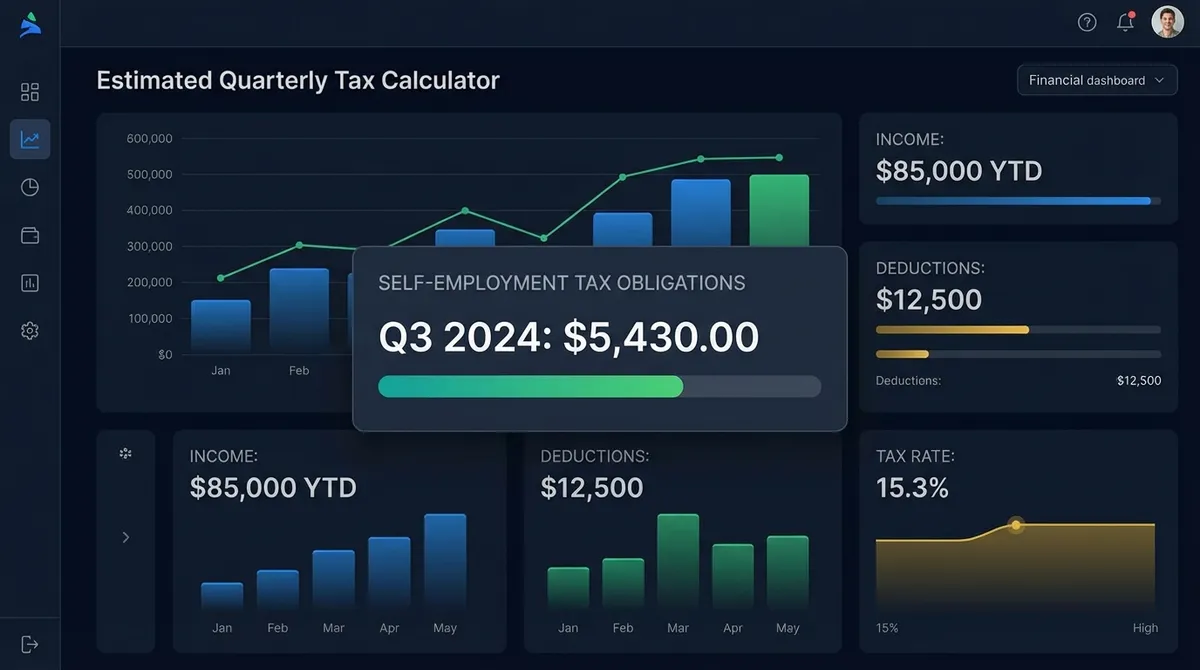
Understanding and managing quarterly estimated tax payments is crucial for anyone with income not subject to regular withholding. Whether you're self-employed, a freelancer, independent contractor, or have significant investment income, the IRS requires you to pay taxes as you earn income throughout the year.
Understanding Quarterly Estimated Taxes
Quarterly estimated tax payments are the IRS's method of collecting income taxes from individuals and businesses that don't have taxes withheld automatically from their paychecks. Unlike traditional employees who have taxes withheld by their employer, self-employed individuals and others must calculate and pay their taxes in four equal installments throughout the year.
The Pay-As-You-Go System
The United States operates on a pay-as-you-go tax system. This means you're required to pay taxes on income as you earn it, not just when you file your annual tax return. For employees, this happens automatically through payroll withholding. For everyone else, quarterly estimated tax payments fill this requirement.
The failure to make adequate quarterly payments results in underpayment penalties, even if you pay your full tax liability when filing your return. For 2025, these penalties typically accrue at an annual rate of 3-4% on the amount underpaid, calculated from the date the payment was due.
Who Must Pay Quarterly Estimated Taxes?
Generally, you must make estimated tax payments if you expect to owe $1,000 or more in tax for 2025 after subtracting withholding and refundable credits, and you expect your withholding and credits to be less than:
- 90% of the tax shown on your 2025 tax return, or
- 100% of the tax shown on your 2024 tax return (110% if your 2024 adjusted gross income was over $150,000)
This requirement commonly applies to:
- Self-employed individuals: Freelancers, consultants, gig workers, and independent contractors
- Small business owners: Sole proprietors, partners, and S-corporation shareholders
- Investors: Those with significant dividend, interest, or capital gains income
- Landlords: Rental property owners with positive cash flow
- Retirees: Those with pension income or IRA distributions without withholding
Calculating Your Quarterly Tax Payments
Accurately calculating your quarterly tax payments requires understanding several components: federal income tax, self-employment tax, deductions, and credits. Our calculator simplifies this process using current 2025 tax laws.
Step 1: Estimate Your Annual Income
Begin by estimating your total income for 2025 from all sources. This includes:
- Self-employment income (1099-NEC, cash payments)
- Business profits from partnerships or S-corporations
- Dividend and interest income
- Capital gains from investments or asset sales
- Rental income
- Any other income not subject to withholding
Be realistic in your estimates. Underestimating income can lead to underpayment penalties, while overestimating means you're giving the IRS an interest-free loan. Many taxpayers use last year's income as a starting point, adjusting for expected changes.
Step 2: Deduct Business Expenses
Self-employed individuals can deduct ordinary and necessary business expenses. These reduce both your income tax and self-employment tax liability. Common deductions include:
- Office supplies and equipment
- Business mileage and vehicle expenses
- Professional development and education
- Marketing and advertising costs
- Professional fees (accountants, lawyers)
- Health insurance premiums (for self-employed)
- Retirement contributions (SEP-IRA, Solo 401(k))
Step 3: Apply Deductions
After reducing your income by business expenses, apply either the standard deduction or itemized deductions:
- Standard Deduction (2025): $15,000 (Single), $30,000 (Married Filing Jointly), $22,500 (Head of Household)
- Itemized Deductions: Only beneficial if they exceed your standard deduction. Include state and local taxes (SALT, capped at $10,000), mortgage interest, charitable contributions, and medical expenses exceeding 7.5% of AGI.
Step 4: Calculate Self-Employment Tax
Self-employment tax covers your Social Security and Medicare obligations. For 2025, it consists of:
- Social Security Tax: 12.4% on net earnings up to $176,100
- Medicare Tax: 2.9% on all net earnings
- Additional Medicare Tax: 0.9% on earnings above $200,000 (single) or $250,000 (married filing jointly)
The self-employment tax applies to 92.35% of your net business income (accounting for the employer portion you pay). Importantly, you can deduct half of your self-employment tax when calculating your adjusted gross income.
Step 5: Calculate Federal Income Tax
Use the 2025 tax brackets to calculate your federal income tax on your taxable income:
| Tax Rate | Single Filers | Married Filing Jointly | Head of Household |
|---|---|---|---|
| 10% | $0 – $11,925 | $0 – $23,850 | $0 – $17,000 |
| 12% | $11,925 – $48,475 | $23,850 – $96,950 | $17,000 – $64,850 |
| 22% | $48,475 – $103,350 | $96,950 – $206,700 | $64,850 – $103,350 |
| 24% | $103,350 – $197,300 | $206,700 – $394,600 | $103,350 – $197,300 |
| 32% | $197,300 – $250,525 | $394,600 – $501,050 | $197,300 – $250,500 |
| 35% | $250,525 – $626,350 | $501,050 – $751,600 | $250,500 – $626,350 |
| 37% | Over $626,350 | Over $751,600 | Over $626,350 |
Step 6: Apply Tax Credits
Tax credits directly reduce your tax liability dollar-for-dollar. Common credits include:
- Child Tax Credit: Up to $2,000 per qualifying child (refundable portion $1,700 for 2025)
- Child and Dependent Care Credit: For childcare expenses while working
- Education Credits: American Opportunity Credit and Lifetime Learning Credit
- Earned Income Tax Credit (EITC): For low-to-moderate income workers
After subtracting credits from your total tax liability (federal income tax + self-employment tax), you have your total annual tax obligation.
Safe Harbor Rules: Your Protection Against Penalties
The IRS provides "safe harbor" provisions that protect you from underpayment penalties if you meet specific payment thresholds. Even if you underpay your actual tax liability, you won't face penalties if you qualify for safe harbor protection.
Safe Harbor Option 1: 90% of Current Year Tax
Pay at least 90% of your current year's total tax liability through quarterly payments and withholding. This option works well when your income is stable or declining from the prior year.
Safe Harbor Option 2: 100% of Prior Year Tax
Pay at least 100% of your prior year's total tax liability (shown on last year's tax return). If your adjusted gross income was over $150,000 ($75,000 if married filing separately), you must pay 110% of last year's tax.
This option provides certainty because you know exactly how much you need to pay. It's particularly beneficial if your income increased significantly this year, as it limits your quarterly payment amounts even with higher earnings.
Annualized Income Installment Method
If your income varies significantly throughout the year, you can use the annualized income installment method. This allows you to calculate different payment amounts for each quarter based on actual income earned during that period.
This method is particularly useful for:
- Seasonal businesses (e.g., retail with heavy Q4 sales)
- Professionals with irregular income (commission-based sales, consultants)
- Those who receive large lump-sum payments at unpredictable times
- Individuals transitioning to self-employment mid-year
Form 2210 provides worksheets for calculating annualized income installments, but the calculations are complex. Consider working with a tax professional if this method would significantly benefit you.
2025 Quarterly Tax Payment Deadlines
Mark your calendar with these critical 2025 quarterly estimated tax payment due dates:
| Quarter | Payment Period | Due Date | Action Required |
|---|---|---|---|
| Q1 | January 1 – March 31 | April 15, 2025 | First payment due |
| Q2 | April 1 – May 31 | June 16, 2025 | Second payment due (June 15 is Sunday) |
| Q3 | June 1 – August 31 | September 15, 2025 | Third payment due |
| Q4 | September 1 – December 31 | January 15, 2026 | Final payment for 2025 tax year |
If any due date falls on a weekend or federal holiday, your payment is due the next business day. For example, June 15, 2025, is a Sunday, so Q2 payments are due June 16, 2025.
How to Make Quarterly Tax Payments
The IRS offers several convenient methods for making quarterly estimated tax payments:
1. IRS Direct Pay
The IRS Direct Pay system allows you to pay directly from your checking or savings account at no cost. This method provides immediate confirmation and is the most popular option for individual taxpayers. Visit IRS.gov/DirectPay, select "Estimated Tax" as your reason for payment, and follow the prompts.
2. Electronic Federal Tax Payment System (EFTPS)
EFTPS is a free system offered by the U.S. Department of Treasury. You can schedule payments up to 365 days in advance and view up to 16 months of payment history. Enrollment is required and takes about a week to complete, so plan ahead. Many businesses prefer EFTPS for its advanced features and reporting capabilities.
3. IRS2Go Mobile App
The IRS2Go mobile app (available for iOS and Android) allows you to make payments via your mobile device. The app integrates with IRS Direct Pay and other payment processors for convenient on-the-go payments.
4. Phone Payments
You can pay by phone using the IRS's voice response system at 1-800-555-3453. Have your bank account information and Social Security Number ready when you call.
5. Mail with Form 1040-ES
Traditional mail payments are still accepted using Form 1040-ES (Estimated Tax for Individuals). The form includes payment vouchers that you mail with your check or money order to the appropriate IRS address for your location. Make checks payable to "United States Treasury" and include your Social Security Number and "2025 Form 1040-ES" on the memo line.
Note: Credit card payments are also available through third-party processors, but they charge convenience fees (typically 1.87% to 1.99% of the payment amount), making them a more expensive option.
State Quarterly Tax Considerations
In addition to federal quarterly estimated taxes, most states require quarterly estimated tax payments for state income taxes. State requirements vary significantly:
- State Due Dates: Most follow the federal schedule, but some states have different deadlines
- State Safe Harbors: Many states have their own safe harbor rules, often similar to but not identical to federal rules
- State Tax Rates: Wide variation in tax rates, brackets, and standard deductions
- No Income Tax States: Alaska, Florida, Nevada, South Dakota, Tennessee, Texas, Washington, and Wyoming don't require state quarterly payments
Check with your state's tax agency for specific requirements. Many states offer their own online payment systems similar to IRS Direct Pay.
Common Quarterly Tax Mistakes to Avoid
Even experienced self-employed individuals make these common quarterly tax mistakes:
Mistake 1: Failing to Pay Quarterly at All
New self-employed individuals often don't realize they need to make quarterly payments until they face a large tax bill plus penalties at filing time. If you're newly self-employed, start making quarterly payments immediately to avoid this costly mistake.
Mistake 2: Underestimating Income
While it's tempting to be optimistic about business expenses or conservative about income projections, significantly underestimating income can lead to substantial underpayment penalties. If your income exceeds projections, adjust your remaining quarterly payments upward.
Mistake 3: Forgetting Self-Employment Tax
Many new freelancers calculate only their income tax and forget about the additional 15.3% self-employment tax. This is often the largest tax surprise for the newly self-employed and can result in significant underpayment.
Mistake 4: Missing Payment Deadlines
Payment deadlines occur whether you're ready or not. Set calendar reminders at least a week before each due date. Late payments incur penalties from the original due date, even if you pay before the next quarter's deadline.
Mistake 5: Not Adjusting Payments
Your business and income change throughout the year. Review your estimated tax calculations quarterly and adjust payments if your income significantly increases or decreases. The annualized income method can help if your income varies substantially by quarter.
Special Situations and Exceptions
Various special circumstances affect quarterly tax requirements:
Farmers and Fishermen
Farmers and fishermen have different rules. They can make a single estimated payment by January 15 or file their tax return and pay the full amount by March 1 to avoid penalties. Additionally, they have special safe harbor provisions that require less stringent payment schedules.
High Income Taxpayers
Taxpayers with adjusted gross income over $150,000 must pay 110% of prior year tax (not 100%) to meet safe harbor requirements. This prevents high earners from using prior year safe harbor while experiencing significant income increases.
Recent Retirees or Disabled Individuals
If you retired after age 62 or became disabled during the tax year, you may qualify for penalty waivers if your underpayment was due to reasonable cause and not willful neglect. Form 2210 includes provisions for these situations.
Disaster Victims
The IRS frequently provides relief for taxpayers in federally declared disaster areas, including extended payment deadlines and penalty relief. Check IRS disaster relief announcements if you're affected by natural disasters.
Record Keeping for Quarterly Taxes
Proper documentation is essential for quarterly tax compliance and preparing your annual return. Maintain detailed records of:
- All Income: 1099 forms, business revenue records, investment statements
- Business Expenses: Receipts, invoices, mileage logs, home office calculations
- Estimated Tax Payments: Payment confirmations, bank statements, Form 1040-ES vouchers
- Tax Returns: Prior year returns, supporting schedules, carryforward information
- Correspondence: IRS notices, state tax communications, professional advice
Keep records for at least three years (the statute of limitations for IRS audits), though keeping six years of records is advisable if you have complex tax situations or carryforward items.
Planning for Next Year
As you navigate quarterly taxes in 2025, use these strategies to improve your process for 2026:
- Improve Estimates: Track how accurate your 2025 projections were and adjust your estimating process
- Automate Savings: Set up automatic transfers to a separate tax savings account each time you receive income
- Software Integration: Use accounting software that projects tax liability and reminds you of payment deadlines
- Professional Relationship: Establish a relationship with a tax professional before year-end, not just at tax time
- Quarterly Reviews: Schedule quarterly tax reviews like you would any important business meeting
- Education: Stay informed about tax law changes that affect your specific situation
When to Seek Professional Help
While many self-employed individuals can manage quarterly taxes themselves, consider professional help if:
- Your income exceeds $200,000 annually
- You have multiple business entities or complex business structures
- You experience significant income fluctuations or have seasonal businesses
- You've been subject to underpayment penalties in prior years
- You have both self-employment and W-2 income sources
- You're subject to the alternative minimum tax (AMT)
- You have substantial investment income or complex tax situations
- You owe state taxes in multiple states
A qualified tax professional can help optimize your quarterly payment strategy, ensure compliance, and identify opportunities to reduce your overall tax burden legally.
Final Thoughts: Mastering Quarterly Estimated Taxes
Quarterly estimated tax payments are a fundamental responsibility for self-employed individuals and others with non-wage income. While they require discipline and planning, they're manageable with the right approach and tools.
The key to success is treating quarterly taxes as a regular business expense rather than an annual surprise. By implementing systems to estimate accurately, save consistently, and pay timely, you maintain IRS compliance while avoiding penalties and interest charges.
Remember that quarterly tax management is an ongoing process, not a set-it-and-forget-it task. Regularly review your income, adjust your estimates, and stay current with changing tax laws that affect your situation.
Use this calculator as your starting point, but don't hesitate to seek professional guidance for complex situations. The cost of professional tax advice is often far less than the cost of penalties, interest, and missed planning opportunities.
Take control of your quarterly estimated tax obligations today—your future self will thank you when April 15th comes around and you're prepared, compliant, and penalty-free.