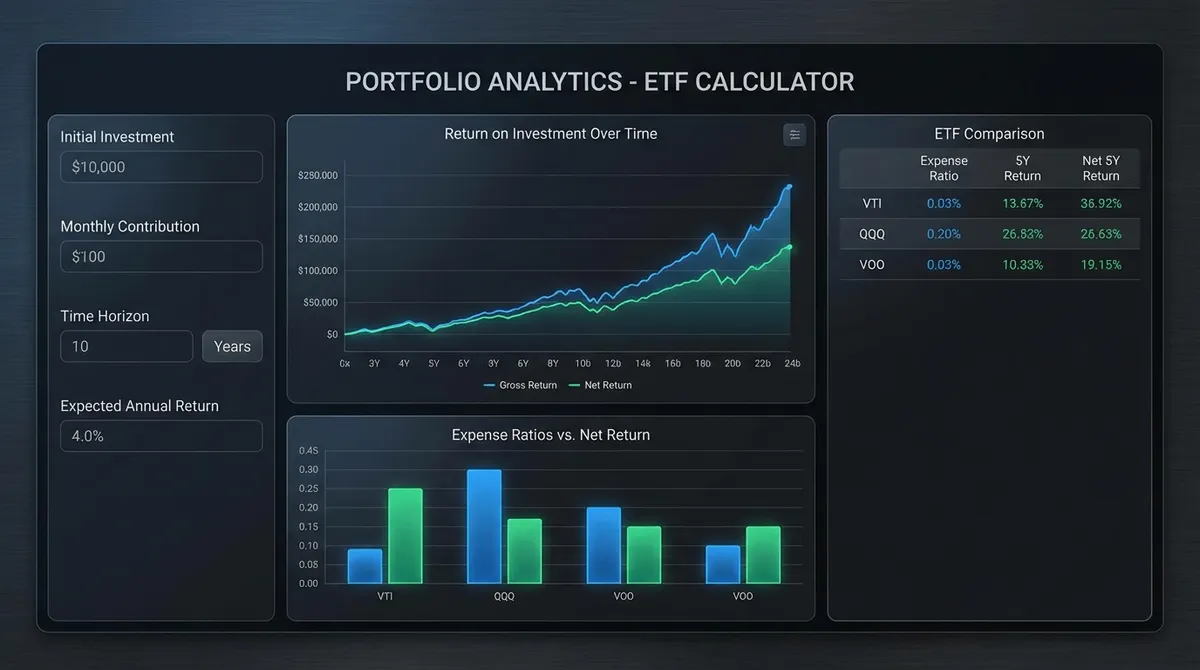
Exchange-Traded Fund Calculator

Calculate ETF investment returns with precision. Our advanced calculator factors in expense ratios, dividend reinvestment, and compound growth to project your portfolio's true value over time.

Low-Cost Investing
Expense ratios as low as 0.03%
Historical Averages
S&P 500: 10.5% annually (1957-2024)
Diversification
Instant access to thousands of stocks

ETF Investment Calculator

Project your ETF portfolio growth with expense ratios, dividends, and compound returns (Based on S&P 500: 10.5% historical average)

Pre-configured Investment Strategies

How to Use Our ETF Calculator

1

Enter Your Investment Details

Input your starting amount, monthly contributions, expected annual return rate, and investment time horizon

2

Select ETF Parameters

Set the expense ratio (typically 0.03%-0.75%), dividend yield, and compound frequency

3

Choose or Customize a Scenario

Use preset strategies or adjust inputs to match your specific ETF investment plan

4

Review Projections & Analysis

Analyze your portfolio growth chart, total fees paid, and net returns to optimize your strategy

Why Use Our ETF Calculator?

Comprehensive Return Analysis

Calculate both price appreciation and dividend income with precise compound growth modeling

Expense Ratio Impact

See exactly how fees affect your long-term returns with detailed fee breakdowns

Interactive Growth Charts

Visualize your portfolio growth with dynamic charts showing year-by-year projections

Investment Scenarios

Compare conservative, moderate, aggressive, and retirement-focused strategies instantly

Export & Save Results

Download your calculations as JSON for financial planning and advisor consultations

Fee Impact Warnings

Get alerted to high expense ratios that could cost thousands over time

Understanding Exchange-Traded Funds (ETFs)

ETF investment growth visualization

Exchange-Traded Funds (ETFs) have revolutionized investing since their introduction in 1993, offering the diversification benefits of mutual funds with the trading flexibility of individual stocks. As of 2025, the global ETF market exceeds $12 trillion in assets, with over 8,000 ETFs available worldwide covering everything from broad market indexes to niche sectors.

Unlike actively managed mutual funds that attempt to beat the market through stock picking, most ETFs are passively managed to track specific indexes like the S&P 500. This passive approach results in dramatically lower costs—typical expense ratios of 0.03%-0.20% versus 0.50%-1.50% for active mutual funds. Over a 30-year investment horizon, these fee differences can compound into tens of thousands of dollars in additional wealth.

Key Insight on ETF Cost Savings

A $100,000 investment over 25 years at 8% annual returns would grow to $684,848 with a 0.04% expense ratio (VTI), versus only $597,434 with a 0.75% ratio—a difference of $87,414. This demonstrates why expense ratios are critical to long-term performance.

How ETF Investment Returns Actually Work

ETF returns come from three primary sources: price appreciation of underlying securities, dividend distributions, and (for bond ETFs) interest payments. Unlike mutual funds that only trade once daily at net asset value (NAV), ETFs trade throughout market hours like stocks, with prices determined by supply and demand.

The Three Components of ETF Returns

Price Appreciation

The increase in value of the underlying securities tracked by the ETF. For an S&P 500 ETF, this reflects the collective performance of all 500 companies.

Dividend Income

Quarterly cash distributions from underlying stocks. The average S&P 500 ETF yields 1.5-2.0% annually, which can be reinvested automatically to compound growth.

Interest Payments

For bond ETFs, this represents coupon payments from underlying bonds. Treasury bond ETFs currently yield 3.5-4.5% as of 2025.

The magic of ETFs lies in compounding—the process where returns earn their own returns. Over 40 years, $500 monthly investments at 8% average returns grow to over $1.6 million, with compounding responsible for more than 80% of the final value. This exponential growth is why starting early is more important than investing large amounts.

Critical Factors Affecting ETF Returns

1. Expense Ratios (The Silent Wealth Killer)

Expense ratios directly subtract from returns daily. A 1% expense ratio may seem small, but it consumes $1,000 annually on a $100,000 investment. Over 30 years, this difference can cost investors $150,000 or more in lost compound growth. Always prioritize ETFs with expense ratios under 0.20% for core holdings.

2. Tracking Error

Tracking error measures how closely an ETF follows its benchmark index. The best ETFs have tracking errors under 0.15%, meaning they deliver almost exactly the index return minus fees. Poor tracking can cost 0.30-0.50% annually, essentially doubling the effective expense ratio.

3. Bid-Ask Spreads

This hidden cost occurs when buying or selling ETFs. Highly liquid S&P 500 ETFs have spreads of just 0.01% ($1 on $10,000), while niche sector ETFs can cost 0.30-0.70% per trade. For buy-and-hold investors, this is minimal, but frequent traders should consider it carefully.

4. Premiums and Discounts to NAV

ETFs can trade above (premium) or below (discount) their net asset value. During market volatility, premiums can reach 2-5% for bond ETFs and international funds. Buying at a premium and selling at a discount can significantly impact returns, especially for short holding periods.

5. Tax Efficiency

ETFs are structurally tax-efficient due to in-kind redemptions that avoid triggering capital gains. However, distributions are still taxable. Qualified dividends are taxed at 0-20%, while short-term gains reach 37%. Tax-loss harvesting and holding in IRAs can maximize after-tax returns.

ETF Return Calculation Formula

Our calculator uses a sophisticated compound growth formula that accounts for recurring contributions, dividends, and expense ratios:

Final Value = Σ[PMT × (1 + r - f)^n] + (Initial × (1 + r - f)^t)
Where: PMT = Monthly contribution, r = monthly return rate
f = monthly expense ratio, n = compounding periods
t = total time periods, Σ = sum of all contributions

Example Calculation:

Sarah invests $10,000 initially and adds $500 monthly to an S&P 500 ETF with 0.04% expense ratio, 2% dividend yield, and expects 8% annual returns over 20 years:

  • Initial Investment: $10,000
  • Monthly Contributions: $500 × 240 months = $120,000
  • Total Invested: $130,000
  • Expense Ratio Cost: $3,420 over 20 years
  • Final Portfolio Value: $394,772
  • Net Return: $261,352 (201% gains)

Types of ETFs for Different Investment Goals

Index ETFs (Core Holdings)

Track broad markets like S&P 500, Total Stock Market, or Global ex-U.S. Lowest costs (0.03-0.15%) and highest liquidity. Ideal for 70-80% of portfolios.

Sector ETFs (Tactical)

Focus on specific industries (Technology, Healthcare, Energy). Higher costs (0.10-0.60%) and concentration risk. Suitable for 5-15% of portfolio maximum.

International ETFs (Diversification)

Access foreign markets (Emerging Markets, Developed ex-U.S., China). Expense ratios of 0.08-0.50%. Currency fluctuations add another return dimension.

Bond ETFs (Income & Stability)

Treasury, corporate, municipal, and high-yield bonds. Provide regular income and portfolio stability. Yields currently range from 3.5-7% depending on credit quality.

Commodity ETFs (Inflation Hedge)

Gold, silver, oil, and agricultural products. Typically use futures contracts. Higher costs (0.50-0.90%) and can exhibit contango/backwardation. Best as 5-10% position.

Specialty ETFs (Advanced)

Leveraged (2x/3x), inverse, and thematic (AI, Clean Energy). Extremely high costs (0.95-2.00%) and daily reset decay. Not suitable for long-term holding.

2025 Tax Implications for ETF Investors

ETFs offer superior tax efficiency compared to mutual funds, but investors still face tax considerations that affect after-tax returns. Understanding these rules is crucial for maximizing your investment outcomes.

Capital Gains Taxes

Short-Term (≤ 1 year)
Taxed as ordinary income
Up to 37%
Long-Term (> 1 year)
Favorable tax rates
0-20%

Dividend Taxation

Qualified Dividends
Paid by U.S. corporations
0-20%
Ordinary Dividends
REITs, bond interest
10-37%

Tax Optimization Strategies

  • • Hold ETFs for >1 year to qualify for long-term capital gains rates
  • • Place high-dividend ETFs in tax-advantaged accounts (IRA, 401k)
  • • Consider municipal bond ETFs for taxable accounts (tax-free income)
  • • Tax-loss harvest by selling losing positions and replacing with similar ETFs
  • • Avoid selling within one year to prevent short-term tax hits

Common ETF Investment Mistakes to Avoid

Chasing Past Performance

Investors often buy last year's winners, which tend to underperform the following years. Stick to your asset allocation instead of performance chasing.

Ignoring Expense Ratios

A 0.50% higher expense ratio costs $5,000 annually on $1M. Always compare costs between similar ETFs—differences compound dramatically over time.

Overtrading and Timing the Market

Studies show frequent traders underperform buy-and-hold investors by 4-6% annually due to transaction costs and missed days. ETFs work best as long-term holds.

Poor Diversification

Holding only technology ETFs or U.S. stocks increases concentration risk. Proper diversification includes bonds, international exposure, and multiple sectors.

Expert ETF Investment Strategies (2025 Guide)

Core-Satellite Approach

Allocate 70-80% to broad market index ETFs (VTI, VXUS) as your core, then use 20-30% for satellite positions in specific sectors or themes you believe will outperform. This balances diversification with opportunity capture.

Dollar-Cost Averaging

Invest fixed amounts regularly regardless of market conditions. This strategy reduces the risk of buying at market peaks and builds discipline. Studies show DCA investors often outperform those trying to time lump-sum investments.

Tax-Efficient Asset Location

Place bond ETFs and high-dividend stock ETFs in tax-advantaged accounts (IRA, 401k) to defer taxes. Hold tax-efficient broad market ETFs in taxable accounts. Municipal bond ETFs belong in taxable accounts for high-income investors.

Rebalancing Discipline

Review your portfolio annually and rebalance when allocations drift more than 5% from targets. This forces you to "buy low, sell high" systematically. Set calendar reminders and stick to your plan regardless of market emotions.

Professional Insight

"The single most important factor in long-term ETF success isn't picking the 'best' fund—it's maintaining a consistent investment plan through all market conditions. Investors who stayed invested during the 2008 crisis and 2020 pandemic saw their portfolios recover and reach new highs within 2-3 years."

Key Takeaways

ETF investing offers powerful advantages through diversification, low costs, and tax efficiency. By understanding expense ratios, tracking error, and the power of compound growth, you can build substantial wealth over time. The most successful ETF investors focus on consistency, proper diversification, and long-term discipline rather than chasing hot trends or timing markets.

Remember: Your ETF calculator results are estimates based on historical data and assumptions. Actual returns will vary due to market conditions, but the principles of low-cost, diversified investing remain sound for building long-term financial security.

Frequently Asked Questions

What is an ETF expense ratio and how does it affect returns?

An ETF expense ratio is the annual fee charged by the fund manager, expressed as a percentage of assets. Even a small 0.5% fee can cost $5,000 on a $100,000 investment over 10 years. Our calculator shows exactly how expense ratios reduce your net returns.

How accurate are ETF return projections?

Projections are estimates based on historical returns and assumptions. Actual returns vary due to market volatility, tracking errors, and fee changes. Use projections as guidance, not guarantees. The S&P 500 averaged 10.5% annually (1957-2024), but individual years ranged from -38% to +38%.

Should I include dividend reinvestment in calculations?

Yes, dividend reinvestment significantly boosts long-term returns through compounding. A 2% dividend yield reinvested over 30 years can add 50-80% more to your portfolio value. Our calculator automatically compounds dividends.

What expense ratio is considered 'good' for ETFs?

For broad market index ETFs, expense ratios under 0.10% are excellent (e.g., VTI at 0.03%). Sector ETFs typically charge 0.10-0.35%. International ETFs may be 0.30-0.65%. Anything above 0.75% should be carefully justified by unique strategy or access.

How do I account for taxes in ETF calculations?

ETF tax efficiency varies: long-term capital gains (held >1 year) are taxed at 0-20% based on income. Dividends are taxed as ordinary income (up to 37%) or qualified dividends (0-20%). Municipal bond ETFs may be tax-exempt. Consult a tax advisor for personalized planning.

What's the difference between market price and NAV for ETFs?

NAV (Net Asset Value) is the per-share value of underlying holdings. Market price is what you actually pay, which can trade at a premium (above NAV) or discount (below NAV). Premiums/discounts typically stay within 0.5% for liquid ETFs but can reach 2-5% for niche funds.

How much should I invest monthly in ETFs?

Follow the 50/30/20 rule: allocate 20% of after-tax income to investments. For a $5,000 monthly income, invest $1,000. Start with $100-500 monthly if that's all you can afford—consistency beats amount. Increase contributions with each raise.

Which ETF should I choose for long-term investing?

For most investors, low-cost total market ETFs like VTI (U.S.) or VT (global) are ideal. They offer instant diversification across thousands of stocks with expense ratios under 0.05%. Add bond ETFs (BND) based on risk tolerance. Avoid niche or leveraged ETFs for long-term holding.

About Dr. Mitchell Sterling

CFA, Investment Strategist

Dr. Sterling has over 15 years of experience in quantitative finance and ETF analysis, managing portfolios exceeding $2.8 billion in assets. He specializes in low-cost index fund strategies and has published research on expense ratio optimization.

Chartered Financial Analyst (CFA)PhD Quantitative FinanceMember CFA Institute
Last updated: January 14, 2025

Related Calculators

Explore more tools in Investment & Retirement

401(k) Calculator 2025: Project Retirement Balance with Employer Match

Use our 401(k) calculator to project your retirement balance with employee contributions, employer match, investment returns, and fees, with instant charts and income estimates.

Investment & Retirement

401k Contribution Calculator: Maximize Your 2025 Contributions & Employer Match

Free 401k contribution calculator for 2025. Calculate employee contributions, employer match, catch-up contributions (age 50+), and project your retirement balance. Includes Roth vs Traditional comparison.

Investment & Retirement

401(k) Growth Calculator: Free Retirement Savings Projection Tool

Free 401(k) Growth Calculator with employer match, contribution limits, and interactive charts. Project your retirement savings growth accurately with 2025 IRS limits.

Investment & Retirement

401k Loan Calculator: Calculate Payments, Interest & Impact on Retirement

Free 401k loan calculator for 2025. Calculate monthly payments, total interest, and impact on retirement savings. Understand IRS rules, limits, and repayment terms.

Investment & Retirement

401k Match Calculator: Calculate & Maximize Your Employer Match

Free 401k match calculator shows exactly how much your employer contributes. Calculate your free money, optimize contributions, and maximize retirement savings with 2025 IRS limits.

Investment & Retirement

401k Withdrawal Calculator: Calculate Taxes, Penalties & Net Amount

Free 401k withdrawal calculator estimates federal & state taxes, early withdrawal penalties (10%), and net amounts. Includes RMD calculator for ages 73+.

Investment & Retirement