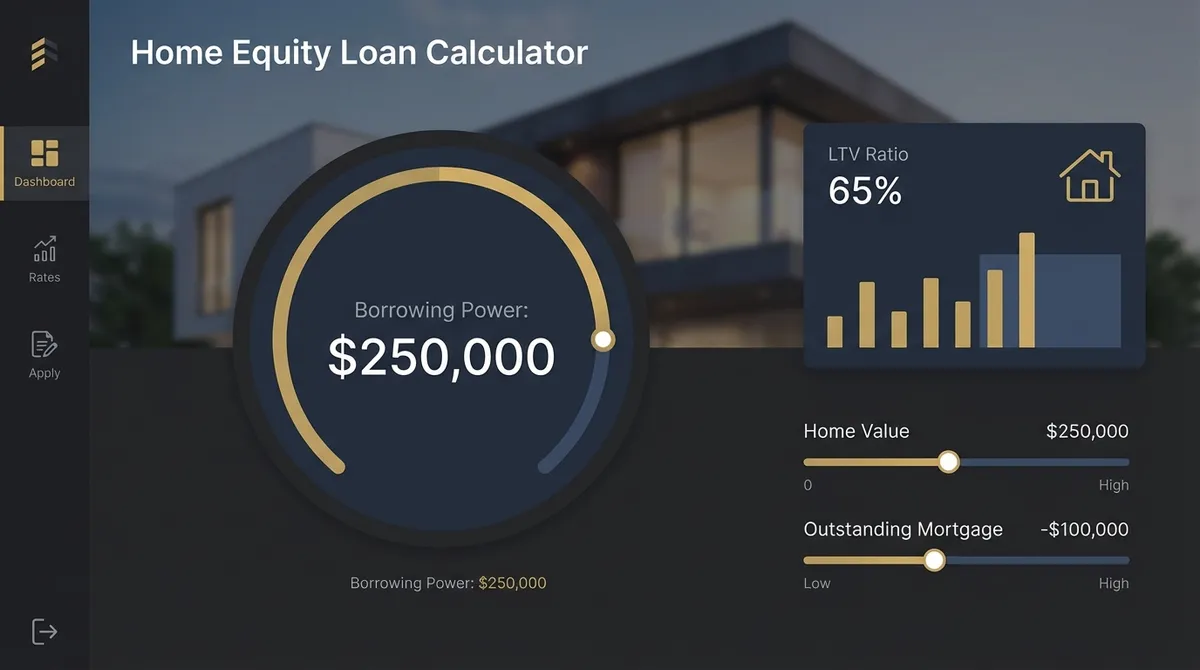
Home Equity Loan Calculator

Use our home equity loan calculator to estimate fixed monthly payments on a lump‑sum second mortgage. Enter amount, rate, and term to compare scenarios.

Free Finance Calculator
100% Private
Instant Results

Home Equity Loan Calculator

Quick Scenarios:

How to Use Home Equity Loan Calculator

1

Enter Your Data

Input your financial information, amounts, rates, and terms in the calculator fields

2

Adjust Parameters

Fine-tune options like compounding frequency, payment schedules, or additional contributions

3

Calculate Results

Click Calculate to instantly see your results with detailed breakdowns and charts

4

Analyze & Compare

Review the results, try different scenarios, and use insights for financial planning

Key Features

Fast home equity loan calculator calculations

Clear inputs and results

Mobile-friendly, privacy-first

Free to use, no signup

What Is a Home Equity Loan and Why It Matters in 2025?

A home equity loan is a powerful financial tool that allows homeowners to borrow against the equity they've built in their property. Unlike personal loans or credit cards that may carry interest rates of 18-24%, home equity loans typically offer fixed rates between 7-10% in 2025, making them one of the most cost-effective ways to access substantial funds for major expenses.

Every mortgage payment you make, combined with rising property values, increases your home equity. This calculator helps you understand exactly how much you can borrow and what your monthly payments will be. Whether you're planning a kitchen renovation, consolidating high-interest debt, financing education, or covering major medical expenses, a home equity loan provides predictable payments and substantial borrowing power.

Key Stat: The average U.S. homeowner gained $24,000 in home equity in 2024 alone, bringing total tappable equity to a record $17.6 trillion nationwide. With 48% of homeowners having at least 50% equity, millions of Americans can access five-figure loans at rates significantly lower than credit cards or personal loans.

Unlike a Home Equity Line of Credit (HELOC) with variable rates and draw periods, home equity loans provide a lump sum with a fixed interest rate and predictable monthly payments over a set term. This stability makes financial planning straightforward—you'll know exactly your payment amount and payoff date from day one.

How Home Equity Loan Calculations Work: The Fixed-Rate Formula

Our home equity loan calculator uses the standard amortization formula that banks and lenders employ. Understanding this formula helps you see how changing interest rates or loan terms dramatically affects your total cost.

M = P[r(1+r)^n]/[(1+r)^n-1]
P (Principal):

Your total loan amount—typically up to 80-85% of your home's appraised value minus remaining mortgage balance.

r (Monthly Interest Rate):

Your annual interest rate divided by 12. A 9% annual rate becomes 0.0075 monthly (9% ÷ 12 = 0.75% per month).

n (Number of Payments):

Total months in your loan term. A 15-year loan has 180 payments (15 × 12). Each payment reduces principal and pays interest.

M (Monthly Payment):

Your fixed monthly payment, combining principal reduction and interest charges, staying constant throughout the loan.

Why Interest Costs More Early in the Loan

In year 1 of a $50,000 loan at 9% APR over 15 years, roughly 40% of each monthly payment goes toward interest. By year 15, only about 5% goes to interest because your remaining balance is dramatically smaller. This is why paying extra principal early dramatically reduces total interest paid.

Real Example: $65,000 Home Equity Loan

$659.21
Monthly Payment
$53,658
Total Interest
$118,658
Total Repayment

*15-year term at 8.5% APR. Notice how total interest nearly equals the original loan amount! This is why interest rate and term length are critical factors.

Real-World Scenario: The Johnson Family&aposs Kitchen Renovation

The Johnson family bought their home 8 years ago for $350,000 with a $70,000 down payment. After years of mortgage payments and with home values in their neighborhood appreciating, their home is now worth $500,000, and they owe $220,000 on their mortgage. They've built $280,000 in equity (56% of current value).

They want to renovate their outdated kitchen and bathrooms, which will cost $75,000. Here's how their home equity loan calculation works out:

Loan Terms

  • • Amount: $75,000
  • • Rate: 8.75%
  • • Term: 12 years
  • • Payment: $847/month

Projected Return

  • • Home value increase: $60,000
  • • ROI: 80% on renovation
  • • New equity: $340,000
  • • Loan adds $47,220 in interest

Decision Analysis

  • • Payment fits budget easily
  • • Renovation adds value
  • • Fixed rate provides certainty
  • • Better than 18% credit cards

The Bottom Line

By using a home equity loan instead of credit cards (which would cost $1,875/month at 18% APR), the Johnsons save over $1,000 monthly while adding significant value to their home. Even after paying $47,220 in total interest over the loan term, they come out ahead by increasing home value and improving their quality of life.

Key takeaway: Home equity loans provide substantial funds at much lower rates than alternatives, making large projects financially feasible when monthly cash flow is available.

7 Critical Home Equity Loan Mistakes That Cost Thousands

Mistake 1: Borrowing the Maximum Amount Available

Risk: Borrowing 80-85% of your home&aposs value leaves no buffer for market fluctuations or financial emergencies. If home values drop 15% and you need to sell, you could owe more than the sale price.

Solution: Borrow only what you need for the specific purpose, keep total loan-to-value below 75%, and maintain an emergency fund separate from home equity.

Mistake 2: Ignoring the Real Cost of Interest

Risk: A $100,000 loan at 9% over 20 years costs $110,000 in interest—more than the principal! Many borrowers focus only on monthly payments, not total cost.

Solution: Use this calculator to see total interest costs. Consider shorter terms (10-15 years) if monthly payments fit your budget, reducing total interest by 40-60%.

Mistake 3: Overlooking Fees and Closing Costs

Risk: Origination fees (1-3% of loan), appraisal costs ($300-600), and closing fees can add $2,000-5,000 to your loan. Some lenders advertise low rates but charge high fees.

Solution: Get a complete Loan Estimate (LE) from multiple lenders. Compare APR, not just interest rate, as APR includes fees. Some lenders offer "no closing cost" loans with slightly higher rates—calculate which saves more over your expected loan term.

Mistake 4: Using Home Equity for Short-Term Expenses

Risk: Financing vacations, weddings, or consumer purchases with 10-20 year home equity loans means paying interest for decades on items that lose value immediately.

Solution: Use home equity only for investments that build wealth: home improvements that increase property value, education that boosts earning potential, or debt consolidation that reduces total interest. Save cash or use short-term loans (2-3 years max) for discretionary expenses.

Mistake 5: Not Shopping Around Aggressively

Risk: Accepting the first offer from your current mortgage lender could cost thousands. Interest rates vary 0.5-1.5% between lenders—that's $50-150/month difference on a $100,000 loan.

Solution: Get quotes from at least 3-4 lenders: your current bank, a credit union (often best rates for members), an online lender, and a mortgage broker. Rate differences compound dramatically over loan terms.

Mistake 6: Failing to Consider Future Income Changes

Risk: Planning retirement in 5 years, facing job uncertainty, or having variable income without factoring these changes could make your payment unaffordable when the time comes.

Solution: Choose a loan term that ends before retirement or major income changes. Build emergency reserves to cover 12 months of payments. Consider slightly higher monthly payments on a shorter term to pay off before retirement.

Mistake 7: Confusing Home Equity Loans with HELOCs

Risk: Taking a variable-rate HELOC when you need a lump sum for a one-time expense exposes you to payment increases when interest rates rise. HELOC rates increased 3-4% from 2022-2024, causing payment shock for many borrowers.

Solution: Use home equity loans for fixed, one-time expenses (renovations, debt consolidation). Reserve HELOCs for ongoing projects with variable costs or as emergency credit lines. If you choose a HELOC, stress-test your budget with rates 3-4% higher than current levels.

Expert Strategies to Optimize Your Home Equity Loan

Timing Strategies

  • Rate Environment: If the Fed signals rate cuts, consider waiting 2-3 months. If rates are rising, lock in quickly. Monitor the 10-year Treasury yield as it predicts mortgage rate trends.
  • Seasonal Factors: Apply in January-February when lenders are less busy and more competitive. Avoid summer months when volume peaks and service suffers.
  • Credit Optimization: Apply after paying down credit cards below 30% utilization, which can boost your score 20-50 points and lower your rate by 0.25-0.5%.

Loan Structure Optimization

  • Biweekly Payments: Pay half your monthly amount every two weeks. This equals 13 payments annually, cutting a 15-year loan to ~13 years and saving thousands in interest.
  • Extra Principal: Even $100 extra monthly on a $75,000 loan saves $12,000+ in interest and pays off the loan 3+ years early. Use our calculator to test scenarios.
  • Shorter Terms: Choose the shortest term with affordable payments. A 10-year loan costs 40% less total interest than a 15-year loan at the same rate.

Negotiation Tactics That Work

Get 4+ Quotes

Use competing offers as leverage. Lenders often match or beat rates when you show written quotes.

Ask for Rate Matching

Your current lender may match lower rates to keep your business, saving you refinance hassles.

Fee Negotiation

Origination fees (1-3%) are negotiable. Strong credit scores, low LTV, or existing relationships give leverage.

Who Benefits Most from Home Equity Loans?

The High-Interest Debt Consolidator

Profile: Sarah has $35,000 in credit card debt at 19% APR, paying $875/month in minimums with minimal principal reduction.

Solution: A $35,000 home equity loan at 8.5% for 10 years costs $409/month—saving $466 monthly and $38,000+ in total interest.

Result: Frees up cash flow, destroys high-interest debt, and establishes a clear 10-year payoff plan.

The Strategic Home Improver

Profile: Michael has $80,000 equity and wants to finish his basement ($40,000) and update his kitchen ($30,000).

Solution: A $70,000 home equity loan at 8.25% for 15 years costs $684/month. The renovations add $60,000+ to home value.

Result: Improves quality of life, adds equity, and costs less than moving to a larger home.

The Education Investor

Profile: Linda needs $50,000 for her daughter's last two years of college. Parent PLUS loans charge 8.05% plus 4.2% in fees.

Solution: A $50,000 home equity loan at 8.5% for 15 years costs $492/month, less than Parent PLUS payments.

Result: Lower monthly payments, potential tax deductibility, and fixed rate versus variable student loan rates.

The Emergency Prepared Parent

Profile: David and Lisa face $25,000 in medical bills after insurance. Credit cards charge 22% APR.

Solution: A $25,000 home equity loan at 9% for 7 years costs $402/month versus $712/month on credit cards.

Result: Saves $310/month and $26,000+ in interest while preserving emergency savings.

Key Takeaways: Making Your Home Equity Work for You

A home equity loan calculator is your roadmap to turning the equity you've built into financial opportunities. By understanding how loan amount, interest rate, and term interact, you can make informed decisions that save thousands in interest while achieving your financial goals.

The Math is Clear:

A $50,000 loan at 8.5% costs $492/month over 15 years, but rates, terms, and total interest vary dramatically by lender and credit profile.

Best Use Cases:

Debt consolidation, value-adding renovations, education financing, and emergency expenses where the math clearly beats alternatives.

Avoid Pitfalls:

Never borrow the maximum, ignore total interest costs, or use equity for short-term purchases. Shop aggressively and negotiate fees.

Optimization Wins:

Shorter terms, biweekly payments, and extra principal payments can save $10,000-$30,000 in interest on typical loans.

Your home's equity represents years of mortgage payments and market appreciation. Using it strategically can transform your financial situation, but requires careful calculation and disciplined decision-making. Always run multiple scenarios before committing, and remember: the cheapest monthly payment isn't always the best total deal.

About the Author

Jurica Šinko, Finance Expert and Mortgage Specialist with 15+ years in residential lending and home equity products. Jurica has helped thousands of homeowners optimize their equity through strategic borrowing decisions.

Last updated: September 12, 2025

About the Author

Jurica Šinko

Finance Expert, CPA, MBA with 15+ years in corporate finance and investment management

Connect with Jurica

Frequently Asked Questions

How much can I borrow with a home equity loan in 2025?

Most lenders allow you to borrow up to 80-85% of your home's appraised value minus your remaining mortgage balance. For example, if your home is worth $400,000 and you owe $200,000, you may qualify for up to $120,000-140,000 in a home equity loan. Credit score, debt-to-income ratio (typically max 43-50%), and payment history also affect approval amounts. Use our calculator to estimate payments on different loan amounts before applying.

What's the difference between a home equity loan and a HELOC?

A home equity loan provides a lump sum with a fixed interest rate and fixed monthly payments (like a traditional mortgage). A HELOC (Home Equity Line of Credit) works more like a credit card—you draw funds as needed during a 10-year draw period, then repay over 10-20 years, typically with a variable interest rate. Choose a home equity loan when you know the exact amount needed and want payment predictability. Choose a HELOC for ongoing projects with uncertain costs.

Is the interest on home equity loans tax deductible in 2025?

Home equity loan interest may be tax deductible if you use the funds to 'buy, build, or substantially improve' your home. For tax year 2025, you can deduct interest on up to $750,000 of qualified residence loans (including your primary mortgage and home equity loan). Interest used for debt consolidation, education, or other purposes is generally not deductible. Always consult with a tax professional regarding your specific situation and maintain documentation of how loan proceeds were used.

What interest rate can I expect on a home equity loan right now?

As of 2025, home equity loan rates typically range from 8.0% to 10.5% APR for borrowers with good to excellent credit (680+ FICO). Rates vary by lender, loan-to-value ratio (lower LTV = lower rates), loan amount, and term length. Rates are generally 1-2% higher than primary mortgage rates but 8-15% lower than credit cards. Shopping quotes from 3-4 lenders can save 0.5-1.5% on your rate—a $15,000-45,000 difference in total interest on a $100,000 loan over 15 years.

How quickly can I get a home equity loan?

The typical home equity loan process takes 2-4 weeks from application to funding. This includes: application and document submission (1-2 days), appraisal scheduling and completion (5-10 days), underwriting review (3-7 days), and closing/funding (1-3 days). Having all documents ready (tax returns, pay stubs, mortgage statements, insurance) speeds the process. Some lenders offer expedited approval in 5-7 days for well-qualified borrowers with straightforward situations.

Can I get a home equity loan with bad credit?

While challenging, it's possible with credit scores as low as 620-640 from some lenders, though interest rates will be higher (10-13% vs 8-9% for good credit). You'll also face stricter debt-to-income limits (max 43% vs 50%) and may only borrow 70-75% of home value versus 85% for strong credit. Improving your credit score even 40-60 points before applying can significantly improve your rate. Consider adding a co-signer with strong credit if needed, but remember they become equally responsible for repayment.

Should I choose a 10, 15, or 20-year term for my home equity loan?

Choose the shortest term where monthly payments comfortably fit your budget. A 10-year loan costs 35-40% less total interest than a 15-year loan at the same rate, but payments are higher. A $50,000 loan at 8.5% costs: 10 years = $620/month ($24,400 interest), 15 years = $492/month ($38,560 interest), 20 years = $433/month ($53,920 interest). The 15-year option saves $15,160 versus 20 years—enough for a car down payment. Never stretch your budget; payment stress leads to financial problems.

Share this calculator

Help others discover this tool

Related Calculators

Explore more tools in Loans & Mortgages

Auto Loan Calculator: Monthly Payment & Total Cost (2025)

Free auto loan calculator estimates monthly payments, total interest, and amortization. Compare new vs used cars, down payment impacts, and current 2025 rates.

Loans & Mortgages

Auto Loan Payoff Calculator: Calculate Early Payoff Savings & Interest Reduction

Free auto loan payoff calculator shows how much you'll save by paying off your car loan early. See interest savings, months reduced, and new payoff date. Includes prepayment penalty considerations.

Loans & Mortgages

Auto Loan Refinance Calculator: Free Car Loan Refinancing Tool & Savings Estimator

Use our auto loan refinance calculator to see how much you can save by refinancing your car loan. Compare current vs new rates, calculate monthly savings, and determine if refinancing makes financial sense.

Loans & Mortgages

Boat Loan Calculator: Free Marine Financing & Payment Calculator

Free boat loan calculator with 2025 rates. Calculate monthly payments, total interest, and understand marine financing requirements including surveys and documentation.

Loans & Mortgages

Bridge Loan Calculator: Estimate Monthly Costs and Rates

Use our bridge loan calculator to estimate interest‑only payments and total cost for short‑term financing. Model rate, fees, and term. Get instant results.

Loans & Mortgages

Cash-Out Refinance Calculator: Estimate Your Home Equity & New Payment (2025)

Free cash-out refinance calculator estimates how much equity you can access, new monthly payment, and total costs. Includes LTV limits, closing costs, and 2025 guidelines.

Loans & Mortgages