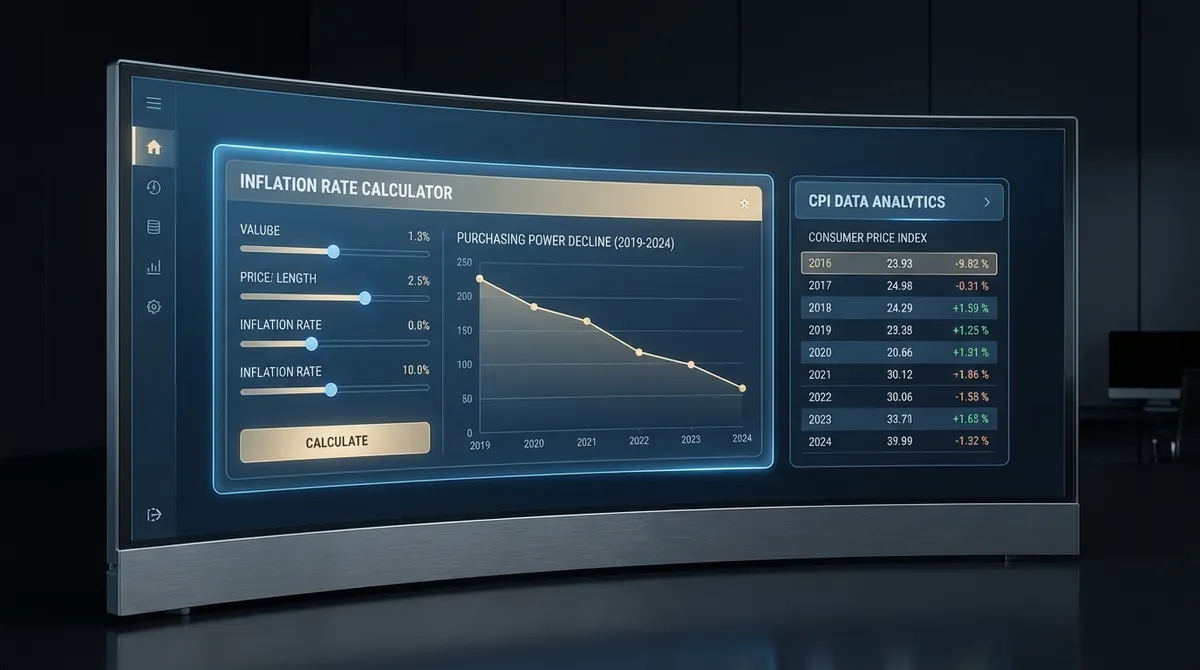
Inflation Rate Calculator — Free CPI Inflation Calculator (2025)

Calculate inflation rate between any two years using Consumer Price Index (CPI) data. Determine purchasing power loss, equivalent values, and annualized inflation rates. Free and accurate.

Free Finance Calculator
100% Private
Instant Results

Inflation Rate Calculator — Free CPI Inflation Calculator (2025)

Enter your details below to calculate

How to Use Inflation Rate Calculator

1

Enter Your Data

Input your financial information, amounts, rates, and terms in the calculator fields

2

Adjust Parameters

Fine-tune options like compounding frequency, payment schedules, or additional contributions

3

Calculate Results

Click Calculate to instantly see your results with detailed breakdowns and charts

4

Analyze & Compare

Review the results, try different scenarios, and use insights for financial planning

Key Features

Accurate CPI-based calculations

Purchasing power analysis

Interactive inflation charts

Export calculation data

Real-time results

Mobile-friendly design

Privacy-first (no data tracking)

Free professional tool

What Is Inflation Rate and Why It Matters for Your Financial Future

The inflation rate measures how much prices increase over time, directly impacting your purchasing power and financial planning. When inflation rises, each dollar you own buys fewer goods and services, silently eroding your savings and investment returns. Understanding how to calculate and interpret inflation rates isn't just academic—it's essential for protecting your wealth and making informed financial decisions.

In 2025, with inflation showing significant volatility and the Federal Reserve actively adjusting monetary policy, tracking inflation has become more critical than ever. Whether you're negotiating a salary increase, planning for retirement, or evaluating investment opportunities, the inflation rate serves as your financial compass, helping you distinguish between nominal gains and real purchasing power.

Key Insight: A 3% annual inflation rate might seem modest, but over 20 years it cuts your purchasing power nearly in half. That means $100,000 in savings today would only buy what $55,000 buys today—making inflation calculation and planning not just important, but absolutely essential for long-term financial health.

How Inflation Rate Calculations Work: The Math Behind Price Changes

Inflation rate calculation uses Consumer Price Index (CPI) data to measure price changes over time. The CPI tracks the cost of a fixed basket of goods and services, providing a standardized way to compare purchasing power across different years and economic conditions.

Inflation Rate Formula: ((Current CPI - Initial CPI) ÷ Initial CPI) × 100%
  • 1
    Current CPI: The Consumer Price Index value for the most recent period you're measuring, typically published monthly by the Bureau of Labor Statistics.
  • 2
    Initial CPI: The baseline CPI value from your starting period, serving as the reference point for measuring price changes.
  • 3
    Result Interpretation: A positive percentage indicates inflation (prices increased), while negative values represent deflation (prices decreased).

The Consumer Price Index (CPI) tracks approximately 80,000 items across 200+ categories, including food, housing, transportation, medical care, and education. This comprehensive approach ensures the inflation rate reflects real-world spending patterns rather than isolated price changes in specific sectors.

Real-World Example: The 2020-2024 Inflation Surge Explained

Let's examine one of the most significant inflation periods in recent history: the price surge from 2020 to 2024. This example demonstrates how to use historical CPI data to calculate real inflation and understand its impact on everyday purchasing power.

Initial Period (2020):
• CPI: 258.8
• Average Household Spending: $5,000/month
• Purchasing Power: Baseline reference
Target Period (2024):
• CPI: 306.2
• Equivalent Spending Required: $5,920/month
• Total Inflation: 18.3%

Using our inflation rate formula: ((306.2 - 258.8) ÷ 258.8) × 100% = 18.3% total inflation over 4 years. This translates to an average annual inflation rate of approximately 4.3%, significantly higher than the Federal Reserve's 2% target.

Impact Analysis: A family spending $5,000 monthly in 2020 needed $920 more per month by 2024 to maintain the same standard of living. Over a year, that's an additional $11,040 in expenses—money that must come from increased income, reduced savings, or lifestyle adjustments.

Step-by-Step: How to Use This Inflation Rate Calculator Effectively

1

Gather Your Data

Collect CPI values for your starting and ending periods from reliable sources like the Bureau of Labor Statistics or your national statistics office.

2

Enter Initial Values

Input your starting CPI, year, and the amount of money you want to analyze for purchasing power changes.

3

Add Target Period

Enter your ending CPI and year. The calculator will automatically compute the inflation rate and purchasing power impact.

4

Analyze Results

Review the inflation rate, purchasing power loss, and equivalent value to understand the real impact on your money.

Common Mistakes When Calculating Inflation Rates

Using Nominal Instead of Real Values

Never compare dollar amounts across years without adjusting for inflation. $50,000 in 1990 had significantly more purchasing power than $50,000 today.

Ignoring Compounding Effects

Inflation compounds annually. A 3% inflation rate for 10 years doesn't equal 30% total inflation—it's actually 34.4% due to compounding.

Using Seasonal Instead of Annual CPI

Always use annual average CPI values, not monthly snapshots, to avoid seasonal fluctuations skewing your results.

Related Financial Concepts

Real vs. Nominal Returns

Nominal return is what you see on paper; real return adjusts for inflation. If your investment earns 7% but inflation is 3%, your real return is only 4%.

Purchasing Power

The real value of money measured by how many goods and services it can buy. Inflation directly reduces purchasing power, making it crucial to factor into financial planning.

Cost of Living Adjustments (COLA)

Many pensions and Social Security benefits include COLA provisions that automatically increase payments based on inflation rates, protecting recipients from purchasing power erosion.

Inflation-Protected Securities

Treasury Inflation-Protected Securities (TIPS) and I-Bonds automatically adjust their principal value based on CPI changes, providing guaranteed protection against inflation.

When Should You Calculate Inflation Rates?

Salary Negotiations

Use inflation data to justify cost-of-living adjustments and ensure your raise maintains purchasing power.

Retirement Planning

Calculate how much your retirement savings need to grow to maintain lifestyle throughout retirement.

Investment Analysis

Determine real returns after inflation to evaluate whether investments are truly growing your wealth.

Historical Inflation Rates: Lessons from the Past

Historical inflation data provides valuable context for understanding current economic conditions. The United States has experienced dramatically different inflation environments over the past century, each with distinct causes and consequences.

High Inflation Periods:
• 1970s-1980s: Peaked at 13.5% (1980)
• Post-WWII: 18.1% (1946)
• Current Era: 9.1% (2022)
Driven by oil shocks, war spending, supply chain issues
Low Inflation Periods:
• Great Depression: -10.3% deflation (1932)
• Post-2008: Averaged 1.5% (2009-2020)
• 1990s: Averaged 2.9%
Economic downturns, increased productivity, globalization

These historical examples demonstrate that inflation is neither constant nor predictable. Periods of high inflation often follow major economic disruptions, while extended low-inflation periods typically coincide with stable economic growth and technological advancement.

How to Protect Your Wealth from Inflation

Invest in Equities

Stocks historically outpace inflation over long periods. Companies can raise prices during inflationary periods, protecting their earnings and your investment value.

Consider Real Estate

Property values and rental income typically rise with inflation, making real estate a natural hedge against purchasing power erosion.

Use Inflation-Protected Securities

TIPS and I-Bonds automatically adjust for inflation, providing guaranteed protection for conservative portions of your portfolio.

Diversify Internationally

International investments provide exposure to different economic conditions and currencies, reducing dependence on any single country's inflation rate.

MH

Written by Marko Hrvojević

Finance Expert, CPA with 12+ years in financial analysis and tax planning

Last updated: November 16, 2025

About the Author

Marko Hrvojević

Finance Expert, CPA with 12+ years in financial analysis and tax planning

Connect with Marko

Frequently Asked Questions

What is the Consumer Price Index (CPI) and how is it used to calculate inflation?

The Consumer Price Index (CPI) measures the average change in prices paid by urban consumers for a market basket of consumer goods and services. The Bureau of Labor Statistics collects price data monthly from 75 urban areas and approximately 23,000 retail and service establishments. To calculate inflation rate, we compare CPI values from two time periods: ((Current CPI - Initial CPI) ÷ Initial CPI) × 100%. This percentage shows how much prices have increased, directly measuring the inflation rate and its impact on purchasing power.

What does 'purchasing power' mean in the context of inflation?

Purchasing power represents the real value of money—how many goods and services your dollars can actually buy. When inflation rises at 3% annually, your money loses 3% of its purchasing power each year. Over 20 years, this compounds dramatically: $100,000 at 3% annual inflation will only buy what $55,000 buys today. Our calculator shows you exactly how much purchasing power your money has lost between any two years, helping you understand the real impact of inflation on your savings and income.

How do I find accurate CPI data for my calculation?

For U.S. calculations, visit the Bureau of Labor Statistics (BLS) website (bls.gov/cpi) for official CPI data. Use the 'All Urban Consumers (CPI-U)' series for broad inflation measurement. For annual calculations, always use the annual average CPI rather than monthly data to avoid seasonal fluctuations. For other countries, use your national statistics office: Eurostat for EU countries, ONS for the UK, Statistics Canada, etc. Our calculator includes example values, but for precise calculations, always source official CPI data from these authoritative sources.

What is the difference between total inflation rate and annualized inflation rate?

Total inflation rate shows the percentage price increase over your entire time period. Annualized inflation rate shows what the equivalent yearly inflation rate would be if inflation remained constant each year. For example, 18% total inflation over 4 years equals approximately 4.3% annualized. The formula for annualized rate is: ((Target CPI ÷ Initial CPI)^(1 ÷ Number of Years) - 1) × 100%. This helps compare inflation across different time periods and understand the compounding effect of year-over-year price increases.

Why is calculating inflation important for salary negotiations?

Understanding inflation is crucial for salary negotiations because your raise needs to exceed inflation to represent a real increase in purchasing power. If inflation is 4% and you receive a 3% raise, you've actually experienced a 1% pay cut in real terms. Use our calculator to determine exactly how much inflation has eroded your purchasing power, then negotiate for at least inflation plus additional compensation based on your performance. Many employers expect informed discussions about cost-of-living adjustments backed by CPI data.

How does inflation affect my retirement savings?

Inflation significantly impacts retirement planning because your savings need to last 20-30 years while maintaining purchasing power. A $1 million retirement portfolio today will only be worth about $550,000 in today's dollars after 20 years of 3% inflation. When calculating retirement needs, always add 2-3% annually for inflation to your expense projections. Use our calculator to see how inflation will affect your specific retirement timeline, then invest accordingly in assets that historically outpace inflation, such as stocks and real estate.

What is deflation and how is it different from inflation?

Deflation is the opposite of inflation—it occurs when prices decrease over time, increasing purchasing power. While this sounds beneficial, deflation can signal economic problems like reduced consumer spending and business investment. Our calculator will show negative percentages for deflationary periods. Historical examples include the Great Depression (-10.3% in 1932) and the 2008 financial crisis. Most central banks aim for 2% inflation (not zero) to avoid deflation risks while maintaining price stability. Use the calculator to analyze any period and see whether inflation or deflation occurred.

How accurate are inflation rate calculations using CPI data?

CPI-based inflation calculations are highly accurate for measuring broad price changes in the economy. However, your personal inflation rate may differ from the national average based on your spending patterns. CPI weights categories like housing (32%), transportation (18%), and food (14%) based on average consumer spending. If you spend more on healthcare and less on transportation, your personal inflation rate will differ. Our calculator provides exact CPI-based inflation rates, which serve as the standard benchmark for financial planning, contracts, and government policy decisions.

Share this calculator

Help others discover this tool

Related Calculators

Explore more tools in Personal Finance Planning

50/30/20 Budget Calculator: Free Budget Planning Tool

Use our free 50/30/20 budget calculator to divide your income into needs, wants, and savings. Visualize your budget with interactive charts and customize percentages for your situation.

Personal Finance Planning

Budget Calculator: Free Personal Budget Planner & Monthly Budget Calculator

Free budget calculator with 50/30/20 rule, zero-based budgeting, and real-time tracking. Create your monthly budget plan, track expenses, and achieve your financial goals in 2025.

Personal Finance Planning

COLA Calculator | Cost of Living Adjustment Estimator

Estimate Cost‑of‑Living Adjustments (COLA) to keep salary or benefits aligned with inflation. See compounding increases, totals, and a clear yearly breakdown.

Personal Finance Planning

Cost of Living Calculator | Compare Living Expenses by City

Thinking of moving? Use our cost of living calculator to compare expenses (housing, food, taxes) between cities and see how far your salary will go. Plan smart.

Personal Finance Planning

Emergency Fund Calculator | How Much Emergency Savings?

Determine your ideal safety net with our emergency fund calculator. Calculate how much you should save based on your monthly expenses (e.g., 3-6 months).

Personal Finance Planning

Expense Calculator: Free Monthly Budget & Expense Tracking Tool

Free expense calculator to track monthly expenses, analyze spending patterns, and optimize your budget. Includes automated categorization, budget health analysis, and personalized recommendations.

Personal Finance Planning