Complete Guide to Invoice Financing: Costs, Benefits, and Smart Alternatives (2025)
Invoice financing—also called accounts receivable financing or factoring—provides immediate cash by converting unpaid invoices into working capital. For businesses waiting 30, 60, or even 90 days for customer payments, this financing method bridges the critical cash flow gap that can make or break operations.
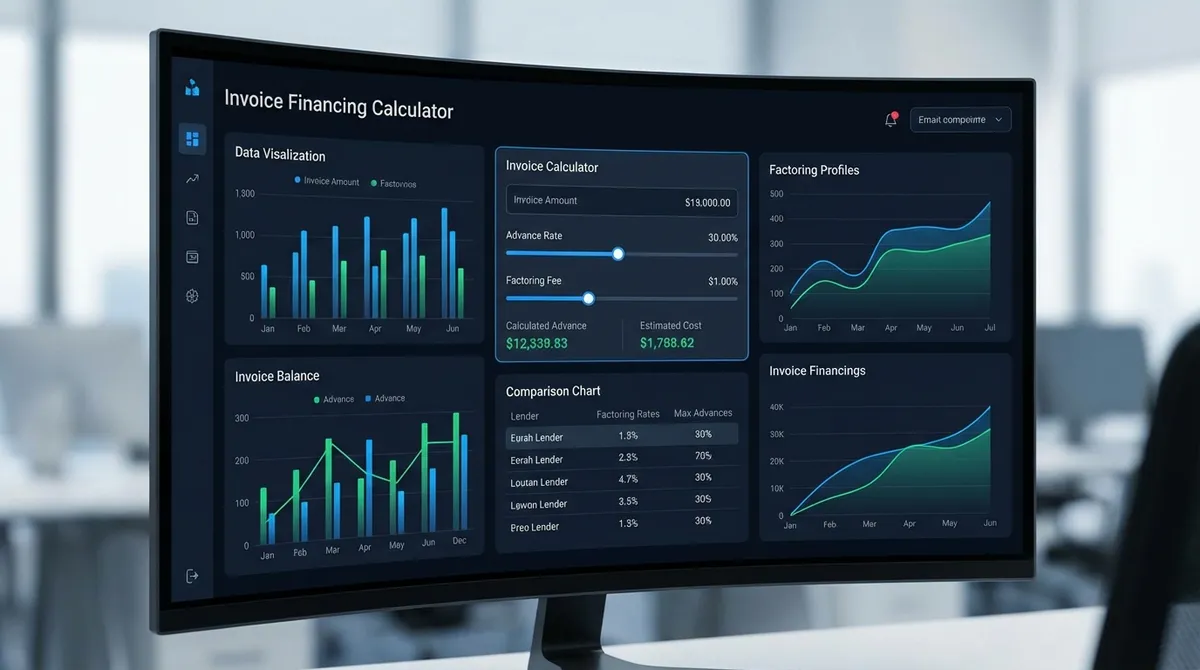
In 2025, with rising interest rates and tighter lending standards from traditional banks, invoice financing has become a lifeline for small and mid-sized businesses. The market has grown to over $3 trillion globally, with advance rates typically ranging from 70% to 90% of invoice value and discount fees of 1.5% to 4% per month.
The Invoice Financing Calculator on this page lets you plug in your own invoices, advance rates, and discount fees so you can see the true cost of factoring before signing an agreement.
Key Statistic: According to the Commercial Finance Association, businesses using invoice financing report 23% faster growth and 31% fewer cash flow crises compared to those relying solely on traditional payment terms.
What Is Invoice Financing and How Does It Work?
Invoice financing is a funding method where businesses sell their unpaid invoices to a factoring company at a discount in exchange for immediate cash. Unlike traditional loans that create debt, invoice financing converts an existing asset (accounts receivable) into liquid capital without adding liabilities to your balance sheet.
The process typically works in three stages: First, you submit an invoice to a factoring company. Second, you receive an advance payment of 70-90% of the invoice value within 24-48 hours. Third, when your customer pays the invoice, you receive the remaining balance minus the factoring fees.
Key Invoice Financing Components:
- Advance Rate: Percentage of invoice value you receive upfront (typically 70-90%)
- Discount Fee: The cost of financing, usually 1.5-4% of invoice value per month
- Reserve Account: Portion held back until customer payment is received
- Factoring Period: Number of days until invoice is paid (30, 60, 90 days)
- Additional Fees: Setup, processing, wire transfer, and monthly service fees
- Recourse vs. Non-Recourse: Whether you're liable if customer does not pay
Current Invoice Financing Rates and Costs in 2025
As of November 2025, invoice financing rates reflect the broader credit environment. With the Federal Reserve maintaining higher rates to combat inflation, factoring costs have increased but remain competitive for businesses that need immediate capital.
Typical Discount Rates by Industry (Monthly)
- Staffing & Professional Services1.5% - 2.5%
- Manufacturing & Distribution2.0% - 3.5%
- Construction3.0% - 5.0%
- Transportation & Trucking2.5% - 3.5%
Additional Fees to Expect
- Setup Fee: $500 - $2,000 one-time (varies by factor)
- Processing Fee: $25 - $50 per invoice
- Wire Transfer: $15 - $35 per transaction
- Monthly Minimum: $500 - $1,000 if volume is below threshold
- Credit Check: $10 - $25 per customer
- Early Termination: 1-3% of remaining contract if canceled
Cost Comparison Example: A $50,000 invoice with 85% advance at 2.5% monthly rate for 30 days:
- Immediate cash advance: $42,500
- Discount fee (2.5%): $1,250
- Setup fee: $500
- Total cost: $1,750 (3.5% of invoice)
- Final payment when invoice clears: $46,250
Types of Invoice Financing and Best Use Cases
Not all invoice financing is created equal. Understanding the different structures helps you choose the right solution for your specific cash flow needs and risk tolerance.
1. Invoice Factoring (Most Common)
Best for: Businesses with reliable customers who pay slowly (30-90 days)
You sell invoices to a factoring company, which handles collections and customer communication. Advances 70-90% upfront, with remaining balance (minus fees) paid when customer pays. Rates: 1.5-4% monthly.
2. Spot Factoring (Selective)
Best for: Businesses needing occasional cash flow help for specific large invoices
Factor individual invoices as needed without long-term contracts. More flexible but slightly higher rates (2-5% monthly). No monthly minimums. Good for seasonal businesses or project-based work.
3. Invoice Discounting (Confidential)
Best for: Established businesses wanting to maintain customer relationships
Similar to factoring but you handle collections. Customers pay you directly, preserving relationship confidentiality. Requires stronger financials and established processes. Rates: 1-3% monthly.
4. Reverse Factoring (Supply Chain)
Best for: Large companies managing supplier cash flow
Your large customers arrange financing for your invoices. They get extended payment terms; you get early payment at lower rates (0.5-2% monthly). Win-win for both parties.
Pros and Cons of Invoice Financing
✓ Advantages
- •Immediate cash flow within 24-48 hours
- •No debt added to balance sheet
- •Grows with your sales (no fixed limit)
- •Easier approval than bank loans
- •Factors handle collections (saves time)
- •Outsourcing credit checks reduces risk
✗ Disadvantages
- •Higher cost than traditional loans (20-60% APR equivalent)
- •Customers know you're using factoring
- •Loss of control over collections process
- •Only works for B2B with creditworthy customers
- •Minimum volume requirements may apply
- •Potential customer relationship strain
How to Qualify for Invoice Financing
Qualifying for invoice financing is typically easier than traditional bank loans because approval is based on your customers’ creditworthiness, not on your personal credit profile. However, factors still evaluate several criteria.
Basic Qualification Requirements:
- Business Type: B2B or B2G (business-to-government) with invoiced sales
- Minimum Revenue: Typically $50,000 - $100,000 annually
- Creditworthy Customers: Established businesses with good payment history
- Invoice Quality: Clean invoices without disputes or offsets
- Time in Business: Most factors require 3-12 months operating history
- No Tax Liens: Clean tax records (or payment plan in place)
What Factors Actually Evaluate:
- Your customers’ credit scores and payment history
- Average invoice size and total monthly volume
- Industry risk and typical payment cycles
- Concentration (reliance on few vs. many customers)
- Your invoicing and collection processes
Documents You'll Need:
- Accounts receivable aging report (30/60/90 day buckets)
- Sample invoices and customer list
- Business bank statements (3-6 months)
- Articles of incorporation/LLC formation documents
- Tax ID number and business licenses
- Personal guarantee (for most small businesses)
When to Use Invoice Financing vs. Alternatives
Invoice financing serves specific business needs but is not always the best option. Understanding when it makes sense—and when alternatives are better—can save you thousands in financing costs.
✓ Good Use Cases for Invoice Financing
- Seasonal businesses with cash flow gaps
- Fast-growing companies needing capital for expansion
- Businesses with reliable but slow-paying customers
- Companies winning large contracts requiring upfront costs
- Businesses needing immediate cash for payroll or supplies
- Companies unable to qualify for traditional bank loans
✗ When to Consider Alternatives
Consider a line of credit if: You have good credit, 2+ years in business, and need ongoing access to capital. Rates are typically 8-15% APR vs. 20-60% for factoring.
Consider a term loan if: You need capital for equipment, real estate, or long-term investments. Lower rates and predictable payments over 2-10 years.
Consider merchant cash advance if: You're B2C with strong daily credit card sales. Fast funding but very expensive—use only as last resort.
Cost Comparison Example
| Financing Type | Amount | Rate/Cost | Time to Fund |
|---|---|---|---|
| Invoice Factoring | $50,000 | 3.5% ($1,750) | 1-2 days |
| Business Line of Credit | $50,000 | 12% APR ($600) | 1-4 weeks |
| Merchant Cash Advance | $50,000 | 40% factor ($20,000) | 1-2 days |
Common Invoice Financing Mistakes to Avoid
Even experienced business owners make costly errors with invoice financing. Avoid these common pitfalls to save thousands and maintain healthy customer relationships.
Mistake #1: Not Understanding True Cost
Many businesses focus on the discount rate alone but miss additional fees that can add 0.5-1% more. Always request a complete fee schedule including wire fees, monthly minimums, and early termination penalties.
Solution: Calculate annualized cost using our calculator. If effective APR exceeds 40%, explore alternatives.
Mistake #2: Factoring All Invoices
Factoring every invoice unnecessarily increases costs. Only factor invoices when you have immediate cash needs or the cost is justified by business opportunities.
Solution: Maintain a mix—factor invoices for large orders or slow periods, keep regular customers on normal terms when possible.
Mistake #3: Not Checking Factor Reputation
Some factoring companies use aggressive collection tactics that damage customer relationships. Others have hidden fees or fail to fund on time.
Solution: Check Better Business Bureau ratings, read reviews, and ask for references from businesses in your industry.
Mistake #4: Ignoring Contract Terms
Many factors require monthly minimums, long-term contracts (6-24 months), or personal guarantees. Exiting early can cost thousands in penalties.
Solution: Negotiate shorter terms for first contract, understand minimums, and clarify termination clauses before signing.
Mistake #5: Poor Record-Keeping
Invoicing errors, missing documentation, or unclear terms can lead to delayed funding or disputes. Factors verify every invoice carefully.
Solution: Use professional invoicing software, maintain clear payment terms, and submit complete documentation with each invoice.
Real-World Example: How Invoice Financing Saved a Growing Agency
TechSolve Consulting, a 15-person IT services firm in Austin, Texas, landed a major contract with a Fortune 500 client in March 2025. The project would generate $180,000 over six months but required hiring 3 additional developers immediately. This is where calculating ROI becomes vital.
The Challenge
TechSolve's client had 60-day payment terms. The first invoice for $30,000 would not be paid until May, but payroll for the new developers started immediately at $25,000/month. The company had only $35,000 in cash reserves.
The Invoice Financing Solution
- Invoice amount: $30,000 (first milestone)
- Advance rate: 85% ($25,500 immediate cash)
- Discount rate: 2.5% monthly for 60 days = $1,500
- Additional fees: $350 (processing + wire)
- Total cost: $1,850 (6.2% of invoice)
- Final payment: $2,650 (reserve minus fees)
The Outcome
TechSolve received $25,500 within 24 hours of submitting the invoice. This covered the first month of developer salaries while preserving their cash reserves. When the client paid 58 days later, they received the remaining $2,650. The agency successfully completed the project, generated $180,000 in revenue, and established a relationship that led to three more contracts totaling $420,000 in 2025.
Key Takeaway: The $1,850 cost was more than justified by the $180,000 contract revenue. Without invoice financing, TechSolve would have had to decline the opportunity or take expensive personal loans.