What Is a Loan Payoff Calculator and Why It Matters for Your Financial Freedom
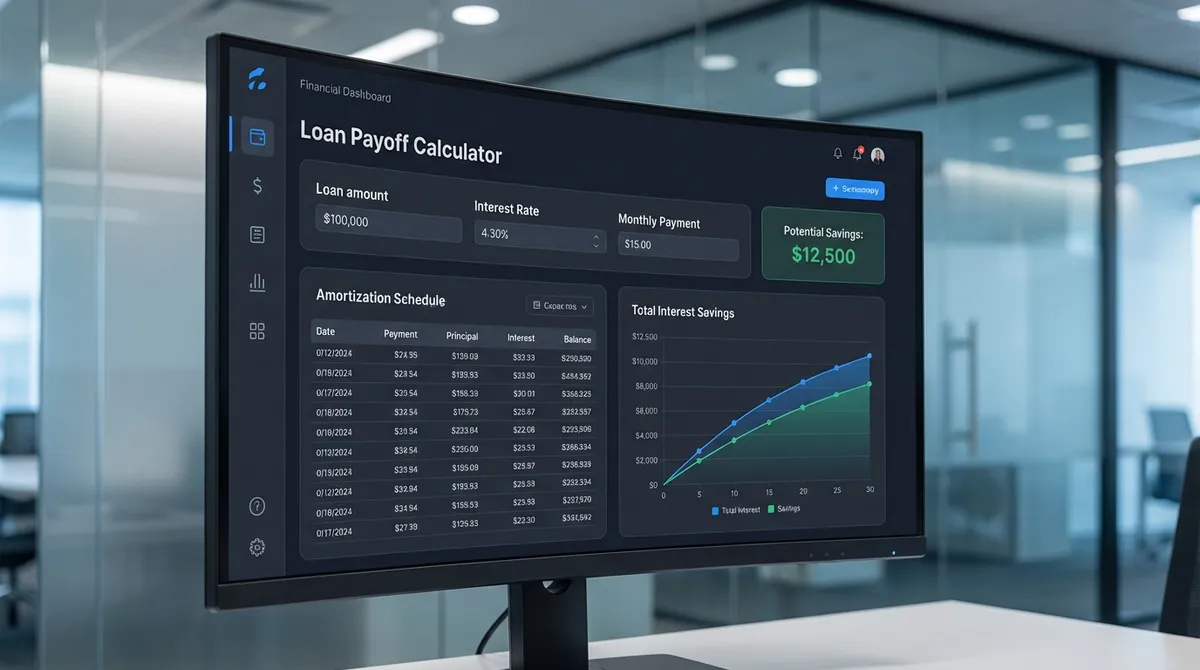
A loan payoff calculator is an essential financial tool that helps you understand exactly how long it will take to eliminate your debt and how much interest you'll pay over the life of your loan. Unlike basic payment calculators, a sophisticated loan payoff calculator lets you test different strategies—extra monthly payments, bi-weekly payments, or lump-sum contributions—to see which approach saves you the most money and gets you debt-free fastest.
In today's economic climate, where the average American household carries over $101,000 in debt (including mortgages, auto loans, and credit cards), understanding your payoff timeline isn't just helpful—it's critical for financial success. A loan payoff calculator transforms vague "someday" debt freedom into a concrete, achievable plan with specific dates and dollar amounts.
Key Statistic: Making just one extra mortgage payment per year on a $300,000, 30-year loan at 6.5% interest saves you $77,000 in interest and pays off your loan 5.5 years early. That's the power of understanding and optimizing your payoff strategy.
How Loan Payoff Calculations Work: The Math Behind Debt Freedom
Loan payoff calculations start with the fundamental time value of money formulas, but add critical variables that reflect real-world loan behavior and payoff strategies. Understanding these mechanics helps you make smarter financial decisions and spot opportunities to save thousands of dollars.
Core Components of Loan Payoff Calculations
Every loan payoff calculation involves five essential variables that determine your path to debt freedom:
- •Principal Balance (P): The current amount you owe on your loan. For accurate results, use your current balance—not the original loan amount. This represents the baseline debt you're working to eliminate.
- •Monthly Payment (M): Your required monthly payment, which includes both principal and interest. Higher payments (including extra amounts) directly reduce your payoff time and total interest.
- •Annual Interest Rate (r): Your loan's APR expressed as a decimal. Even small rate differences dramatically impact total interest—0.5% on a 30-year mortgage can mean $30,000 more or less in interest paid.
- •Remaining Term (n): How many months remain in your original loan agreement. This determines the baseline for comparison against accelerated payoff strategies.
- •Extra Payment Strategy: The additional amount and frequency you choose to pay beyond the minimum—this is where the real magic happens for debt elimination.
Extra Payments: The Compound Interest Killer
When you make an extra payment, every dollar goes directly toward reducing your principal balance. This creates a powerful snowball effect: lower principal means less interest accrues, which means more of your next regular payment goes toward principal, which further reduces interest... the cycle accelerates your payoff dramatically.
💡 Critical Insight:
Every extra dollar you pay in month 1 saves you compound interest on that dollar for the remaining life of your loan. On a 30-year mortgage at 6.5%, $100 extra in month 1 saves you $494 in interest over the loan's life—a 5-to-1 return on your money.
Real-World Example: The Martinez Family's Mortgage Freedom Journey
Carlos and Maria Martinez bought their first home in 2020 with a $320,000, 30-year fixed mortgage at 6.75% interest. Their monthly payment was $2,075 ($1,800 principal + interest, plus $275 for property taxes and insurance). After 3 years, their remaining balance was $303,000, and they faced 27 more years of payments totaling $672,300 including remaining interest.
The Strategy They Chose
After using our loan payoff calculator, they discovered that switching to bi-weekly half-payments ($1,037.50 every two weeks) instead of monthly full payments would have them make 26 half-payments annually—the equivalent of 13 monthly payments instead of 12. This simple change required minimal budget adjustment since they timed payments with Carlos's bi-weekly paychecks.
• Current Balance: $303,000
• Interest Rate: 6.75%
• Remaining Term: 324 months (27 years)
• Monthly Payment: $2,075
• Total Remaining Interest: $369,300
• Bi-weekly Payment: $1,037.50
• Payoff Time: 297 months (24.75 years)
• Time Saved: 27 months (2.25 years)
• Interest Saved: $36,450
• Total Savings: $36,450 + 27 months of living payment-free
The Life-Changing Impact: By paying off their mortgage 27 months early, the Martinez family not only saved $36,450 in interest but also freed up $2,075 monthly for 27 months—that's $56,025 in additional cash flow they can redirect toward retirement savings, their children's education, or other financial goals. The total financial impact exceeds $92,000.
What Made It Work
Three factors made their strategy successful: First, they automated the bi-weekly payments through their bank, removing willpower from the equation. Second, they didn't wait until they had "extra money"—they started immediately, which maximized the compound effect. Third, they used the calculator's amortization schedule to track progress, which kept them motivated during the first two years when only small differences were visible.
💡 Expert Tips from Jurica Šinko to Pay Off Your Loans Faster
1. Start With Your Highest-Interest Loan First (Debt Avalanche): Always tackle the loan with the highest interest rate, regardless of balance. A 15% credit card costs you $150 annually per $1,000 borrowed, while a 4% mortgage costs only $40. Every dollar you pay toward the 15% loan gives you an instant 15% return on your money—guaranteed and tax-free.
2. The Bi-weekly Half-Payment Strategy: Switching from monthly to bi-weekly payments means you make 26 half-payments annually instead of 12 full payments—the equivalent of one extra monthly payment per year. On a typical mortgage, this shaves 4-6 years off your loan and saves tens of thousands in interest without significantly impacting your monthly budget.
3. Throw Windfalls at Your Principal: Tax refunds, bonuses, inheritances, and other unexpected money should go directly to loan principal. A $3,000 tax refund applied to a 6.5% mortgage in year 1 saves $13,700 in interest over the loan's life. That's a 457% return on your money—better than any investment you'll find.
4. Round Up Your Payments: If your payment is $1,847, pay $1,900 or even $2,000. That extra $53-$153 monthly doesn't hurt your budget much, but compounds dramatically over time. Rounding up to the nearest $100 on a typical mortgage pays it off 2-3 years early and saves $15,000-$25,000 in interest.
5. Eliminate PMI and Redirect the Savings: Once you've paid your mortgage down to 78-80% loan-to-value, Private Mortgage Insurance automatically cancels. That $150-$400 monthly PMI payment can then become extra principal payments—accelerating your payoff while making the same total payment you've already budgeted.
6. Automate Everything: Set up automatic extra principal payments through your bank on the same day your paycheck deposits. This eliminates the temptation to spend the money and makes paying down debt effortless. Studies show automated debt payers eliminate loans 18 months faster than manual payers.
⚠️ Common Mistakes That Sabotage Your Loan Payoff Efforts
Mistake 1: Waiting Until You Have "Extra Money"
The biggest error is postponing extra payments until you feel rich. The early years of a loan are when extra payments have the most impact because they prevent the most compound interest. A $200 extra payment in month 1 saves more interest than the same $200 in month 100. Start now with even $25 extra per month.
Mistake 2: Splitting Extra Payments Across Multiple Loans
If you have $5,000 in extra money and three loans, putting $1,667 toward each is mathematically inefficient. The optimal strategy is putting the full $5,000 toward the highest-interest loan while making minimums on others. This saves more interest than splitting it up.
Mistake 3: Not Checking for Prepayment Penalties First
Some auto loans and personal loans charge penalties for paying off early. Always read your loan agreement or call your lender to check. While paying off early often still makes sense even with a penalty, you need to know this cost upfront. Federal law prohibits prepayment penalties on most mortgages, but other loan types may have them.
Mistake 4: Paying Extra on Low-Interest Loans While Carrying High-Interest Debt
Paying extra on your 4% mortgage while carrying 18% credit card debt is like trying to fill a pool while the water's draining out the bottom. The math is clear: $1,000 toward an 18% credit card saves $180 annually, while the same $1,000 toward a 4% mortgage saves only $40. Always eliminate high-interest debt first.
Mistake 5: Not Notifying Your Lender to Apply Extra Payments to Principal
Some lenders automatically apply extra payments to future monthly payments rather than principal reduction. Always specify "apply to principal" when making extra payments online, and write it on check memos. Then verify your principal balance actually decreased by that amount on your next statement.
Frequently Asked Questions About Loan Payoff Strategies
How much money does making one extra mortgage payment per year actually save?
On a $300,000, 30-year mortgage at 6.5% interest, one extra monthly payment per year (around $1,896) saves you approximately $77,000 in total interest and pays off your loan 5.5 years early. The exact savings depend on your loan amount, interest rate, and when you start the strategy. Early implementation maximizes savings because it reduces compound interest over the loan's lifetime.
Is it better to make small extra payments monthly or save up for a large lump sum?
Mathematically, paying extra monthly is better than saving for a lump sum because it reduces your principal balance sooner, preventing interest from compounding on that amount. For example, paying $200 extra monthly on a 6% loan saves more interest than paying $2,400 once a year, even though the total extra is the same. The only exception is if you need the money for emergencies—then save it first, pay later.
Should I pay off my mortgage early or invest the money instead?
This depends on your mortgage rate versus expected investment returns. If your mortgage rate is 4% and you expect 7-8% annual returns from index funds, investing typically wins mathematically. However, paying off your mortgage provides a guaranteed return and psychological benefits. A balanced approach: max out retirement accounts first (especially with employer matches), maintain an emergency fund, then put extra money toward mortgage principal if you value being debt-free. There's no single right answer—it's personal.
What happens if I pay extra on a car loan or personal loan?
Most auto loans amortize like mortgages, so extra payments save interest and shorten your loan term. However, some auto loans use "precomputed interest" where you owe the full interest amount regardless of early payoff. Personal loan terms vary widely. Always check your loan agreement or call your lender to confirm: (1) if extra payments reduce principal, (2) if prepayment penalties apply, and (3) how to ensure payments are applied correctly to principal.
Can I negotiate a lower interest rate if I make extra payments?
Generally, no. Your interest rate is fixed in your loan agreement. Extra payments reduce your balance and total interest paid, but don't lower your rate. However, significant extra payments that substantially reduce your loan-to-value ratio might help you qualify for refinancing at a better rate. For example, if extra payments get your mortgage below 80% LTV, you can refinance and eliminate PMI, effectively reducing your total borrowing cost.
How do I know if my lender is applying extra payments correctly to principal?
After making an extra payment, monitor your next two statements closely. Your principal balance should decrease by the extra payment amount plus the regular principal portion of your normal payment. For example, if your regular payment is $2,000 ($1,200 principal + $800 interest) and you pay an extra $500, your balance should drop by $1,700 ($1,200 + $500). If it only drops by $1,200, the lender applied your extra payment to future payments instead of principal—call them immediately to correct it.
What's the fastest way to become completely debt-free?
Use the debt avalanche method: list all debts by interest rate (highest to lowest), make minimums on everything, and throw every extra dollar at the highest-rate debt until it's gone. Then roll that payment amount into the next-highest-rate debt, creating a "snowball effect." For most people, this means: credit cards (18-25%) → personal loans (10-15%) → auto loans (5-8%) → student loans (4-7%) → mortgage (3-6%). This approach minimizes total interest paid and gets you debt-free fastest. Learn more about these methods on Ramsey Solutions.
Should I use savings or emergency fund money to pay down loans faster?
Never use emergency fund money for extra loan payments. Keep 3-6 months of expenses liquid for true emergencies. However, if you have excess savings beyond your emergency fund earning less than your loan rates, it makes mathematical sense to use that money for debt payoff. For example, if you have $20,000 in a savings account earning 1% and a car loan at 7%, paying down the loan gives you a 6% net benefit (7% saved minus 1% foregone). Just ensure you maintain adequate liquidity for unexpected expenses.
Your Action Plan: Steps to Take Today
- Gather your current loan statements for all debts (mortgage, auto, personal, credit cards)
- Input your highest-interest loan details into the calculator above
- Test different extra payment amounts to see the interest savings
- Choose one payoff strategy you're confident you can stick with
- Set up automatic extra payments through your bank or lender
- Mark your calendar to check your loan balance in 6 months to see progress
- Review and adjust your strategy quarterly as your financial situation changes
Last updated: November 16, 2025 | Article written by Jurica Šinko, your expert guide to strategic debt elimination and financial freedom.