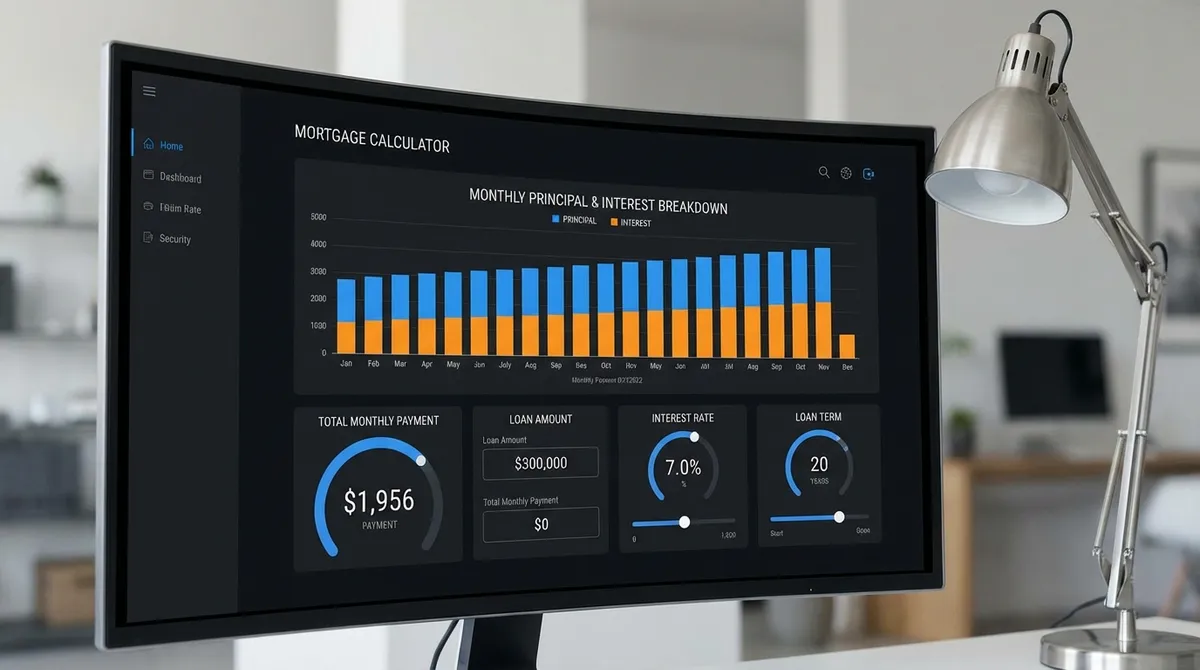
Mortgage Payment Calculator — Calculate PITI Payments (2025)

Free mortgage payment calculator estimates your complete monthly PITI payment including taxes, insurance, and PMI. Accurate 2025 home loan calculator.

Free Finance Calculator
100% Private
Instant Results

Mortgage Payment Calculator — Calculate PITI Payments (2025)

Calculate your complete monthly mortgage payment including taxes, insurance, and PMI

How to Use This Mortgage Calculator

1

Enter Home Price & Down Payment

Input your home purchase price and down payment amount or percentage. The calculator automatically adjusts the other value for accuracy.

2

Set Interest Rate & Loan Term

Enter the current mortgage interest rate (check 2025 rates: 6.25%-6.75% for 30-year fixed) and select your loan term (15, 20, 30, or 40 years).

3

Add Property Tax & Insurance

Input annual property taxes (check your county rate) and homeowners insurance. These vary significantly by location—Texas averages 1.6% while Hawaii is 0.27%.

4

Review Complete PITI Payment

Instantly see your total monthly payment including PMI if applicable. Use the results to budget accurately and compare different home price scenarios.

Key Features

Calculates complete PITI payments (Principal, Interest, Taxes, Insurance)

Includes PMI calculation for down payments under 20%

Real-time results update as you adjust parameters

Export detailed payment breakdown and amortization schedule

Mobile-optimized with 48px touch targets and responsive design

100% privacy-focused—no data stored or tracked

Compares different loan terms (15, 20, 30, 40 years)

Shows loan-to-value (LTV) ratio and PMI requirements

What Is a Mortgage Payment Calculator?

A mortgage payment calculator is a powerful financial tool that estimates your monthly home loan payment by calculating principal, interest, taxes, and insurance—commonly known as PITI. This essential calculator helps homebuyers and homeowners understand the true cost of homeownership beyond just the loan amount, providing a complete picture of what you'll pay each month for your property. For broader financial planning, consider using our home affordability calculator first to determine your budget.

Unlike simple loan calculators that only compute principal and interest, a comprehensive mortgage payment calculator factors in property taxes, homeowners insurance, and private mortgage insurance (PMI) to give you the exact monthly payment you'll send to your lender. This accuracy is crucial for budgeting and ensures you don't underestimate your housing costs when shopping for a home in 2025's competitive real estate market. If you're comparing different loan terms, our loan calculator can help you evaluate various scenarios.

Key Statistic: According to the Federal Reserve Bank of St. Louis, the median home sales price in the U.S. reached $416,900 in Q1 2025. For a typical 30-year mortgage at 6.5% interest, this translates to a monthly principal and interest payment of approximately $2,634—before adding taxes, insurance, and PMI.

How Mortgage Payment Calculations Work

Mortgage payment calculations use a standardized amortization formula that accounts for compound interest over the loan term. The core calculation determines your fixed monthly payment that remains constant throughout the loan, though the proportion of principal versus interest changes with each payment.

Standard Mortgage Formula:
M = P × [r(1+r)ⁿ] ÷ [(1+r)ⁿ-1]

Where:
M = Monthly payment
P = Principal loan amount
r = Monthly interest rate (annual rate ÷ 12)
n = Total number of payments (years × 12)

This formula ensures that by making consistent monthly payments, you'll pay off both the principal and accumulated interest by the end of your loan term. In the early years of your mortgage, a larger portion of each payment goes toward interest. Over time, this shifts so that more of your payment reduces the principal balance.

Understanding PITI Components

  • Principal: The portion of your payment that reduces your loan balance. On a $320,000 loan at 6.5% over 30 years, your first payment includes only $267 toward principal, with the remaining $2,367 going to interest.
  • Interest: The cost of borrowing money, calculated monthly on your remaining balance. At 6.5% annual interest, your monthly rate is 0.5417%, applied to your current loan balance.
  • Taxes: Property taxes vary significantly by location. The national average is 0.90% of home value annually, but ranges from 0.27% in Hawaii to 2.33% in New Jersey. These are typically escrowed and paid by your lender.
  • Insurance: Homeowners insurance averages $1,200-$1,500 annually but varies based on location, home value, and coverage. Flood or earthquake insurance may be additional.
  • PMI: Private mortgage insurance is required when your down payment is less than 20%. PMI rates range from 0.3% to 1.5% of the loan amount annually, based on your credit score and loan-to-value ratio.

How to Use Mortgage Payment Calculator

Follow these simple steps to accurately estimate your monthly mortgage payment using our calculator.

1

Enter the Home Price

Input the total purchase price of the home you are interested in buying. This is the starting point for the calculation.
Tip: Check recent sales of similar homes in the area to ensure the price is realistic.
2

Determine Your Down Payment

Enter the amount of cash you plan to pay upfront. You can enter this as a dollar amount or a percentage of the home price.
Tip: Aim for at least 20% to avoid PMI, but many lenders accept as little as 3-5%.
3

Select Your Loan Term

Choose the duration of your mortgage, typically 15 or 30 years. This determines how long you will be making payments.
Warning: Shorter terms save interest but have higher monthly payments. Ensure the higher payment fits your budget.
4

Input the Interest Rate

Enter the current annual interest rate. Rates vary by lender, credit score, and economic conditions.
Tip: Check current daily mortgage rates online for the most accurate estimate.
5

Review the PITI Breakdown

Analyze the calculated monthly payment breakdown. Look specifically at how much goes to Principal & Interest vs. Taxes & Insurance.
Warning: Don't forget to factor in HOA fees if you are buying a condo or in a planned community.

Complete!

By following these steps, you'll have a clear understanding of your estimated monthly housing costs.

This guide provides general instructions for using Mortgage Payment Calculator. Results should be interpreted in consultation with healthcare professionals.

Key Mortgage Concepts and Definitions

Amortization

The gradual repayment of a loan through regular payments over time. Each payment covers interest and reduces principal according to a schedule that ensures full repayment by the loan's maturity date.

Loan-to-Value (LTV)

The ratio of your loan amount to your home's appraised value, expressed as a percentage. LTV above 80% typically requires PMI, while LTV below 80% may allow PMI removal.

Debt-to-Income (DTI) Ratio

The percentage of your gross monthly income that goes toward debt payments. Most lenders prefer DTI below 36% for conventional loans, though some allow up to 43% with compensating factors.

Escrow Account

An account held by your lender to pay property taxes and insurance on your behalf. Your monthly payment includes 1/12 of these annual costs, which the lender pays when due.

Points (Discount Points)

Upfront fees paid to lower your interest rate. One point equals 1% of your loan amount and typically reduces your rate by 0.25%. Points can save money if you keep the loan long-term.

APR (Annual Percentage Rate)

The total cost of borrowing expressed as an annual rate, including interest and certain fees. APR allows comparison between loans with different rates and fee structures.

Real-World Example: The Johnson Family

Sarah and Mike Johnson are first-time homebuyers in Austin, Texas, looking to purchase a $450,000 home in 2025. They've saved $67,500 for a 15% down payment and have good credit scores around 740. Using our mortgage payment calculator, they can see exactly what their monthly costs will look like.

Current Situation:
• Home Price: $450,000
• Down Payment: $67,500 (15%)
• Loan Amount: $382,500
• Interest Rate: 6.5% (30-year fixed)
• Property Tax: $9,000/year (2% rate)
• Insurance: $1,500/year
Projected Monthly Payment:
• Principal & Interest: $2,417
• Property Tax: $750
• Home Insurance: $125
• PMI (0.5%): $159
Total: $3,451/month

The Johnsons' total monthly payment of $3,451 represents 28% of their combined $12,300 monthly gross income, fitting comfortably within the recommended 28/36 rule. Over the life of their 30-year loan, they'll pay $487,620 in interest alone, making the total cost of their $450,000 home approximately $937,620 when including taxes and insurance.

However, once their loan balance reaches $360,000 (80% LTV) in about 7 years, they can request PMI removal, reducing their payment to $3,292/month. This example demonstrates why understanding the complete mortgage calculation—not just principal and interest—is crucial for accurate budgeting. To explore how extra payments could accelerate your timeline, try our mortgage payoff calculator.

💡 Expert Tips from Marko Šinko

1. Make Biweekly Payments: Instead of one monthly payment, pay half your mortgage every two weeks. This results in 26 half-payments (13 full payments) per year, cutting a 30-year loan to about 23 years and saving tens of thousands in interest.

2. Round Up Your Payment: Round your mortgage payment up to the nearest $100. On a $2,417 payment, paying $2,500 extra $83/month reduces your loan term by over 3 years and saves approximately $45,000 in interest on a $382,500 loan.

3. Put Windfalls Toward Principal: Tax refunds, work bonuses, and inheritances applied directly to principal can dramatically reduce interest. A single $5,000 lump sum payment in year 2 of your mortgage saves over $23,000 in interest over the loan life. Use our mortgage amortization calculator to see exactly how extra payments affect your loan timeline.

4. Recast Your Mortgage: If you receive a large sum (inheritance, bonus), ask your lender about recasting. For a small fee ($200-$500), they'll recalculate your payment based on the reduced principal while keeping your interest rate and term, permanently lowering your monthly payment. If you're considering refinancing instead, our mortgage refinance calculator can help you compare options.

⚠️ Common Mortgage Calculation Mistakes to Avoid

Mistake 1: Forgetting PMI in Your Budget

Many buyers calculate only principal, interest, taxes, and insurance, forgetting PMI adds $100-$400/month until they reach 20% equity. Always include PMI if your down payment is under 20%.

Mistake 2: Using National Average Tax Rates

Property taxes vary dramatically by location. Using national averages instead of your specific county rate can underestimate payments by hundreds of dollars monthly. Research your exact property tax rate.

Mistake 3: Not Accounting for Escrow Adjustments

Property taxes and insurance premiums change annually. Your escrow payment will be adjusted, changing your total monthly payment. Budget for 2-5% annual increases in these costs.

Mistake 4: Ignoring HOA Fees

Condominium and some neighborhood HOA fees can add $200-$500+ to your monthly payment. Always include these in your calculations when buying in managed communities.

Frequently Asked Questions about Mortgage Payment Calculator

Have more questions? Feel free to contact us for personalized assistance with Mortgage Payment Calculator.

🎯 When to Use Mortgage Payment Calculator

Home Affordability Calculator: Use before mortgage payment calculator to determine how much house you can afford based on your income, debts, and down payment savings.
Refinance Calculator: Use when you already own a home and want to see if refinancing to a lower rate makes financial sense after accounting for closing costs.
Amortization Calculator: Use to see exactly how much principal and interest you'll pay each month over your entire loan term, helpful for tax planning.
PMI Calculator: Use specifically to calculate private mortgage insurance costs and determine when you'll reach 20% equity to remove PMI.

About the Author

Marko Hrvojević

Finance Expert, CPA with 12+ years in financial analysis and tax planning

Connect with Marko

Frequently Asked Questions

What is PITI and why does it matter for mortgage calculations?

PITI stands for Principal, Interest, Taxes, and Insurance—the four components of a complete mortgage payment. Principal reduces your loan balance, interest is the cost of borrowing, property taxes fund local services, and insurance protects your investment. Understanding PITI matters because many first-time buyers only calculate principal and interest, underestimating their true monthly payment by hundreds of dollars. Our calculator includes all four components plus PMI to give you the exact payment you'll make to your lender.

How do current 2025 mortgage rates affect my payment?

As of November 2025, average 30-year fixed mortgage rates range from 6.25% to 6.75% depending on your credit score, down payment, and lender. For every $100,000 borrowed, each 0.25% rate change affects your monthly payment by approximately $15-$17. On a $400,000 loan, the difference between 6.25% and 6.75% is about $130 per month, or $46,800 over a 30-year loan term. Use our calculator to see exactly how different rates impact your specific situation.

When can I remove PMI from my mortgage payment?

You can request PMI removal when your loan balance reaches 80% of your home's original appraised value (20% equity). By law, lenders must automatically remove PMI at 78% LTV if you're current on payments. On a $400,000 home with 10% down, this typically takes 7-9 years with normal payments, but you can accelerate it by making extra principal payments or if your home appreciates significantly. Our calculator shows your LTV ratio to help you track PMI removal eligibility.

How much should I budget for property taxes and insurance?

Property taxes average 0.90% of home value nationally but vary dramatically: Texas (1.60%), New Jersey (2.33%), and Illinois (2.08%) are highest, while Hawaii (0.27%), Alabama (0.39%), and Colorado (0.52%) are lowest. Homeowners insurance averages $1,200-$1,500 annually but can exceed $3,000 in Florida, Texas, and California due to natural disaster risks. Research your specific county and state rates—our calculator defaults are just starting points that you must adjust for accuracy.

What is the 28/36 rule and how does it apply to mortgage payments?

The 28/36 rule is a lending guideline stating that no more than 28% of your gross monthly income should go toward housing costs (PITI), and no more than 36% toward total debt payments including your mortgage, car loans, credit cards, and student loans. If you earn $8,000 monthly, your mortgage payment should not exceed $2,240, and total debt payments should stay under $2,880. This rule helps prevent overextension and is used by lenders to determine loan approval and maximum loan amounts.

Should I choose a 15-year or 30-year mortgage term?

15-year mortgages have higher monthly payments but save enormous interest—on a $400,000 loan at 6.5%, a 15-year term costs $3,484/month versus $2,528 for 30 years, but saves $306,360 in total interest. Choose a 15-year term if you can comfortably afford the higher payment while maintaining emergency savings. Choose a 30-year term if you need payment flexibility, have other high-interest debt, or want to invest the difference. Our calculator lets you compare both scenarios instantly.

Share this calculator

Help others discover this tool

Related Calculators

Explore more tools in Loans & Mortgages

Auto Loan Calculator: Monthly Payment & Total Cost (2025)

Free auto loan calculator estimates monthly payments, total interest, and amortization. Compare new vs used cars, down payment impacts, and current 2025 rates.

Loans & Mortgages

Auto Loan Payoff Calculator: Calculate Early Payoff Savings & Interest Reduction

Free auto loan payoff calculator shows how much you'll save by paying off your car loan early. See interest savings, months reduced, and new payoff date. Includes prepayment penalty considerations.

Loans & Mortgages

Auto Loan Refinance Calculator: Free Car Loan Refinancing Tool & Savings Estimator

Use our auto loan refinance calculator to see how much you can save by refinancing your car loan. Compare current vs new rates, calculate monthly savings, and determine if refinancing makes financial sense.

Loans & Mortgages

Boat Loan Calculator: Free Marine Financing & Payment Calculator

Free boat loan calculator with 2025 rates. Calculate monthly payments, total interest, and understand marine financing requirements including surveys and documentation.

Loans & Mortgages

Bridge Loan Calculator: Estimate Monthly Costs and Rates

Use our bridge loan calculator to estimate interest‑only payments and total cost for short‑term financing. Model rate, fees, and term. Get instant results.

Loans & Mortgages

Cash-Out Refinance Calculator: Estimate Your Home Equity & New Payment (2025)

Free cash-out refinance calculator estimates how much equity you can access, new monthly payment, and total costs. Includes LTV limits, closing costs, and 2025 guidelines.

Loans & Mortgages