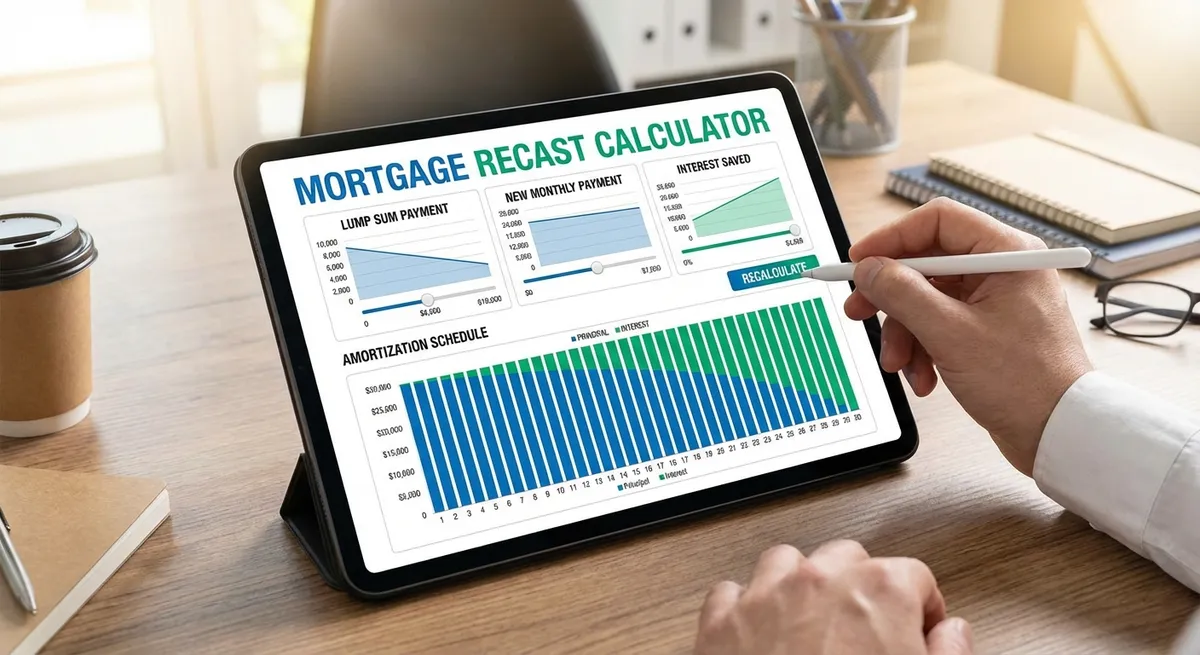
Mortgage Recast Calculator

Use our mortgage recast calculator to model a lump‑sum payment and see your lower payment and interest over the remaining term without changing your loan rate.

Free Finance Calculator
100% Private
Instant Results

Mortgage Recast Calculator

Enter your details below to calculate

How to Use Mortgage Recast Calculator

1

Enter Your Data

Input your financial information, amounts, rates, and terms in the calculator fields

2

Adjust Parameters

Fine-tune options like compounding frequency, payment schedules, or additional contributions

3

Calculate Results

Click Calculate to instantly see your results with detailed breakdowns and charts

4

Analyze & Compare

Review the results, try different scenarios, and use insights for financial planning

Key Features

Fast mortgage recast calculator calculations

Clear inputs and results

Mobile-friendly, privacy-first

Free to use, no signup

What Is Mortgage Recasting and How Does It Work in 2025?

A mortgage recast is a powerful financial strategy that allows homeowners to reduce their monthly mortgage payments without refinancing. When you recast your mortgage, you make a substantial lump-sum payment toward your principal balance, and your lender then reamortizes the remaining balance over your original loan term. This creates a new payment schedule with lower monthly payments while keeping your existing interest rate and loan maturity date unchanged.

Unlike refinancing, which replaces your existing mortgage with a new loan, recasting keeps your current mortgage intact. This distinction is particularly valuable when current mortgage rates are higher than your existing rate, or when you want to avoid the costs and credit implications of refinancing. In 2025, with mortgage rates remaining elevated compared to pre-2022 levels, recasting has become an increasingly attractive option for homeowners who have accumulated savings or received windfalls.

Key Statistic: A homeowner with a $350,000 mortgage at 6.8% interest who recasts with a $50,000 lump sum payment after 10 years could reduce their monthly payment by over $380 and save more than $91,000 in total interest over the remaining loan term. These savings can be redirected toward investments, retirement accounts, or other financial goals.

How Mortgage Recasting Calculations Work: The Math Behind Lower Payments

The mortgage recasting process involves several key calculations that determine your new monthly payment and potential savings. Understanding these formulas helps you evaluate whether recasting makes sense for your financial situation.

Step 1: Determine Your Current Balance

First, calculate your remaining principal balance:

Remaining Balance = Original Balance × (1 + r)ⁿ - Payment × [((1 + r)ⁿ - 1) ÷ r]

Where r = monthly interest rate, n = months paid

Step 2: Apply Lump Sum Payment

Subtract your lump sum from the current balance:

New Balance = Current Balance - Lump Sum

Step 3: Calculate New Monthly Payment

Reamortize using your original interest rate and remaining term:

New Payment = P × [r(1 + r)ⁿ/((1 + r)ⁿ - 1)]

Where P = new balance, r = monthly rate, n = remaining months

Real Example: Sarah has a $400,000 mortgage at 6.5% for 30 years. After 8 years (96 payments), her balance is $354,890. She inherited $75,000 and uses it to recast. Her new balance becomes $279,890, and her payment drops from $2,529 to $1,998 per month—a $531 monthly savings that adds up to over $95,000 in interest savings over the remaining 22 years.

The mortgage recast calculator above uses these exact formulas to provide accurate, real-time calculations. By inputting your specific loan details, you can see precisely how much you'll save and whether the recasting fee justifies the expense.

Mortgage Recast Requirements and Eligibility in 2025

Not all mortgages qualify for recasting, and lenders have specific requirements that borrowers must meet. Understanding these criteria helps you determine if recasting is an option for your situation.

Loan Type Eligibility

Conventional Loans: Generally eligible for recasting
FHA Loans: Typically not eligible for recasting
VA Loans: Usually not eligible for recasting
USDA Loans: Generally not eligible for recasting
ARMs: May be eligible depending on lender policies

Typical Requirements

Minimum Payment: Usually $5,000-$10,000 minimum lump sum
Payment History: On-time payments for 12+ months
Equily Position: Some lenders require minimum equity thresholds
Recast Fee: $150-$500 (requested upfront)

Lender Variations: Each lender sets their own policies regarding recasting eligibility, minimum payment amounts, and fees. Major lenders like Chase, Bank of America, and Wells Fargo offer recasting, but terms vary significantly. Always contact your specific lender to confirm requirements.

Mortgage Recasting vs. Refinancing vs. Extra Principal Payments

Homeowners looking to reduce their mortgage costs have three main options: recasting, refinancing, or making extra principal payments. Each approach serves different financial goals and has distinct advantages and drawbacks.

FactorRecastingRefinancingExtra Payments
Interest RateStays the sameChanges to current market rateStays the same
Loan TermRemains unchangedCan be changed (15, 20, 30 years)Shortens loan term
Monthly PaymentReduced immediatelyChanges based on new rate/termStays the same (or increases if you choose)
Upfront Costs$150-$5002-6% of loan amount$0 (no formal process)
Credit RequirementsNo credit checkFull underwriting requiredNo credit check
Closing ProcessSimple admin process30-45 days, appraisal, title workImmediate (just make payment)

Choosing the Right Strategy

Choose Recasting If:

  • • You have a lump sum available
  • • You want lower payments
  • • Your interest rate is already favorable
  • • You want to avoid refinancing costs

Choose Refinancing If:

  • • You want a lower interest rate
  • • You need to change loan term
  • • You want to tap home equity
  • • You have good credit and income

Choose Extra Payments If:

  • • You want to pay off loan faster
  • • You prefer flexible amounts
  • • You have irregular windfalls
  • • You prioritize debt freedom

Real-World Scenarios: When Mortgage Recasting Makes Sense

Understanding when recasting is advantageous requires examining real-life situations where homeowners might benefit from this strategy. Here are three scenarios where recasting proves particularly valuable:

Scenario 1: Inheritance or Windfall

Situation: Mark and Lisa, both 45, inherited $150,000 from a relative. They have a $280,000 mortgage at 5.5% with 22 years remaining and monthly payments of $2,100.

Recast Strategy: They use $100,000 for recasting (keeping $50,000 for emergencies/investments), reducing their balance to $180,000.

Results:

  • • New payment: $1,350/month ($750 savings)
  • • Monthly savings = $750
  • • Lifetime interest savings = $198,000
  • • Break-even: 4 months (on $250 fee)

Scenario 2: Downsizing Windfall

Situation: After selling a larger home, Susan has $200,000 cash. She bought a new home with a $300,000 mortgage at 7% but wants to keep payments manageable.

Recast Strategy: She immediately recasts with $150,000, reducing her mortgage to $150,000.

Results:

  • • Payment drops from $1,996 to $998/month
  • • Frees up $998/month for other goals
  • • Keeps favorable loan terms
  • • Avoids refinancing at high rates

Scenario 3: Investment Return Strategy

Situation: David, 38, has $80,000 in a taxable investment account earning 4% annually. His mortgage is $250,000 at 6.75% with 20 years left.

Analysis: His investments earn $3,200/year while his mortgage costs $16,875/year in interest.

Recast Benefits:

  • • Reduces balance to $170,000
  • • New payment: $1,303 (from $1,945)
  • • Interest savings: $154,560 over 20 years
  • • Frees up $642/month for higher-return investments

Key Takeaways

  • • Recasting works best when you have significant cash available and plan to stay in your home long-term
  • • The strategy is most effective with higher interest rate mortgages where potential savings are substantial
  • • Compare the opportunity cost of using cash for recasting versus other investment returns
  • • Consider your overall financial picture, including emergency funds, retirement savings, and other debt

Common Mistakes to Avoid When Recasting Your Mortgage

Even savvy homeowners can make costly errors when recasting. Avoid these common pitfalls to ensure you maximize the benefits of your mortgage recast:

❌ Mistake 1: Insufficient Emergency Fund

Using all your cash reserves for recasting can leave you vulnerable to unexpected expenses. Always maintain 3-6 months of living expenses in an emergency fund before committing to a large lump-sum payment.

Solution: Keep emergency fund separate from recast funds.

❌ Mistake 2: Ignoring Higher-Interest Debt

Paying down a 6% mortgage while carrying 18% credit card debt is mathematically inefficient. Always prioritize high-interest debt before considering mortgage recasting.

Solution: Pay off credit cards and personal loans first.

❌ Mistake 3: Not Calculating Break-Even Period

The recast fee needs time to pay for itself through monthly savings. If you might move or refinance before breaking even, recasting could cost more than it saves.

Solution: Ensure you’ll stay in home for break-even period + 2 years.

❌ Mistake 4: Neglecting Investment Opportunities

If you can earn 8-10% in the stock market long-term, using cash for a 6% mortgage recast may not be optimal. Consider your alternative investment opportunities.

Solution: Compare returns and consider your risk tolerance.

❌ Mistake 5: Assuming All Loans Qualify

Many homeowners don't verify loan eligibility before planning their recast strategy. Government-backed loans (FHA, VA, USDA) typically cannot be recast.

Solution: Contact lender first to confirm eligibility.

❌ Mistake 6: Recasting vs. Paying Down Without Recasting

Making a large principal payment without recasting reduces your balance but keeps payments the same, shortening your loan term instead of reducing monthly expenses.

Solution: Explicitly request recasting, not just principal reduction.

The Bottom Line: Is Mortgage Recasting Right for You?

Mortgage recasting offers a unique opportunity to reduce your monthly payments without the costs and complications of refinancing. For homeowners with substantial cash reserves who plan to stay in their homes long-term, recasting can provide significant financial relief and interest savings.

The strategy is particularly compelling in 2025's interest rate environment. If you secured your mortgage when rates were lower, recasting allows you to keep that favorable rate while reducing your payment burden. This differs from refinancing, where you would sacrifice your low rate for current market rates.

However, recasting isn't universally optimal. Homeowners with high-interest debt, insufficient emergency funds, or better investment opportunities should prioritize those financial goals first. Likewise, if you have an FHA, VA, or USDA loan, recasting simply isn't an available option.

Final Recommendation: Use our mortgage recast calculator above to model your specific situation. Input your exact loan details, proposed lump sum payment, and recast fee to see precise savings projections. This data-driven approach ensures you make the right decision for your unique financial circumstances, goals, and timeline.

About the Author

Jurica Šinko

Finance Expert, CPA, MBA with 15+ years in corporate finance and investment management

Connect with Jurica

Frequently Asked Questions

What is mortgage recasting and how does it differ from refinancing?

Mortgage recasting is when you make a large lump-sum payment toward your principal, and your lender recalculates your monthly payments based on the new, lower balance while keeping your interest rate and loan term the same. Unlike refinancing, you don't replace your loan with a new one, avoiding closing costs (2-6% of loan amount) and credit checks. Recasting typically costs $150-$500 in administrative fees, much less than refinancing. However, refinancing lets you change your interest rate and loan term, while recasting preserves your existing rate.

How much money do I need to recast my mortgage?

Most lenders require a minimum lump-sum payment of $5,000 to $10,000 for recasting, though some may have higher requirements. The payment must be substantial enough to meaningfully reduce your monthly payments. For example, on a $300,000 mortgage at 6%, a $10,000 payment might only save $60/month, while $50,000 could save $300/month. Always check with your lender about their specific minimum requirements and whether your loan type qualifies for recasting.

What types of mortgages can be recast?

Only conventional mortgages are typically eligible for recasting. Government-backed loans like FHA, VA, and USDA mortgages generally cannot be recast. Some lenders may allow recasting on adjustable-rate mortgages (ARMs), but policies vary. If you have a conventional loan from major lenders like Chase, Bank of America, or Wells Fargo, you likely qualify. Contact your lender directly to confirm eligibility and understand their specific requirements for loan seasoning and payment history.

How long does it take to break even on recasting costs?

The break-even period depends on your monthly savings and the recast fee. For example, if recasting saves you $300/month and the fee is $250, you'll break even in less than one month. If you save $100/month with a $500 fee, break-even is 5 months. Our calculator shows your specific break-even period. Generally, you should plan to stay in your home at least 2-3 years beyond the break-even point to make recasting worthwhile. If you might move sooner, consider keeping the cash liquid instead.

Can I recast my mortgage multiple times?

Most lenders allow only one recast per loan, though some may permit multiple recasts with additional fees. Each recast requires meeting the lender's criteria again, including minimum payment amounts and good payment history. The more cost-effective strategy is to wait until you have a substantial lump sum that will create meaningful monthly savings. Some homeowners recast once with their initial down payment savings, then make regular extra principal payments afterward to accelerate payoff without additional fees.

When is recasting better than making extra principal payments?

Recasting reduces your required monthly payment, giving you cash flow flexibility. Extra principal payments shorten your loan term but keep payments the same. Choose recasting if you want lower monthly obligations to free up cash for other goals. Choose extra payments if your priority is paying off your mortgage faster and you can comfortably afford current payments. Some homeowners do both: recast to reduce required payments, then continue paying the original amount to accelerate payoff while maintaining flexibility.

How much can I save by recasting my mortgage?

Savings vary dramatically based on your loan amount, interest rate, remaining term, and lump sum payment. On a $350,000 mortgage at 6.8% with 20 years remaining, a $50,000 recast could save $380/month and over $91,000 in total interest. Our calculator shows your exact savings. Generally, recasting is more beneficial with larger loan balances, higher interest rates, and substantial lump-sum payments. Even modest recasts can save tens of thousands in interest over the loan's remaining term.

What are the tax implications of mortgage recasting?

Mortgage recasting doesn't change the tax deductibility of your mortgage interest. You'll still be able to deduct interest paid on up to $750,000 of mortgage debt (or $1 million if your loan originated before December 15, 2017). However, because recasting reduces your total interest paid over the loan term, you'll have lower interest deductions in future years. This trade-off is usually beneficial since paying less interest means keeping more money. Consult a tax professional about your specific situation, especially if you have large mortgage balances.

Share this calculator

Help others discover this tool

Related Calculators

Explore more tools in Loans & Mortgages

Auto Loan Calculator: Monthly Payment & Total Cost (2025)

Free auto loan calculator estimates monthly payments, total interest, and amortization. Compare new vs used cars, down payment impacts, and current 2025 rates.

Loans & Mortgages

Auto Loan Payoff Calculator: Calculate Early Payoff Savings & Interest Reduction

Free auto loan payoff calculator shows how much you'll save by paying off your car loan early. See interest savings, months reduced, and new payoff date. Includes prepayment penalty considerations.

Loans & Mortgages

Auto Loan Refinance Calculator: Free Car Loan Refinancing Tool & Savings Estimator

Use our auto loan refinance calculator to see how much you can save by refinancing your car loan. Compare current vs new rates, calculate monthly savings, and determine if refinancing makes financial sense.

Loans & Mortgages

Boat Loan Calculator: Free Marine Financing & Payment Calculator

Free boat loan calculator with 2025 rates. Calculate monthly payments, total interest, and understand marine financing requirements including surveys and documentation.

Loans & Mortgages

Bridge Loan Calculator: Estimate Monthly Costs and Rates

Use our bridge loan calculator to estimate interest‑only payments and total cost for short‑term financing. Model rate, fees, and term. Get instant results.

Loans & Mortgages

Cash-Out Refinance Calculator: Estimate Your Home Equity & New Payment (2025)

Free cash-out refinance calculator estimates how much equity you can access, new monthly payment, and total costs. Includes LTV limits, closing costs, and 2025 guidelines.

Loans & Mortgages