Understanding Your 2025 New York Tax Bill
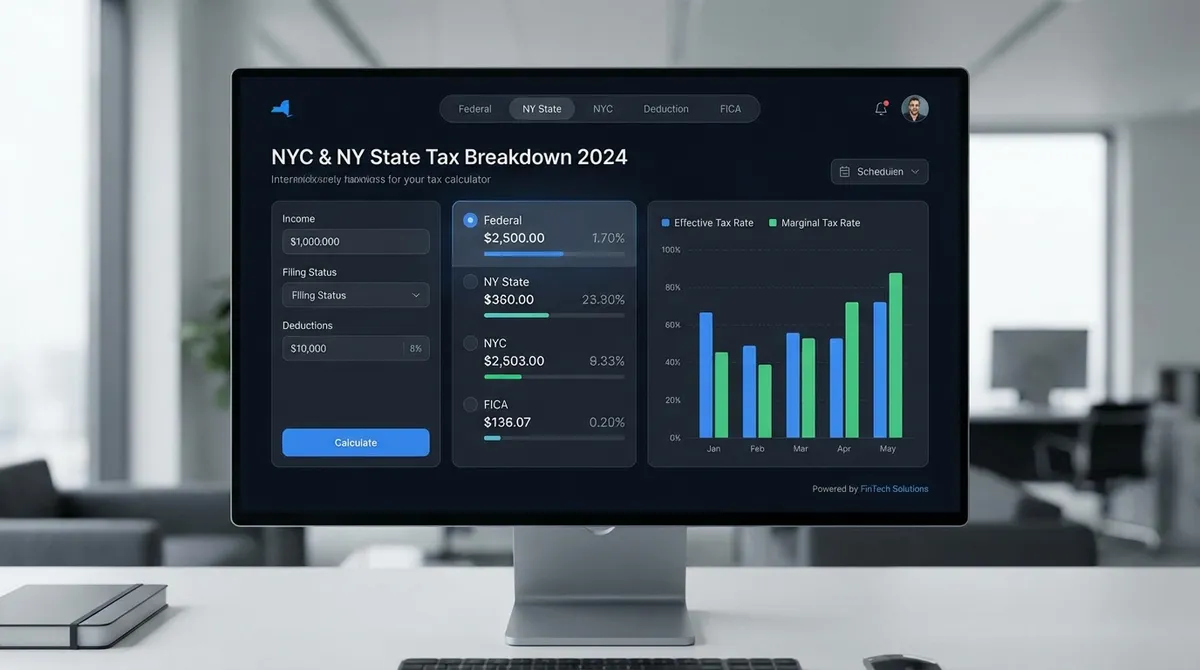
If you live or work in the Empire State, you likely face one of the most complex tax landscapes in the country. New York State employs a progressive income tax system with rates ranging from 4% to 10.9%. But for the millions who call New York City home, there's a second layer: a local city tax that adds another 3.078% to 3.876%.
This "double tax" reality means high earners in NYC can face a combined marginal state and local tax rate approaching 14.8%—before even factoring in federal taxes. Our 2025 calculator breaks this down instantly, showing you exactly how much goes to Albany and how much stays in the five boroughs.
New York State Income Tax Brackets (2025)
New York's tax system is progressive, meaning you pay higher rates only on income that falls into higher brackets. Your first $8,500 of income is taxed at just 4%, regardless of how much you earn in total (unless affected by the tax benefit recapture for very high earners).
| Tax Rate | Single Filers (Taxable Income) | Joint Filers (Taxable Income) |
|---|---|---|
| 4.00% | $0 - $8,500 | $0 - $17,150 |
| 4.50% | $8,501 - $11,700 | $17,151 - $23,600 |
| 5.25% | $11,701 - $13,900 | $23,601 - $27,900 |
| 5.50% | $13,901 - $80,650 | $27,901 - $161,550 |
| 6.00% | $80,651 - $215,400 | $161,551 - $323,200 |
| 6.85% | $215,401 - $1,077,550 | $323,201 - $2,155,350 |
| 9.65% | $1,077,551+ | $2,155,351+ |
* Note: Brackets for Head of Household and Married Filing Separately differ slightly. High earners (> $107,650) may also be subject to tax benefit recapture, effectively smoothing the lower rates.
The NYC Resident Tax Explained
If you live in one of the five boroughs—Manhattan, Brooklyn, Queens, the Bronx, or Staten Island—you are subject to New York City personal income tax.
- Who pays: Anyone domiciled in NYC or who maintains a permanent place of abode and spends 184+ days there.
- Who doesn't: Commuters who work in NYC but live in the suburbs (e.g., Westchester, Long Island, NJ, CT) generally do not pay this specific city tax (though Yonkers residents have their own surcharge).
- The Rates: 3.078%, 3.762%, 3.819%, and 3.876%.
Top 3 Mistakes New Yorkers Make
1. The "183 Day" Rule
Many assume if they "live" in Florida but keep a NYC apartment, they are safe. Incorrect. If you maintain a "permanent place of abode" and spend more than 183 days in NYC/NYS, you are a statutory resident and taxed on worldwide income.
2. Telecommuting Audit
If you work for a NY company remotely from another state (e.g., Vermont) for your own convenience, NYS may still tax that income under the "Convenience of the Employer" rule.
3. Bonus Withholding
Bonuses in NY are often withheld at a flat aggregate rate that might be lower than your actual marginal rate (especially with NYC tax added), leading to a surprise bill in April.
How to Lower Your NY Tax Bill
While rates are statutory, your taxable income is adjustable. Here are the most effective levers for New Yorkers:
- 1Maximize 401(k) / 403(b):
Every dollar contributed reduces your NYS and NYC taxable income. For a top-bracket NYC resident, a $23,000 contribution could save over $3,400 in state/city taxes alone.
- 2Use the 529 Limit:
New York allows a deduction of up to $5,000 ($10,000 for married couples) annually for contributions to NY's 529 College Savings Program.
- 3Check for Credits:
Don't miss the Empire State Child Credit or the NYC School Tax Credit. These are dollar-for-dollar reductions in your tax bill, not just deductions.
Standard Deduction vs. Itemized: 2025 Guide
One unique aspect of New York tax law is that you are generally required to follow your federal election. If you took the standard deduction on your IRS return, you must take it on your New York return. However, there are exceptions, and the amounts differ significantly.
2025 NY Standard Deduction Amounts
- Single$8,000
- Married Filing Jointly$16,050
- Head of Household$11,200
Unlike the federal deduction which indexes for inflation annually, New York's standard deduction has remained relatively static. This often pushes more New Yorkers to itemize if they have significant state taxes (SALT) or mortgage interest, but remembers: the $10,000 FEDERAL cap on SALT deductions does not apply to the New York return itself, which can make itemizing on your state return highly beneficial if allowed.
Freelancers & Self-Employed in NYC
If you are your own boss in the Big Apple, you face a triple-threat of taxation. Not only do you pay Federal, NY State, and NYC Income tax, but you are also responsible for the Unincorporated Business Tax (UBT).
What is UBT?
New York City imposes a 4% tax on business income for sole proprietorships and partnerships if your earnings exceed a certain threshold.
- Exemption: If you earn roughly less than $100,000 in self-employment profit, credits often wipe out this tax.
- Liability: Once profit exceeds $150,000, you will likely owe the full 4%.
- Professionals: Doctors, lawyers, and writers famously used to be exempt, but modern rules have narrowed many loopholes. Consult a CPA if you freelance in NYC.
Beyond Income Tax: Sales Tax & MCTMT
Don't Forget Sales Tax
While this calculator focuses on income, your purchasing power is also affected by sales tax.
- NYS Base Rate: 4.00%
- NYC Total Rate: 8.875% (Includes State + City + MCTD)
- Average Local Rate: ~8.50%
MCTMT (Commuter Tax)
If you are self-employed with net earnings over $50,000 in the Metropolitan Commuter Transportation District (NYC + surrounding counties like Westchester, Nassau, Suffolk, etc.), you may owe this additional tax.
Rate: 0.34% to 0.60% of net earnings.
STAR Credit
The School Tax Relief (STAR) program offers property tax relief for eligible New York State homeowners.
- Basic STAR: For primary residences with income under $500k.
- Enhanced STAR: Additional benefits for seniors (65+).
Frequently Asked Questions
Do I have to pay NYC tax if I moved out halfway through the year?
Yes, but only for the days you were a resident. You will file a "Part-Year Resident" return (Form IT-201 or IT-203). New York is aggressive about auditing partial-year moves, so keep rigorous records of your move date (lease breaks, moving truck receipts, changing voter registration).
Is the "Yonkers Tax" real?
Yes. Yonkers is the only city in New York State besides NYC that has its own personal income tax surcharge. It is generally calculated as a percentage of your total NY State tax net (around 16.75%), or a flat rate on earnings if you work there but live elsewhere.
What is the "Convenience of the Employer" rule?
This is a controversial rule. If you work for a NY-based company but choose to work remotely from New Jersey or Connecticut for your own convenience (not because your employer requires it), New York still taxes your income as if you were physically in the office. You then have to claim a credit on your home state return to avoid double taxation, but it complicates filing immensely.
What is the NY "Millionaire's Tax"?
Technically, the top rates were extended and increased in recent years. For tax years through 2027, the top rate is 10.9%. This applies to single filers earning over $25 million (!), but significantly higher rates (9.65%) kick in at "just" $1 million in income.
Are unemployment benefits taxable in NY?
Yes. New York State (and the federal government) treats unemployment compensation as ordinary taxable income. You should opt to have taxes withheld from your benefit checks to avoid a tax bill at year-end.