The Ultimate Guide to Revenue Per Employee (2025 Edition)
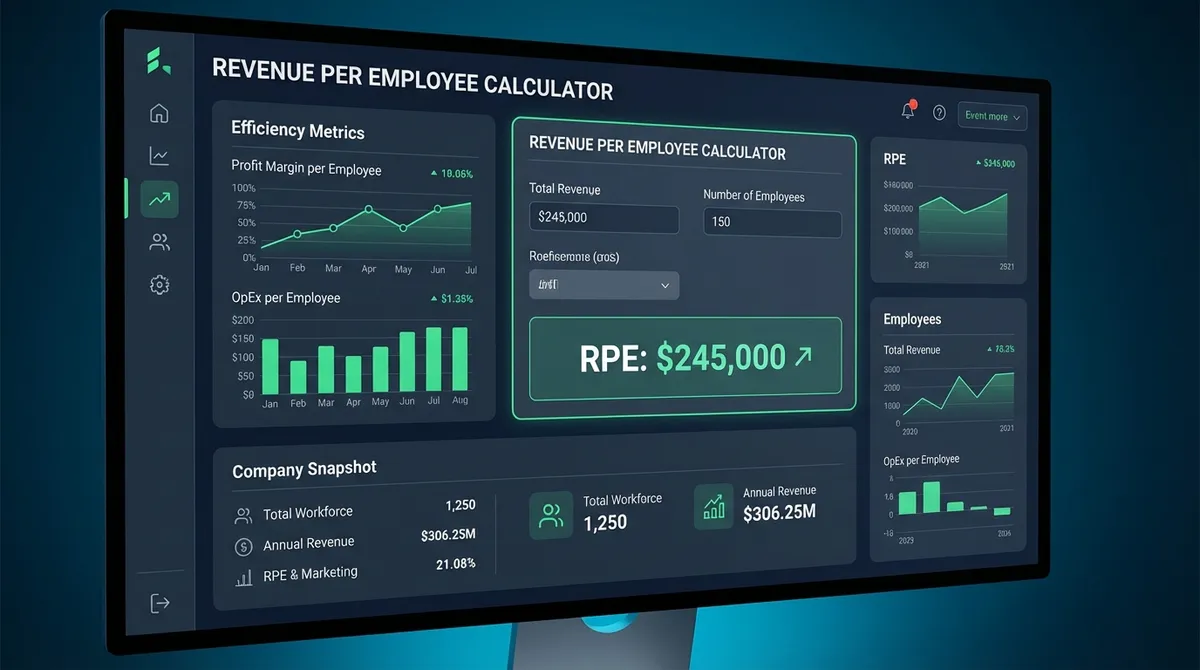
In the efficiency-first business landscape of 2025, Revenue Per Employee (RPE) has emerged as the single most honest metric for organizational health. It strips away the vanity of total revenue and headcount growth to reveal the raw truth: How much value is each person in your organization actually creating?
Whether you're a SaaS founder pitching to VCs who demand "efficient growth," or a manufacturing CFO looking to optimize labor costs, RPE is your North Star. It's the difference between a bloated company that burns cash to grow and a lean, scalable machine that generates profit with every new hire.
Why it matters now:
With AI and automation tools becoming standard, the benchmark for RPE is rising. A $100,000 RPE might have been acceptable in 2020; today, successful tech-enabled firms often target $250,000+. This guide will help you calculate your number, benchmark it against 2025 standards, and fix it if it's broken.
The Formula Deconstructed
The math is deceptively simple, but the nuance lies in the inputs.
2025 Industry Benchmarks: Where Do You Stand?
Comparing a law firm to a software company is useless. Here are the specific benchmarks for 2025 by industry. Note the "Elite" tier—this is where AI-native companies are pushing the boundaries.
| Industry | Average RPE | Elite RPE (Top 10%) | Key Drivers |
|---|---|---|---|
| SaaS / Software | $180k - $250k | $500k+ | Product-led growth, minimal support staff |
| Financial Services | $220k - $350k | $800k+ | High-value transactions, automated compliance |
| Manufacturing | $200k - $300k | $450k+ | Robotics, 24/7 shifts, capital intensity |
| Consulting / Agency | $150k - $200k | $350k+ | High billable rates, low overhead |
| Retail | $90k - $140k | $250k+ | Omnichannel sales, efficient inventory |
Data aggregated from public financial reports and 2025 industry surveys.
Interpreting Your Score: The "Good, Bad, and Ugly"
High RPE (Above Benchmark)
This is generally positive. It means your team is highly productive, your pricing power is strong, or you've successfully automated low-value tasks.
Watch Out For:
Employee burnout. Sometimes RPE is high because you're severely understaffed. If RPE is high but turnover is also high, you have a sustainability problem.
Low RPE (Below Benchmark)
This signals inefficiency. You might have too many layers of management, outdated manual processes, or a pricing model that hasn't kept up with inflation.
The Exception:
Startups in "build mode." If you just hired 20 engineers to build a product that launches next year, your RPE will tank temporarily. That's an investment, not a failure.
3 Levers to Skyrocket Your RPE
The Price Lever (Fastest)
Most companies undercharge. If you raise prices by 10% and lose 5% of your volume, your RPE goes up immediately. Review your pricing strategy annually. Inflation is real; your prices should reflect it.
The Automation Lever (Most Sustainable)
Audit every role. If a human is moving data from Spreadsheet A to Spreadsheet B, that's an RPE killer. Implement tools like Zapier, Make, or custom AI agents to handle repetitive workflows.
The Talent Lever (Hardest)
Practice "Topgrading." One A-player often produces the output of three B-players. Slowly increasing the talent density of your team increases revenue capability without increasing headcount proportionally.
RPE vs. Profit Per Employee: The Critical Distinction
RPE is a measure of volume, not efficiency. It is possible to have high revenue per employee but lose money if your costs are out of control.
| Metric | Formula | What It Tell You |
|---|---|---|
| Revenue Per Employee | Revenue / Employees | Productivity capacity. Can we scale sales without scaling headcount? |
| Profit Per Employee | Net Income / Employees | Actual financial health. After paying those employees, is anything left? |
The Future of RPE: Predictive Workforce Analytics
Leading companies are no longer looking at RPE as a trailing indicator (what happened last quarter). They are using predictive analytics to forecast Marginal Revenue Per Employee (MRPE)—the expected revenue gain from the next hire.
By integrating CRM data, project management velocity, and market trends, AI models can now tell you: "If we hire 3 more sales reps in Q3, our RPE will initially dip to $150k but rebound to $210k by Q4."
Why this changes everything
This moves HR from a cost center ("How much payroll can we afford?") to an investment center ("Where do we deploy capital for maximum return?"). Companies mastering this shift will dominate the talent market in 2026 and beyond.
The "One-Person Unicorn": How AI is Breaking RPE Models
We are entering an era of Hyper-Efficiency. In the past, earning $10M in revenue required 50-100 employees. Today, with Generative AI, small teams of 5-10 people are hitting those numbers.
This means the "average" benchmarks are moving targets. If your RPE remains flat for 2 years while your competitors adopt AI agents for support, coding, and sales, you are effectively shrinking.
- Customer SupportAI bots handle 80% of L1 tickets, driving Support RPE through the roof.
- EngineeringCopilots allow 1 senior dev to do the work of 3 juniors.
Frequently Asked Questions
Does Revenue Per Employee include contractors?
Strictly speaking, no. GAAP counts employees on payroll (W-2s). However, for internal management, you absolutely SHOULD include full-time contractors to get an honest picture of your workforce efficiency.
What is a "bad" RPE number?
Generally, anything under $100,000 suggests you are struggling to cover costs (since employee cost + overhead often exceeds $100k/year). If you are below $50k, you are likely burning cash rapidly.
How often should I calculate this?
Quarterly is standard. Monthly can be too volatile due to revenue recognition timing. Annual is too slow to react to hiring overreach.
Case Studies: The Tale of Two RPE Models
To truly understand RPE, let's look at two iconic examples. Neither is "wrong," but they represent fundamentally different business physics.
Netflix (The Efficiency Engine)
RPE: ~$2.6 Million
Model: Pure technology leverage. One engineer writes code that scales to 250 million users. The marginal cost of serving the next customer is near zero.
Lesson: High RPE allows you to pay top-of-market salaries (Netflix engineers often earn $500k+) while remaining extremely profitable.
McDonald's (The Volume Machine)
RPE: ~$150,000 (Corporate + Franchise mix)
Model: Operationally intensive. Serving 10% more burgers requires roughly 10% more labor hours. The leverage comes from brand and real estate, not labor efficiency.
Lesson: Low RPE businesses must survive on thin margins and strict operational discipline. There is no room for waste.
The 90-Day RPE Optimization Plan
If your RPE is below benchmark, you can't fix it overnight without breaking your culture. Here is a sustainable 90-day sprint to improve your metrics.
Month 1: The Audit
- Freeze all non-essential hiring.
- Categorize every role as "Revenue Generating" (Sales, Marketing), "Product Building" (Eng, Design), or "Overhead" (Admin, HR).
- Identify the "Shadow Work": What manual tasks are consuming 20%+ of your high-paid talent's time?
Month 2: The Tech Injection
- Implement ONE major automation for your biggest time-sink (e.g., auto-scheduling for sales, AI for customer support ticketing).
- Raise prices by 5-10% for new customers. This is the fastest way to lift the numerator (Revenue) without touching the denominator (Employees).
Month 3: The Talent Alignment
- Set RPE targets for department heads. Make them own the efficiency of their teams.
- If you have chronic underperformers (bottom 10%), manage them out. It sounds harsh, but low performers drag down RPE twice: they produce less revenue AND consume management time.