
The Complete Guide to RV Financing in 2025: Rates, Terms, and Hidden Costs
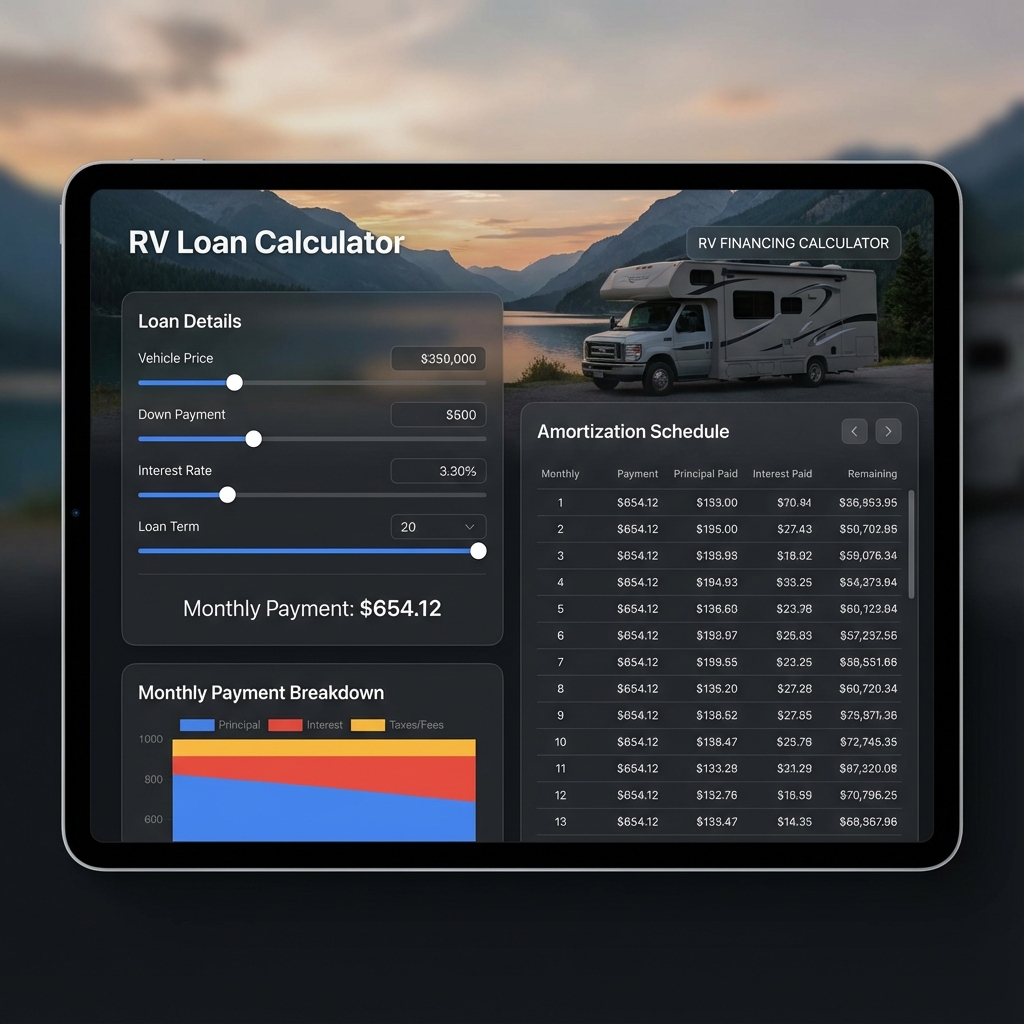
Financing a recreational vehicle isn't just about picking a monthly payment—it's about understanding the total cost of your freedom on the road. Whether you're eyeing a luxury Class A motorhome or a cozy travel trailer, this guide breaks down everything you need to know about RV loans, from interest rates to hidden fees.
RV Loan Rates: What to Expect in 2025
Interest rates for RV loans have stabilized but remain higher than standard auto loans. Lenders justify these rates because RVs are considered "luxury items" and often depreciate faster than cars. Understanding where you fall on the credit spectrum is crucial for predicting your rate. For more on how secured debts work, see Investopedia's guide.
Excellent Credit
6.99% - 7.99%
Score: 760+
Best terms available, 0% down options possible.
Good Credit
8.00% - 9.99%
Score: 700-759
Competitive rates, standard 10% down payment.
Fair Credit
10.00% - 14.99%
Score: 640-699
Higher rates, may require 20% down payment.
Pro Tip: Large Down Payments Lower Rates
Putting down 20% or more won't just lower your monthly payment—it often qualifies you for a lower interest tier. Lenders see you as less of a risk when you have significant "skin in the game." Additionally, a larger down payment protects you from depreciation, ensuring you don't owe more than the RV is worth.
Real-World Example: The True Cost of Ownership
Let's look at a realistic scenario. Imagine you're buying a Class C Motorhome for $85,000. You put $10,000 down and finance the remaining $75,000. Use this breakdown to understand how loan terms impact your total cost.
| Loan Term | Interest Rate | Monthly Payment | Total Interest |
|---|---|---|---|
| 10 Years | 7.99% | $909 | $34,080 |
| 15 Years | 8.49% | $739 | $58,020 |
| 20 Years | 8.99% | $674 | $86,760 |
*Note: Example assumes financed amount of $75,000. Rates increase slightly for longer terms.
Wait, look at that 20-year term again. Your monthly payment drops by only $65 compared to the 15-year term, but you pay nearly $29,000 more in interest. This is the "term trap"—don't stretch your loan just to save a few dollars a month if it costs you a fortune in the long run. Use an amortization calculator to see the difference.
4 Hidden Costs of Financing an RV
The sticker price is just the beginning. When budgeting for your loan, don't forget these often-overlooked expenses that can add hundreds to your monthly budget:
- 1. Sales Tax & Registration
Depending on your state, this can add 6-10% to the upfront cost. On a $50k RV, that's $3,000-$5,000 due immediately or rolled into the loan. Rolling it into the loan means you pay interest on your taxes for 15+ years.
- 2. RV Insurance
Much higher than auto insurance. Expect to pay $800 to $2,000+ annually depending on the RV value and usage. Full-time RVers need specialized policies that cost even more.
- 3. Storage Fees
If you can't park it at home, storage facilities charge $50-$200 per month for outdoor spots and significantly more for indoor climate-controlled units. This is a monthly "rent" for your unused asset.
- 4. Fuel & Maintenance
Big rigs get 6-10 MPG. Plus, RVs require constant maintenance—tires alone can cost $3,000+ for a set on a Class A. Budget at least $1,000/year for routine upkeep.
Types of RVs and Financing Differences
Not all RV loans are created equal. The type of recreational vehicle you choose impacts the loan terms available to you. Lenders categorize RVs into distinct classes, each with its own risk profile and financing structure.
Motorhomes (Class A, B, C)
Considered vehicles, these often have higher interest rates but longer terms (up to 20 years) due to their high price tags ($100k - $500k+). Lenders view them as significant assets similar to second homes. Class A motorhomes, the bus-style giants, typically qualify for the longest terms and most competitive "luxury" financing packages, provided the loan amount exceeds $50,000 or $100,000 depending on the lender.
Towables (Travel Trailers, 5th Wheels)
Generally cheaper ($20k - $80k) with slightly shorter loan terms (10-15 years). Because they aren't motorized, maintenance costs are lower, but depreciation can be steeper. Fifth wheels often hold their value better than standard travel trailers, sometimes allowing for more favorable financing terms closer to motorhome standards. Similar financing dynamics apply to marine vessels (check our APR calculator for comparisons).
New vs. Used RV Financing: What You Need to Know
Just like cars, financing a used RV comes with different rules than buying new. While you save significantly on the sticker price by buying used (letting the first owner take the massive depreciation hit), the financing terms can be trickier.
- Interest Rate Differences
Expected to pay 0.5% to 2.0% higher rates for a used RV loan. Lenders see older vehicles as higher risk because they are harder to value and potentially harder to repossess and resell in good condition.
- Age Restrictions
Most major lenders have a "10-year rule." They typically won't finance an RV older than 10-12 years. If you're looking at a vintage Airstream or a 15-year-old diesel pusher, your financing options shrink to personal loans (higher rates, shorter terms) or cash.
- Shorter Terms
While a $100k new motorhome might qualify for a 20-year term, a $100k used motorhome might be capped at 15 or even 12 years. This increases your monthly payment despite the lower purchase price.
Full-Timer Financing: A Specialized Niche
Planning to sell the house and live in your RV full-time? Be careful what you tell the lender. Most standard RV loans prohibit "full-timing" because lenders view it as a higher risk—if you default, they are repossessing your home, not just a toy, which involves complex eviction laws.
The "Full-Timer" Clause
If you intend to live in the RV, look for specific "Full-Timer RV Loans." These are more similar to mortgages than standard vehicle loans. They require higher credit scores (often 740+) and larger down payments, but they are legitimate. Using a standard recreational loan while living full-time can be considered fraud and may Void your insurance if you have a claim.
Refinancing Your RV Loan: When Does It Make Sense?
Many buyers accept higher dealer financing rates just to get the keys, planning to refinance later. This can be a smart strategy, but timing is key.
When to refinance:
- Credit Score Improved: If your score jumped from 680 to 740, you could drop your rate by 2-3%, saving thousands.
- Rates Drop: If market rates fall significantly below your current rate.
- Cash Flow Needs: Refinancing to a longer term can lower monthly payments (though it increases total interest cost) if your budget gets tight. Use a loan payoff calculator to strategize your exit.
The "Upside Down" Problem: The biggest barrier to refinancing is equity. Because RVs depreciate so fast, you might owe $60,000 on a rig now worth $50,000. Lenders won't refinance more than the RV's current value (LTV ratio). You would need to bring $10,000 cash to the table to close the gap before refinancing is possible.
Is RV Interest Tax Deductible?
Typically, Yes!
The IRS may treat your RV as a "second home" if it has sleeping, cooking, and toilet facilities. This means you might be able to deduct the interest on your RV loan, just like mortgage interest. This is a massive potential benefit that can offset some of the interest costs over the life of the loan.
- The loan must be secured by the RV.
- You must itemize your deductions (Schedule A).
- It applies to only two homes total (primary + one other).
Disclaimer: Tax laws change. Always consult a CPA to confirm your eligibility.
Common RV Financing Mistakes to Avoid
Buying More Than You Can Afford
Just because you qualify for a $1,000 monthly payment doesn't mean you should take it. Check your DTI ratio to stay safe.
Ignoring Depreciation
RVs lose value quickly. Buying new means taking a huge depreciation hit the moment you drive off the lot. Financing 100% of a new RV guarantees you'll be "upside down" for years.
Focusing Only on Monthly Payment
Salespeople love to stretch terms to 20 years to make the payment look small. Always look at the total interest paid (use our calculator!) to see the real cost of that "low" payment.
Financing vs. Paying Cash
If you have the funds, is it better to pay cash? Not always. While paying cash eliminates interest, financing allows you to keep your liquidity for emergencies or investments.
The "Arbitrage" Strategy: If you can get an RV loan at 7% but can earn 10% in the market, financing effectively earns you money. However, with current high rates (8%+), this is harder to justify. For most buyers in 2025, a large down payment (40-50%) strikes the best balance between preserving cash and minimizing interest.
Ready to hit the road? Use the calculator above to finalize your budget before heading to the dealership. It's the smartest way to ensure your dream RV doesn't become a financial nightmare.