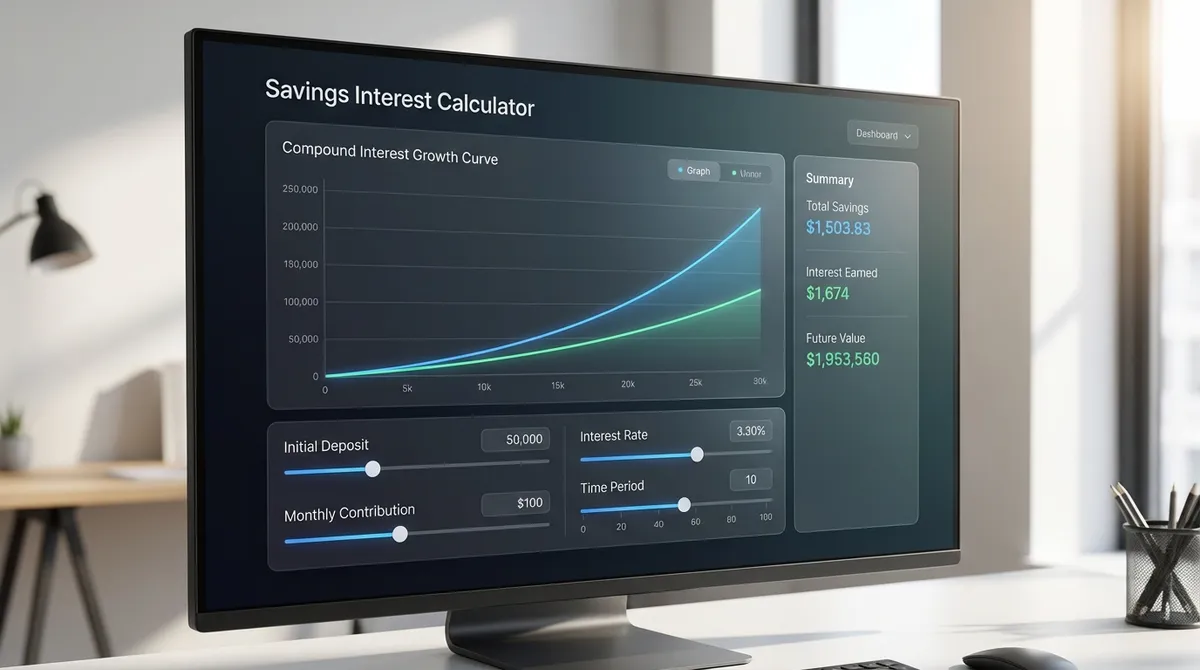
Understanding Savings Interest: Your Money's Growth Engine in 2025
Savings interest is the powerful financial mechanism that transforms your idle cash into a wealth-building asset. Unlike checking accounts that offer minimal returns, high-yield savings accounts leverage compound interest to multiply your money automatically. In 2025's competitive banking landscape, top-tier savings accounts deliver APYs of 4.75% to 5.25%—transforming a modest emergency fund into a growing financial safety net that outpaces inflation while maintaining complete liquidity.
The magic lies in compound interest: your balance earns interest, then that interest earns its own interest, creating an exponential growth curve that accelerates dramatically over time. A $10,000 balance at 5% APY grows to $12,763 in five years through compounding alone. Add monthly contributions of $500, and you're looking at $46,763—demonstrating how consistent saving habits combined with competitive interest rates create substantial wealth without market risk.
Key Insight: In 2025, the difference between a traditional savings account (0.01% APY) and a high-yield account (5.00% APY) is staggering. On a $25,000 emergency fund, the high-yield account generates $1,250 in annual interest versus just $2.50 in a traditional account—a 500x difference that can fund an entire vacation or accelerate debt payoff.
How Savings Interest Calculations Work: The Formula Behind Your Growth
Savings interest calculations follow precise mathematical formulas that account for your principal balance, interest rate, compounding frequency, and time. The key difference between simple and compound interest determines how quickly your money grows:
- •APY (Annual Percentage Yield): The effective annual rate including compound interest, which represents your true earnings over one year.
- •r (Nominal Interest Rate): The stated annual interest rate before compounding effects are applied.
- •n (Compounding Frequency): The number of times interest compounds annually: daily (365), monthly (12), quarterly (4), or annually (1).
Why Daily Compounding Matters
Daily compounding generates slightly higher returns than monthly compounding because interest is calculated and added to your balance every day. While the difference seems minimal on small balances ($2.50 annually on $10,000 at 5% APY), it becomes significant on larger balances over longer periods. A $100,000 balance over 10 years earns an extra $550 with daily versus monthly compounding—essentially free money for choosing the right account.
Understanding Contribution Timing
Our calculator assumes monthly contributions are added at the end of each month after interest is calculated. This conservative approach reflects reality: most people deposit paychecks after receiving them. Early-month contributions would generate slightly more interest, but the difference is negligible over long periods. What matters most is consistency—regular monthly deposits create the dollar-cost averaging effect that smooths out market timing risks.
Real-World Example: Building an Emergency Fund with High-Yield Savings
Meet Jennifer, a 28-year-old marketing manager who decides to build a comprehensive emergency fund. She starts with $8,000 and commits to saving $400 monthly from her $5,000 take-home pay. She opens a high-yield savings account offering 5.00% APY with daily compounding—a realistic rate in 2025's competitive banking environment.
• Initial Balance: $8,000
• Target Emergency Fund: 6 months expenses
• Monthly Deposit: $400
• APY: 5.00%
• Compounding: Daily
• Time Goal: 3 years
• Total Deposits: $22,400
• Interest Earned: $1,842
• Final Balance: $30,242
• Monthly Interest (by year 3): $126
• Goal Achievement: 6+ months expenses saved
Jennifer's emergency fund reaches $30,242 after three years, providing 6+ months of expense coverage. More importantly, by year three, her account generates $126 per month in interest alone—essentially creating a passive income stream that adds over $1,500 annually to her fund without any additional effort. This demonstrates the dual benefit of high-yield savings: liquidity for emergencies and meaningful growth that maintains purchasing power against inflation.
💡 Expert Tips from Marko Šinko to Maximize Savings Interest
1. Choose Daily Compounding with No Minimum Balance Requirements: The best high-yield savings accounts compound daily and don't penalize you for dropping below a certain balance. Look for accounts that maintain their advertised APY regardless of balance fluctuations. Some banks advertise high rates that only apply to balances above $10,000—avoid these tiered structures unless you consistently maintain high balances.
2. Automate Weekly Micro-Deposits Instead of Monthly Lump Sums: Rather than depositing $400 once monthly, set up automatic weekly transfers of $100. This approach leverages dollar-cost averaging for savings and smooths out the impact of rate fluctuations. More importantly, it's psychologically easier—smaller, frequent transfers feel less impactful than large monthly withdrawals, increasing your likelihood of maintaining the habit during tight months.
3. Create Sub-Accounts for Different Goals: Most high-yield savings platforms allow multiple sub-accounts under one login. Create separate accounts for "Emergency Fund," "House Down Payment," "Vacation Fund," and "Car Replacement." This mental accounting trick prevents you from raiding your emergency fund for non-emergencies while maintaining the same competitive APY across all goals. The separation makes each goal feel more tangible and achievable.
4. Time Large Deposits Strategically: If you're transferring a large sum (like a tax refund or bonus), deposit it in the first week of the month to maximize interest earnings. While daily compounding means timing matters less than monthly contributions, getting money into your high-yield account even a few days earlier generates extra interest. Over years, these small timing optimizations compound into meaningful additional earnings.
5. Monitor Rates Quarterly and Be Willing to Switch: High-yield savings rates are variable and can change based on Federal Reserve policy and bank competition. Set a calendar reminder every three months to check if your rate remains competitive. If your bank drops significantly below market leaders (by more than 0.25% APY), consider switching. The process takes less than 30 minutes online and can earn you hundreds in additional interest annually. Your loyalty should be to your financial goals, not to a specific bank.
⚠️ Common Mistakes That Destroy Savings Interest Potential
Mistake 1: Keeping Money in Low-Interest Checking Accounts
Traditional checking accounts earn 0.01% APY or less, essentially losing money to inflation. On a $15,000 balance, you earn $1.50 annually while inflation erodes $525 of purchasing power. You're guaranteed to lose wealth. Move excess checking account balances to high-yield savings immediately—keep only 1-2 months of expenses in checking for daily needs.
Mistake 2: Chasing Slightly Higher Rates at Unstable Banks
A small online bank offering 0.25% above market rates might be desperate for deposits due to financial instability. Always verify FDIC insurance (or NCUA for credit unions) and check the institution's Bauer Financial rating. The highest rate isn't worth the risk of bank failure, even with FDIC protection—the hassle of disrupted automatic transfers and frozen funds during resolution isn't worth an extra $25 annually on a $10,000 balance.
Mistake 3: Ignoring Maintenance Fees and Requirements
Some "high-yield" accounts charge $5-25 monthly maintenance fees if your balance drops below $1,000 or $5,000. On a $2,000 balance, a $10 monthly fee equals a 6% annual penalty—completely negating the benefit of a 5% APY. Always read the fine print. The best accounts have zero maintenance fees, zero minimum balances, and no transaction limits (though federal Regulation D still applies).
Mistake 4: Treating Savings Accounts Like Checking Accounts
Federal Regulation D limits certain savings account withdrawals to six per month. Exceeding this limit can trigger fees or account conversion to checking (losing your high APY). Use savings for its intended purpose: medium-term savings goals and emergency funds. Keep daily spending money in checking and resist the temptation to make frequent transfers from savings—this habit destroys compound interest growth and defeats the purpose of a separate savings account.
Mistake 5: Waiting for "Enough" Money to Open a High-Yield Account
Many people postpone opening a high-yield savings account until they have "something worth saving"—typically $5,000 or $10,000. This procrastination costs hundreds in lost interest. Even $500 in a 5% APY account earns $25 in the first year, covering a nice dinner. More importantly, establishing the account and automatic transfer habit early makes it easier to scale up as your income grows. Start with $100 if that's all you have—the habit is more valuable than the initial balance.
🎯 When to Use Savings Interest Calculator
📊 Real-World Use Cases: How Different People Use Savings Interest Calculators
Case 1: The Emergency Fund Builder
Background: Sarah, 32, recently bought a house and wants to rebuild her depleted emergency fund. She needs $18,000 for 6 months of expenses but can only save $600 monthly after her new mortgage payment.
Calculator Use: She uses the savings interest calculator to determine that with a 5% APY high-yield account, she'll reach her $18,000 goal in 26 months instead of 30 months. The interest earned shaves off 4 months from her timeline, providing peace of mind sooner.
Result: Total deposits: $15,600 • Interest earned: $2,400 • Final balance: $18,000 • Time saved: 4 months
Case 2: The Car Replacement Planner
Background: Mike, 45, has a 7-year-old car with 95,000 miles. He estimates he'll need a replacement in 3 years, costing $35,000. He wants to save $25,000 and finance the remaining $10,000.
Calculator Use: Mike calculates that saving $640 monthly in a 4.75% APY account will grow to $25,089 in 36 months. Without interest, he'd need to save $694 monthly—a $54/month difference that frees up money for other priorities.
Result: Monthly savings needed: $640 • Total interest earned: $1,929 • Reduction in monthly burden: $54
Case 3: The College Savings Maximizer
Background: The Johnsons want to save for their daughter's college education. They'll need $80,000 in 10 years when she starts university. They currently have $15,000 saved and can contribute $400 monthly.
Calculator Use: Using a 5.25% APY account, they project their savings will grow to $82,473 in 10 years. They realize they can reduce monthly contributions to $380 and still exceed their goal, freeing up $20/month for other family priorities.
Result: Total growth: $67,473 • Interest earned: $21,073 • Goal exceeded by: $2,473 • Monthly savings reduced: $20
Case 4: The Medical Expense Planner
Background: Linda, 58, plans to retire at 65 and wants to set aside $50,000 for potential medical expenses not covered by Medicare. She has $20,000 currently saved and can add $350 monthly until retirement.
Calculator Use: Linda calculates that at 4.8% APY, her savings will reach $52,847 in 7 years. She discovers she can actually reduce monthly contributions to $330 and still exceed her goal, providing a buffer for unexpected costs.
Result: Final balance: $52,847 • Goal exceeded by: $2,847 • Interest earned: $6,447 • Monthly savings: $330