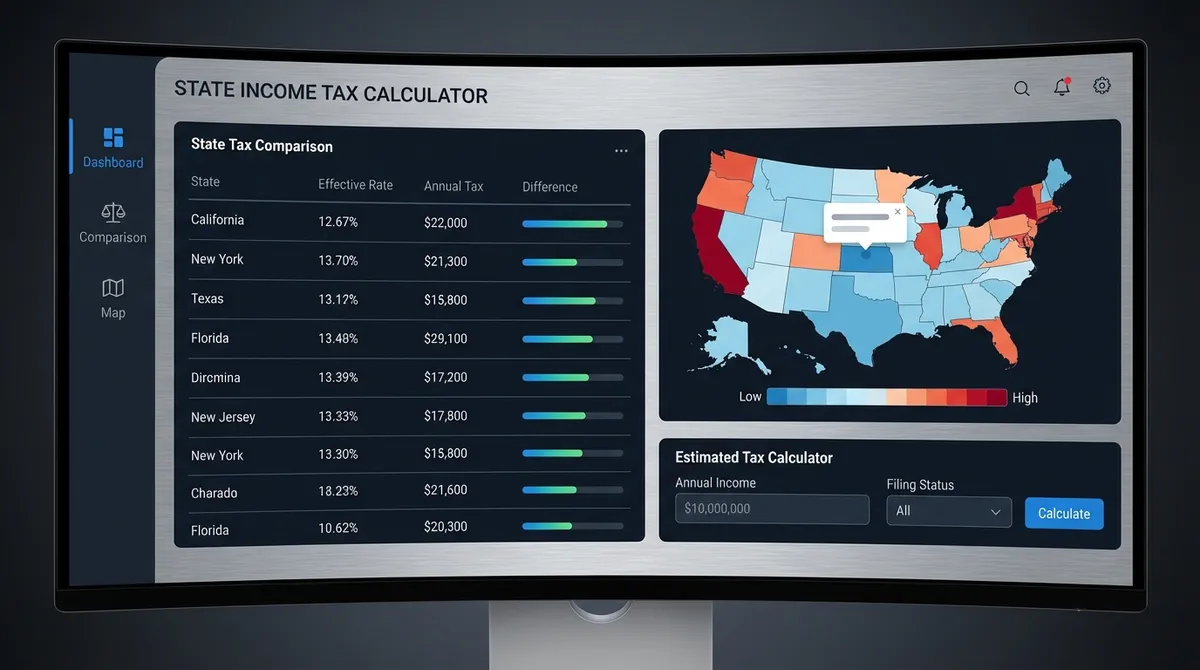
State Income Tax Calculator: Compare Tax Rates Across All States
Compare tax burdens across the US with our state income tax calculator. Estimate your state tax liability and see how different states tax income now.
State Income Tax Calculator: Compare Tax Rates Across All States
Choose a state and enter your income to calculate your tax
State Income Tax Calculator
Estimate your state income tax liability and compare tax rates across all 50 states. See how different states tax income and find potential savings opportunities.
Quick Scenarios
Enter Your Information
About This Calculator
This State Income Tax Calculator helps you estimate your state income tax liability using current 2025 tax rates and brackets for each state. The calculator accounts for:
- Progressive tax brackets for states with tiered systems
- Flat tax rates for applicable states
- Standard deductions based on filing status
- Personal and dependent exemptions
- Additional deductions you may qualify for
9 States with No Income Tax: Alaska, Florida, Nevada, New Hampshire, South Dakota, Tennessee, Texas, Washington, and Wyoming.
Note: This calculator provides estimates based on available state tax data. Actual tax liability may vary due to additional factors like local taxes, specific credits, or recent legislative changes. Consult with a tax professional for complete accuracy.
Important Disclaimer:
This calculator does not account for local income taxes, certain tax credits, or specific state deductions beyond standard deductions and personal exemptions. Always verify with your state's tax authority or a qualified tax professional.
How to Use State Income Tax Calculator
Select Your State
Choose your state from the dropdown to see current tax rates and brackets
Enter Income & Filing Status
Input your annual income and select your filing status (single or married)
Add Deductions & Dependents
Include dependents and any additional deductions for accurate results
Review & Compare
See your estimated state tax and compare with other states instantly
Key Features
Fast state income tax calculator calculations
Clear inputs and results
Mobile-friendly, privacy-first
Free to use, no signup
What Is State Income Tax and How Does It Work in 2025?
State income tax is a tax levied by individual states on income earned by residents and non-residents working within the state. Unlike federal income tax which applies uniformly across the United States, state income tax rates, brackets, and rules vary dramatically from state to state. In 2025, these variations create significant differences in take-home pay, with high earners potentially saving thousands of dollars annually by living in states with favorable tax structures.
Understanding your state income tax obligation is crucial for accurate financial planning, whether you're considering a job offer in a different state, planning for retirement, or simply trying to budget more effectively. State income tax can affect everything from your monthly paycheck to your long-term wealth accumulation, making it essential to calculate accurately and plan strategically.
Key Statistic: As of 2025, nine states have no income tax, while others like California tax high earners at rates exceeding 13%. This means a single person earning $100,000 could pay $0 in state income tax in Florida but over $6,000 in California—a difference of more than $500 per month that could substantially impact housing choices, savings rates, and overall quality of life.
The Three Main State Income Tax Systems Explained
States employ three primary approaches to taxing income, each with distinct implications for taxpayers across different income levels. Understanding which system your state uses is the first step toward accurate tax planning.
Flat Tax States
14 states use flat tax systems where everyone pays the same percentage regardless of income. Examples include Pennsylvania (3.07%), Indiana (3.05%), and Illinois (4.95%).
- • Simple to calculate and predict
- • No progressive brackets to navigate
- • Often favored by higher earners
- • Can be regressive for low-income families
Progressive Tax States
Most common system with graduated brackets similar to federal tax. Higher income faces higher rates. Examples: California (1-13.3%), New York (4-10.9%), and Oregon (4.75-9.9%).
- • Higher earners pay larger percentage
- • Can provide relief for low-income families
- • More complex calculations required
- • Generates more state revenue
No Income Tax States
9 states have no income tax: Alaska, Florida, Nevada, New Hampshire, South Dakota, Tennessee, Texas, Washington, and Wyoming. South Dakota and Wyoming also have no corporate income tax.
- • Maximum take-home pay
- • Budget through other revenue sources
- • May have higher property/sales taxes
- • Popular for retirees and high earners
Important Note on New Hampshire:
While New Hampshire doesn't tax earned income (wages/salary), it does tax dividends and interest income at 5%. This makes it partially income-tax-free, but not completely like the other eight states.
Step-by-Step: How to Calculate Your State Income Tax
State income tax calculation follows a logical sequence similar to federal tax, but with state-specific rates, brackets, and deductions. Here's exactly how the numbers flow:
Determine Your Gross Income
Start with all taxable income including:
- Wages, salaries, and tips from your job
- Self-employment or business income
- Interest and dividend income (in most states)
- Capital gains from investments or property sales
- Retirement account distributions (varies by state)
- Social Security benefits (taxed in some states)
Example: $75,000 annual salary
Subtract Adjustments to Income
Many states allow deductions similar to federal "above-the-line" deductions:
- Student loan interest (some states)
- IRA or retirement contributions (varies)
- Self-employment tax deduction (if applicable)
- Health savings account contributions (in some states)
Example: -$2,500 (student loan interest)
Apply Standard or Itemized Deductions
Each state provides a standard deduction (varies widely) or allows itemizing:
Single Standard Deductions (2025):
- • California: $4,803
- • New York: $8,000
- • Pennsylvania: $0 (no standard deduction)
- • Arizona: $13,650
- • Federal: $14,600
Itemizing Considerations:
- • Some states don't allow itemizing
- • State itemized deductions may differ from federal
- • Medical expenses, property taxes, and mortgage interest vary by state
- • SALT cap ($10,000) affects some state returns
Example: California single filer takes $4,803 standard deduction
Subtract Personal and Dependent Exemptions
Many states offer exemptions that reduce taxable income:
- Personal exemption: For yourself (and spouse if filing jointly)
- Dependent exemption: For each qualifying child or relative
- Some states have eliminated exemptions entirely
Example: Single with 0 dependents, $141 California exemption
Calculate Tax Using State-Specific Rates
Apply your state's tax structure to taxable income:
Taxable Income = Gross Income - Deductions - Exemptions
Using our example: $75,000 - $4,803 - $141 = $70,056 taxable income
For progressive states, income falls into multiple brackets
Real-World State Income Tax Examples
Sarah in California: $75,000 Single Filer
Sarah is a marketing manager in Los Angeles earning $75,000 annually. Here's her state tax calculation:
Calculation Steps:
- Gross Income: $75,000
- Standard Deduction: -$4,803
- Personal Exemption: -$141
- Taxable Income: $70,056
Tax Due by Bracket:
- 1% on first $10,750: $107.50
- 2% on next $14,692: $293.84
- 4% on next $14,657: $586.28
- 6% on next $15,724: $943.44
- 8% on next $14,233: $1,138.64
- Total State Tax: $3,069.70
Key Insight: Sarah's effective tax rate is 4.09%, but her marginal rate is 8%. This means additional income would be taxed at 8%, not the lower rates.
Mark and Lisa in Texas: $120,000 Married Couple
Mark (engineer, $70k) and Lisa (teacher, $50k) live in Austin with a combined household income of $120,000:
Texas Advantage:
- No state income tax
- Combined household income: $120,000
- Texas state tax: $0
- After-tax income: $120,000
If They Lived in California:
- Same income in CA: $120,000
- Estimated CA state tax: ~$4,800
- After-tax income: $115,200
- Annual savings in TX: $4,800
Key Insight: Over 20 years, the $4,800 annual savings could grow to $240,000 if invested at 7% average return—substantially impacting their retirement savings and overall wealth.
Johnson Family in Pennsylvania: $95,000 with 2 Kids
Mike ($55k) and Jennifer ($40k) live in Philadelphia with two children, earning $95,000 combined:
Pennsylvania's flat 3.07% rate makes calculation straightforward:
- • No standard deduction or personal exemptions in PA
- • Same rate applies to all income levels
- • Property taxes and local wage taxes (School District Tax, Municipal Tax) are separate
- • Philadelphia residents pay additional local wage tax (3.75% for residents)
Important: Pennsylvania's simple state tax structure is offset by some of the highest property taxes in the nation, making total tax burden higher than the 3.07% rate suggests.
Strategic State Income Tax Planning in 2025
While you can't change your state's tax structure, strategic planning can minimize your state income tax burden. Here are proven approaches:
Income Shifting Strategies
- Defer income to years when you might be in a lower bracket or living in a lower-tax state
- Accelerate deductions in high-tax years if you itemize on your state return
- Time bonuses to spread across multiple tax years in progressive states
Retirement Planning
- Consider moving to no-income-tax states for retirement (FL, TX, NV, etc.)
- Research state taxation of retirement account distributions and Social Security
- 14 states don't tax Social Security benefits at all
Work Location Flexibility
- Remote work opportunities can let you earn in high-wage markets while living in low-tax states
- Understand reciprocity agreements if working across state lines
- Business owners can strategically locate LLCs or corporations in favorable states
Avoid Common Mistakes
- Don't forget local taxes - cities/counties may have additional income taxes
- Update withholding when moving between states or after major life changes
- Quarterly payments may be required if you're self-employed or have significant non-wage income
Key Takeaways for State Tax Planning
Life Stage Considerations:
- • Young professionals: Factor state taxes into total compensation negotiations
- • Mid-career: Consider tax burden when evaluating job relocations
- • Retirees: Research retirement account taxation by state
Calculate Total Tax Burden:
- • Include property tax, sales tax, and local taxes
- • High property taxes can offset income tax savings
- • Sales tax rates vary from 0% to over 9%
- • Some states tax necessities (groceries, medicine) differently
Important Limitations of State Tax Calculators
What This Calculator Doesn't Include
- • Local income taxes: Many cities/counties impose additional income taxes (e.g., Philadelphia 3.75%, NYC 3.876%)
- • Specific tax credits: Earned Income Tax Credit, Child Tax Credit, education credits
- • Alternative minimum tax (AMT): Some states have AMT parallel systems
- • Special deductions: State-specific deductions for healthcare, education, etc.
- • Non-wage income: Capital gains, business income, rental income taxation varies
- • Part-year residency rules: Moving mid-year creates complex allocations
- • Reciprocity agreements: Special rules for bordering state workers
- • Recent legislative changes: Tax laws change frequently; verify current rates
When to Consult a Tax Professional
Complex Situations:
- • Moving between states within the tax year
- • Working remotely for an out-of-state employer
- • Business income from multiple states
- • Significant investment or capital gains income
Planning Scenarios:
- • Evaluating job offers in different states
- • Planning retirement state relocation
- • Setting up a business in a specific state
- • Estate planning across state lines
Key Takeaways: Mastering State Income Tax in 2025
Understanding your state income tax obligation is essential for accurate financial planning and maximizing your wealth. With rates varying from 0% to over 13%, state choice can significantly impact your lifetime earnings and retirement security.
Remember These Critical Points:
- Use our calculator above to estimate your specific state tax liability
- Factor state taxes into total compensation when evaluating job offers
- Consider total tax burden including property and sales taxes
- Research how states tax retirement income before relocating
Next Steps:
- Calculate your current state tax using our tool above
- Compare scenarios if you're considering moving states
- Adjust your withholding to avoid underpayment penalties
- Consult a tax professional for complex situations
Remember: While state income tax is just one component of overall financial planning, its impact compounds over time. Making informed decisions about where you live and work can save you tens of thousands of dollars over your career, money that can be invested toward achieving your financial goals faster.
About the Author
Jurica Šinko
Finance Expert, CPA, MBA with 15+ years in corporate finance and investment management
Connect with JuricaFrequently Asked Questions
How accurate are the state income tax calculations?
Our calculator uses current 2025 state tax rates and brackets for all states. Results are highly accurate based on the information provided. However, actual tax liability may vary due to local taxes, specific credits, or recent legislative changes not yet reflected in our data.
Which states have no income tax in 2025?
Nine states have no income tax: Alaska, Florida, Nevada, New Hampshire, South Dakota, Tennessee, Texas, Washington, and Wyoming. Note: New Hampshire taxes dividend and interest income at 5%, but not earned income.
Can I itemize deductions on my state return?
Some states allow itemizing deductions even if you take the standard deduction federally. Others require you to make the same choice on both returns. Check your state's specific rules or consult a tax professional for guidance.
How do I estimate taxes if I moved mid-year?
If you moved between states during the year, you'll need to file part-year resident returns for both states. Income is typically allocated based on where you lived when it was earned. Our calculator provides estimates for full-year residency; consult a tax professional for part-year calculations.
What about local income taxes?
Many cities and counties impose additional income taxes (e.g., Philadelphia, New York City, Detroit). These local taxes can add 1-4% to your total tax burden. Our calculator focuses on state-level taxes and doesn't include local taxes.
Do states tax Social Security benefits?
It depends on the state. While the federal government taxes Social Security benefits based on income, 14 states don't tax them at all. Some states follow federal rules, while others have partial exemptions. Research your state's specific rules if you're retired or planning retirement.
How often do state tax rates change?
State tax rates and brackets can change annually through legislation. Some states index brackets for inflation automatically. We update our calculator regularly, but always verify with your state's tax authority or a qualified tax professional for the most current information.
Is my data stored or shared when using this calculator?
No. All calculations happen locally in your browser. We never store, track, or share any of your personal financial information. Your privacy is 100% protected when using our state income tax calculator.
Related Calculators
Explore more tools in Tax & Payroll
ADP Paycheck Calculator | Free Salary & Hourly Estimator
Estimate your net pay with our ADP paycheck calculator. Calculate federal, state, and local withholdings for both salary and hourly employees accurately.
After Tax Income Calculator | Calculate Net Income
Determine your actual earnings with our after tax income calculator. Convert gross salary into net income by accounting for federal, state, and local taxes.
AGI Calculator: Calculate Adjusted Gross Income Accurately (2025 Tax Year)
Free AGI calculator for 2025 tax year. Calculate Adjusted Gross Income accurately with above-the-line deductions. Determine tax credits, ACA subsidies, and IRA eligibility.
Alabama Paycheck Calculator: Calculate Your AL Take-Home Pay
Free Alabama paycheck calculator for 2025. Calculate your take-home pay after federal, state, and local taxes. Accurate AL payroll calculations.
Arizona Paycheck Calculator: Calculate Your AZ Take-Home Pay
Free Arizona paycheck calculator for 2025. Calculate your take-home pay after federal, state, and FICA taxes. Accurate AZ payroll calculations with flat 2.5% state tax rate.
Arizona Income Tax Calculator 2025 | AZ Tax Estimate
Calculate your AZ liability with our 2025 Arizona income tax calculator. Uses the current AZ flat tax rate for accurate estimation. Free AZ tax calculator.