What Is a Stock Profit Calculator and Why Every Investor Needs One
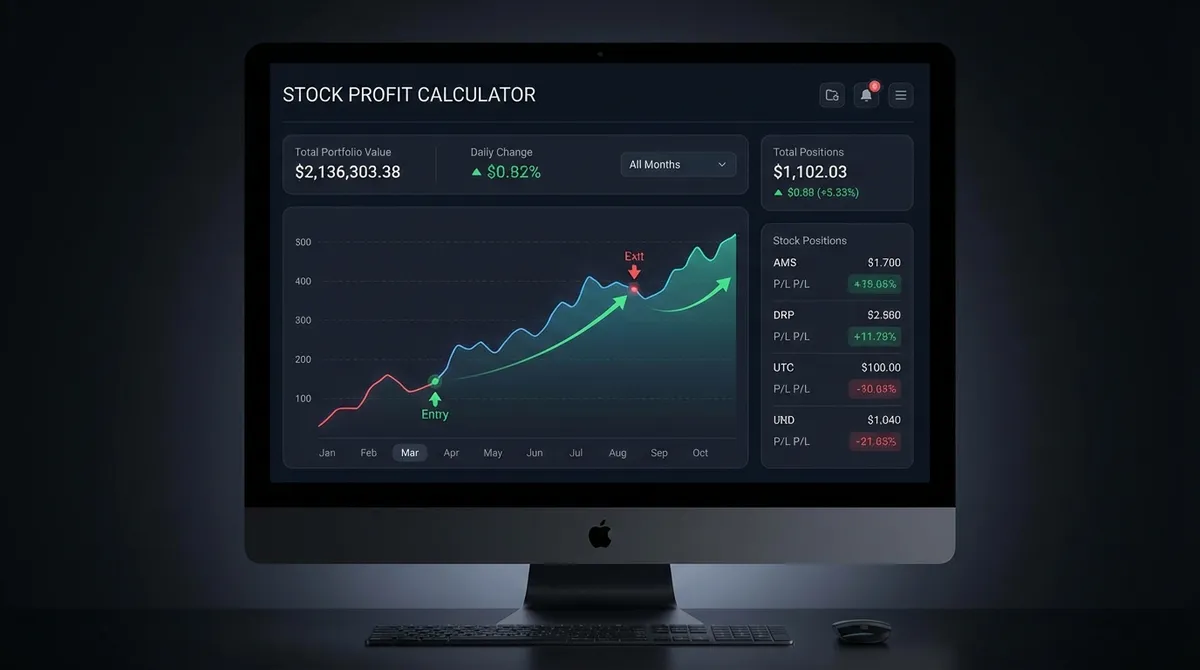
A stock profit calculator is an essential tool that computes your actual profit or loss from stock trades by factoring in purchase price, selling price, number of shares, commissions, fees, and dividends. While many investors simply subtract buy price from sell price, this simplistic approach dramatically overstates real returns by ignoring the significant costs that erode profits.
In 2025, with average brokerage commissions ranging from $0 to $6.95 per trade and regulatory fees adding another layer of costs, accurately calculating net profit is crucial for making informed investment decisions. Whether you're a day trader executing multiple trades daily or a long-term investor building wealth through buy-and-hold strategies, understanding your true returns is fundamental to portfolio success.
The difference between gross and net profit can be substantial. A trade that appears profitable before fees might actually result in a loss after accounting for commissions on both buy and sell transactions. This calculator eliminates guesswork by providing precise figures that reflect real-world trading conditions.
How Stock Profit Calculations Work: The Complete Formula
Understanding the stock profit formula is essential for every investor. The calculation involves several components that transform a simple price difference into an accurate reflection of your actual returns.
Core Components Explained
- •Buy Price × Shares: Your total initial investment before any fees. This represents the capital you commit to the position.
- •Sell Price × Shares: Total proceeds from selling your position before deducting selling costs.
- •Gross Profit: The difference between total proceeds and total cost before any commissions or fees.
- •Commissions: Brokerage fees on both buy and sell transactions that directly reduce your profit.
- •Dividends: Income received from holding the stock that adds to your total return.
ROI Calculation
Return on Investment (ROI) percentage shows your return relative to what you invested:
This percentage allows you to compare the efficiency of different trades regardless of their absolute size.
Real-World Example: Calculating Real Profit on a Tech Stock Trade
Let's follow Alex, an investor who purchased shares of a popular semiconductor company. Understanding whether a trade is truly profitable requires looking beyond the simple price difference.
Trade Details
Sale & Results
Key Insight: While the gross price difference suggested a $750 profit ($15 × 50 shares), the actual net profit after commissions and including dividends was $765.10. The ROI was 10.20% over the holding period, which lasted eight months.
Break-Even Analysis: Knowing Your Minimum Exit Price
Break-even analysis is crucial for risk management. It tells you the minimum price at which you must sell to avoid losing money after accounting for all transaction costs.
Using Alex's example above, the break-even price is about $149.70 per share. You add the total cost of the position and the sell commission, subtract dividends, and divide by the number of shares (($7,504.95 + $4.95 − $25.00) ÷ 50 shares = $7,484.90 ÷ 50 ≈ $149.70). At this price your net profit after all costs and dividends is effectively zero—above it you make money, below it you realize a loss.
Why Break-Even Matters
- • Stop-Loss Planning: Set stop-loss orders just below break-even to limit downside
- • Position Sizing: Understand how commission costs affect smaller trades
- • Multiple Purchases: Calculate weighted average cost basis for accuracy
- • Tax Planning: Know when you've truly realized gains vs. recovering costs
Common Mistakes and Hidden Costs That Destroy Returns
Many investors, especially beginners, make critical errors when calculating stock profits. These mistakes lead to overestimating returns, poor decision-making, and unexpected tax bills.
Common Calculation Errors
- 1.Ignoring Sell-Side Commissions: Some investors only subtract buy commissions, forgetting that selling also costs money.
- 2.Not Accounting for Dividends: Dividend income is part of your total return and should be included in profit calculations.
- 3.Confusing Gross vs. Net: Gross profit looks impressive, but net profit after all costs is what matters.
- 4.Missing Regulatory Fees: SEC fees, FINRA fees, and exchange fees may appear small but add up over time.
Hidden Costs That Erode Profits
- •Spread Costs: The difference between bid and ask prices, especially significant for thinly traded stocks.
- •Margin Interest: If trading on margin, interest charges can significantly reduce or eliminate profits.
- •Currency Conversion: For international stocks, forex spreads can impact returns.
- •Opportunity Cost: Money tied up in losing positions cannot be deployed elsewhere.
Understanding Tax Implications: Capital Gains and Your Net Return
Taxes significantly impact your actual stock profit. Understanding capital gains tax rules helps you make informed decisions about when to sell and how to structure your trades for tax efficiency.
Short-Term vs. Long-Term
- Short-Term: Held for one year or less. Taxed as ordinary income (10%-37% depending on your tax bracket).
- Long-Term: Held for more than one year. Taxed at preferential rates (0%, 15%, or 20% depending on income).
- This difference can be substantial - a $10,000 gain could cost $3,700 in taxes short-term vs. $2,000 long-term for high earners.
Tax Calculation Example
Using Alex's $765.10 profit from earlier:
- • Short-term (held 8 months): $765.10 × 22% = $168.32 tax
- • After-tax profit: $596.78
- • Long-term (held 13+ months): $765.10 × 15% = $114.77 tax
- • After-tax profit: $650.33
- • Tax savings: $53.55 (9% more after-tax profit)
Important: Always consult a tax professional for personalized advice. Tax laws change frequently, and individual circumstances vary significantly. This calculator focuses on pre-tax profit calculation.
How to Use This Stock Profit Calculator: Step-by-Step Guide
Our stock profit calculator is designed for accuracy and ease of use. Follow these steps to get precise profit calculations for your trades.
Step 1Enter Your Purchase Details
Input your buy price per share and the number of shares purchased. These are the foundation of your cost basis calculation.
- Find buy price on your trade confirmation statement
- Include fractional shares if applicable (common with dividend reinvestment)
- If you made multiple purchases, calculate the weighted average price
Step 2Input Your Sale Information
Enter your sell price per share. You can use current market price for unrealized gains or actual sale price for completed transactions.
- Use limit order execution price for accuracy
- If selling in multiple lots, calculate the weighted average
- For unrealized gains, use current bid price
Step 3Add Commission and Fee Details
Include all trading costs from both buy and sell transactions. These have a direct impact on your net profit.
- Brokerage commissions (e.g., $4.95 per trade)
- Regulatory fees (SEC, FINRA, exchange fees)
- Platform fees if applicable
Step 4Include Dividend Income
Don't forget to add any dividends received during your holding period. Dividends are part of your total return and can significantly boost profits.
- Include regular quarterly dividends
- Add special or one-time dividends
- Include dividend reinvestment if applicable
Step 5Review Your Results
The calculator instantly shows your net profit, ROI percentage, break-even price, and detailed breakdown. Use these insights to evaluate your trade's success.
- Check if the ROI meets your investment goals
- Compare with alternative investments
- Use break-even price for future stop-loss planning
- Export or save results for tax documentation
Calculator Tips for Best Results
- • Use exact commission amounts from your brokerage statements for precision
- • Calculate break-even before entering a trade to set appropriate stop-loss levels
- • Run multiple scenarios to understand how price changes affect your profit
- • Include all dividends, even small ones—they compound over time
- • For forex trades, include currency conversion costs in commission fields
How to Interpret Your Stock Profit Results for Better Decision Making
The calculator provides several key metrics. Understanding what each means helps you make better investment decisions and improve your trading strategy over time.
Net Profit
Your actual dollar gain after all costs
- • Positive = profitable trade
- • Negative = losing trade
- • Compare to your investment goal
ROI Percentage
Return relative to your investment
- • Compare to market benchmarks
- • Evaluate risk-adjusted returns
- • Track consistency over time
Break-Even Price
Minimum price to break even
- • Set stop-loss orders
- • Plan exit strategies
- • Manage downside risk
Pro Tip: Don't evaluate trades in isolation. Track your ROI across multiple trades to identify patterns. Are you consistently profitable with certain stock types? Do specific market conditions affect your results? Use these insights to refine your strategy and focus on what works.
More Investment Calculators
Check out these tools to further analyze your investments:
- Stock Average Calculator - Determine your weighted average price.
- Capital Gains Tax Calculator - Estimate taxes on your profits.
- ROI Calculator - Calculate return on investment.
- Dividend Yield Calculator - Analyze dividend returns.
- Tax Bracket Calculator - Find your tax rate.
For official info on capital gains, visit the IRS Topic No. 409.
Final Thoughts: Mastering Stock Profit Calculations
Accurate stock profit calculation is not just about knowing if you made money—it's about understanding the true efficiency of your capital and making data-driven investment decisions. Many investors overestimate their returns by ignoring commissions, fees, and other costs that directly impact net profit.
This calculator eliminates guesswork by providing precise figures that reflect real-world trading conditions. Whether you're evaluating a single trade or analyzing your entire portfolio's performance, accurate calculations are the foundation of successful investing.
Key Takeaway: Always calculate net profit, not gross profit. Consider all costs including buy and sell commissions, regulatory fees, and include dividend income. Use ROI percentage to compare trade efficiency, and always know your break-even price before entering a position. These disciplined practices separate successful investors from those who trade on hope rather than data.
Remember that past performance doesn't guarantee future results, but understanding your real returns helps you identify what's working in your investment strategy. Use this calculator regularly to stay informed, make better decisions, and ultimately achieve your financial goals.
Written by Jurica Šinko
Last updated: September 12, 2025