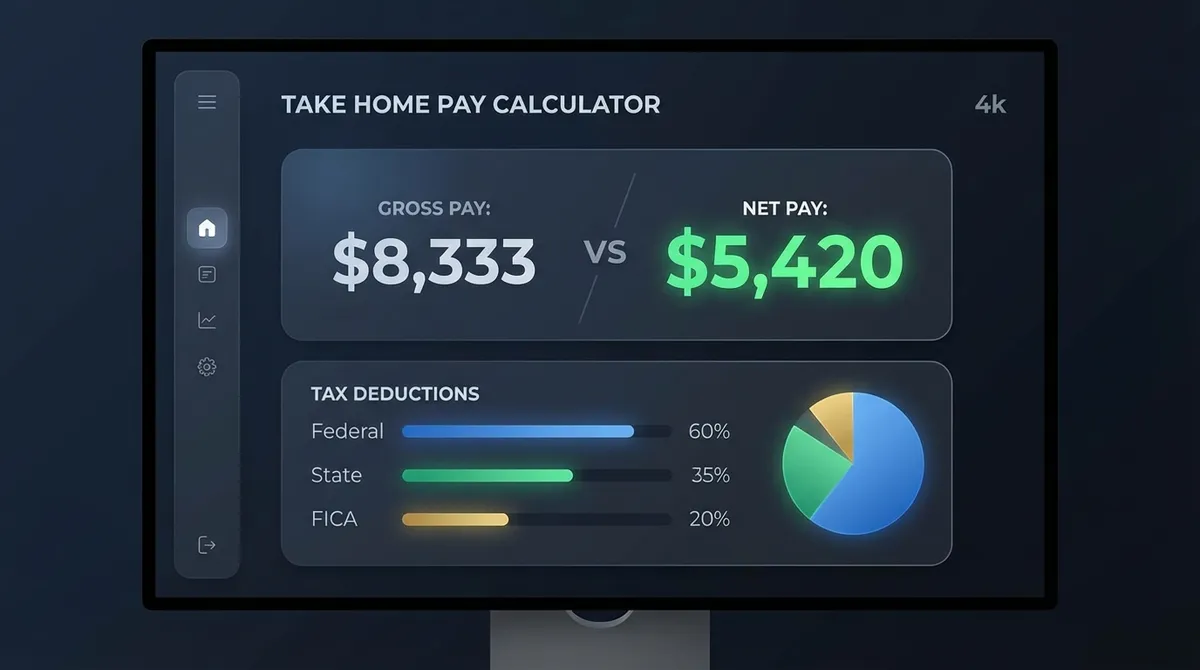
Take Home Pay Calculator: Estimate Your Net Pay After Taxes
Calculate your actual earnings with our take home pay calculator. See your net pay after federal, state, FICA, and other deductions. Free net pay tool.
Take Home Pay Calculator
Calculate your net pay after federal taxes, state taxes, FICA, and deductions. Get an accurate estimate of your actual take-home pay for 2025.
Enter Your Income Details
Enter 0 for states with no income tax
401(k), health insurance, etc.
About These Calculations
Tax Year: Calculations based on 2025 federal tax brackets, standard deductions, and FICA rates.
Federal Tax: Uses progressive tax brackets based on your filing status. Your income is taxed at increasing rates as it moves through each bracket.
FICA Taxes: Social Security tax is 6.2% up to the wage base limit ($176,100 for 2025). Medicare tax is 1.45% on all earnings, plus an additional 0.9% for high earners above the threshold.
State Tax: Uses the flat rate you provide. Actual state taxes may vary based on specific state brackets, deductions, and credits.
Note: This calculator provides estimates for educational purposes. Consult a tax professional for accurate tax planning advice.
How to Use Take Home Pay Calculator
Enter Your Data
Input your financial information, amounts, rates, and terms in the calculator fields
Adjust Parameters
Fine-tune options like compounding frequency, payment schedules, or additional contributions
Calculate Results
Click Calculate to instantly see your results with detailed breakdowns and charts
Analyze & Compare
Review the results, try different scenarios, and use insights for financial planning
Key Features
Accurate 2025 federal tax withholding with progressive tax bracket calculations
All filing statuses: Single, Married Jointly/Separately, Head of Household
FICA breakdown: Social Security (6.2%), Medicare (1.45%), Additional Medicare Tax (0.9%)
State income tax estimation with customizable rates for all 50 states
Four pay frequencies: Annual, Monthly, Bi-weekly, Weekly
Pre-tax deductions: 401(k), health insurance, HSA, and other benefits
Real-time effective tax rates and per-pay-period breakdowns
Mobile-friendly, accessible, and privacy-first design
Comprehensive visual breakdown of all deductions and withholdings
What Is Take-Home Pay and Why It Matters in 2025?
Take-home pay—also called net pay or disposable income—is the actual amount of money you receive in your paycheck after all deductions are withheld. While your gross salary might look impressive on paper, your take-home pay is what determines your real purchasing power, budgeting capacity, and financial planning possibilities. Understanding this difference is crucial for making informed career decisions, negotiating salary, and creating realistic financial plans.
In 2025, with federal tax brackets ranging from 10% to 37%, varying state tax rates, and FICA contributions of 7.65% (or more for high earners), the gap between gross and net pay can be substantial. For example, a $75,000 annual salary might translate to only $52,000-$55,000 in actual take-home pay depending on your filing status, state of residence, and pre-tax deductions. This calculator helps you accurately estimate your true earnings so you can budget effectively and plan for your financial future.
Key Statistic: According to the Bureau of Labor Statistics, the average American worker loses 25-30% of their gross income to taxes and deductions. For a median household income of $77,719, that means approximately $19,000-$23,000 never reaches your bank account. Understanding these deductions helps you optimize your withholdings and maximize your take-home pay.
How Take-Home Pay Calculations Work: Understanding Your Paycheck Deductions
Your take-home pay is calculated through a series of deductions from your gross income. These aren't arbitrary subtractions—they're legally required contributions and voluntary elections that serve important purposes. Understanding each component helps you make informed decisions about your withholdings and financial planning.
Federal Income Tax Withholding
Federal income tax is typically the largest deduction from your paycheck. The U.S. uses a progressive tax system where your income is taxed at increasing rates as it moves through different brackets. For 2025, federal tax rates range from 10% to 37%, applied to taxable income after deductions.
2025 Federal Tax Brackets (Single Filers):
Important: Being "in" a certain tax bracket doesn't mean all your income is taxed at that rate. Only the income within each bracket is taxed at that rate. For example, if you earn $75,000 as a single filer, only the amount above $48,475 is taxed at 22%. Your effective tax rate—the actual percentage you pay overall—is typically much lower than your marginal tax rate.
FICA Taxes (Social Security and Medicare)
FICA (Federal Insurance Contributions Act) taxes fund Social Security and Medicare programs. These are flat-rate taxes that apply to most earned income:
- •Social Security Tax: 6.2% of your gross wages up to the wage base limit ($176,100 for 2025). Your employer matches this contribution, making the total 12.4%.
- •Medicare Tax: 1.45% of all your gross wages with no income limit. Your employer matches this, making the total 2.9%.
- •Additional Medicare Tax: High earners pay an extra 0.9% on income above $200,000 (single) or $250,000 (married filing jointly).
State and Local Income Taxes
State income taxes vary dramatically across the U.S. Nine states have no income tax (Alaska, Florida, Nevada, New Hampshire, South Dakota, Tennessee, Texas, Washington, Wyoming). Others have progressive systems with rates up to 13.3% (California). Some cities and counties also impose local income taxes. This calculator allows you to input your estimated state tax rate.
Pre-Tax Deductions
Pre-tax deductions reduce your taxable income, potentially lowering your tax liability. Common pre-tax deductions include:
- •401(k) or 403(b) retirement contributions
- •Health insurance premiums
- •Health Savings Account (HSA) contributions
- •Flexible Spending Account (FSA) contributions
Real-World Example: Jennifer's $65,000 Salary Breakdown
Jennifer is a marketing manager earning $65,000 annually in Colorado. She's single, claims the standard deduction, and contributes 6% of her salary to her 401(k). Let's break down her take-home pay to understand where her money goes.
• Gross Annual Salary: $65,000
• Filing Status: Single
• Pre-tax 401(k): $3,900 (6%)
• State: Colorado (4.4% effective rate)
• Federal Tax: $6,261
• State Tax: $2,684
• Social Security: $4,030
• Medicare: $943
• Total Deductions: $13,918
Net Results:
Effective Tax Rate: 21.4% overall (9.6% federal, 4.1% state, 7.7% FICA)
Jennifer's case illustrates the significant impact of taxes and deductions. While her gross salary is $65,000, she only takes home $51,082—a difference of $13,918 or 21.4%. Her 401(k) contribution reduces her taxable income, saving her approximately $900 in federal taxes while building retirement savings.
How to Interpret and Use Your Take-Home Pay Results
Understanding Your Effective Tax Rates
This calculator shows both your marginal tax rate (the rate on your last dollar of income) and your effective tax rate (the average rate across all income). Your effective rate is what matters most for financial planning—it's the actual percentage of your income going to taxes.
Budgeting with Your Net Income
Always base your budget on your take-home pay, not your gross salary. Common budgeting frameworks include:
- •50/30/20 Rule: 50% needs, 30% wants, 20% savings and debt repayment
- •Zero-Based Budget: Assign every dollar a purpose until income minus expenses equals zero
- •Pay Yourself First: Allocate savings and investments before other expenses
Planning for Pay Frequency Variations
Your pay frequency affects budgeting:
- •Monthly: 12 paychecks per year—easiest for monthly budgeting
- •Bi-weekly: 26 paychecks per year—creates two "extra" paychecks annually
- •Weekly: 52 paychecks per year—requires more frequent budgeting
Common Take-Home Pay Mistakes and Optimization Strategies
Mistake #1: Underwithholding Federal Taxes
Many people claim too many allowances on their W-4 form to maximize monthly cash flow, only to face a large tax bill in April. While getting a big refund means you've given the government an interest-free loan, owing thousands can strain your finances.
How to Fix It:
Use the IRS Tax Withholding Estimator tool and update your W-4 accordingly. Aim for a small refund or minimal tax due—ideally within $500 of breaking even.
Mistake #2: Not Maximizing Pre-Tax Deductions
Many employees don't fully utilize pre-tax benefits like 401(k) plans, HSAs, or FSAs. These not only reduce current tax liability but also provide valuable benefits.
Optimization Strategy:
At minimum, contribute enough to your 401(k) to get the full employer match (free money). Consider maxing out an HSA if you have a high-deductible health plan—it's triple tax-advantaged.
Mistake #3: Ignoring State Tax Implications
State taxes can significantly impact take-home pay. A $75,000 salary in Texas (no state income tax) results in higher net pay than the same salary in California (up to 13.3% state tax).
Financial Planning Insight:
When considering job offers in different states, always compare take-home pay, not gross salary. A higher gross salary in a high-tax state might result in lower net pay than a lower salary in a tax-free state.
Strategies to Increase Take-Home Pay
- •Adjust Your W-4: Fine-tune your withholding to match your actual tax liability
- •Increase Pre-Tax Contributions: Maximize 401(k), HSA, and FSA contributions
- •Claim All Available Credits: Child tax credit, education credits, and other tax benefits
- •Time Bonuses Strategically: If possible, defer income to years with lower tax liability
- •Review Annually: Life changes (marriage, children, home purchase) affect your optimal withholding
Special Situations and Advanced Considerations
Self-Employment and Independent Contractors
Self-employed individuals must pay both the employee and employer portions of FICA taxes (15.3% total instead of 7.65%). However, they can deduct half of this self-employment tax when calculating adjusted gross income, effectively reducing the overall tax burden.
High Earners and Additional Medicare Tax
Individuals earning above $200,000 (single) or $250,000 (married filing jointly) pay an additional 0.9% Medicare tax on income above these thresholds. This is on top of the regular 1.45% Medicare tax, making the total Medicare tax rate 2.35% for high earners.
Multiple Jobs and Combined Income
If you have multiple jobs, each employer withholds taxes independently based on your W-4 for that job. However, your combined income might push you into a higher tax bracket or trigger additional Medicare tax withholding. Use the IRS withholding calculator to ensure adequate withholding across all jobs.
Moving Between States
If you move between states during the year, you'll file part-year resident returns in both states. Your take-home pay calculations should reflect the state taxes for your current location. Some states have reciprocity agreements that affect how taxes are calculated for cross-border workers.
Frequently Asked Questions About Take-Home Pay
Why is my take-home pay so much lower than my salary?
Your gross salary includes all earnings before any deductions. Federal income tax typically takes 10-22% for middle-income earners, FICA taxes add 7.65%, state taxes can take 0-13.3%, and pre-tax deductions further reduce taxable income. Combined, these often total 25-35% of your gross pay, leaving 65-75% as take-home pay.
How can I increase my take-home pay without changing jobs?
Several strategies can help: (1) Adjust your W-4 withholding to avoid overpaying taxes throughout the year, (2) Maximize pre-tax deductions like 401(k) and HSA contributions (which reduce taxable income), (3) Claim all available tax credits, (4) Review your benefits annually to ensure you're not over-insured, and (5) Consider flexible spending accounts for dependent care or medical expenses.
What's the difference between marginal and effective tax rates?
Your marginal tax rate is the rate you pay on your last dollar of income (your highest tax bracket). Your effective tax rate is your total tax divided by total income—average rate across all brackets. For example, a single filer earning $75,000 is in the 22% marginal bracket but might have an effective federal rate of only 9-10% due to lower rates on lower portions of income.
Why do bonuses seem to be taxed at a higher rate?
Bonuses are subject to federal income tax just like regular wages, but withholding is calculated differently. Employers often use the percentage method, withholding 22% for federal tax (or 37% for very large bonuses). However, when you file your tax return, bonuses are treated as ordinary income and taxed at your regular rates. The higher withholding is temporary—you may get some back as a refund.
How do I account for overtime in my take-home pay calculation?
Overtime pay is taxed at the same rates as regular pay, but it can push you into a higher tax bracket for that pay period. Calculate your annual gross income including expected overtime, then use the annual results to estimate per-period amounts. Remember that overtime withholding might be higher during high-OT periods but will balance out when you file your tax return.
What should I do if I have multiple jobs or side income?
For multiple jobs, each employer withholds taxes based only on what they pay you, which often results in under-withholding. Use the IRS Tax Withholding Estimator and consider having extra tax withheld from your main job's paycheck. For side income (1099 work), set aside 25-30% for taxes and make estimated quarterly payments to avoid penalties.
How accurate are online take-home pay calculators?
Good calculators using current tax brackets and standard deductions provide reasonably accurate estimates (within 1-3% for most people). However, they can't account for all variables like itemized deductions, specific state brackets, local taxes, or complex situations. Use results as a planning tool, then verify with your actual pay stub or a tax professional for precise planning.
Author: Jurica Šinko, CPA, MBA
Last Updated: September 11, 2025
Category: Tax & Payroll
Disclaimer: This calculator provides estimates for educational purposes only. Consult with a qualified tax professional or financial advisor for personalized advice regarding your specific situation. Tax laws change frequently, and individual circumstances vary significantly.
About the Author
Jurica Šinko
Finance Expert, CPA, MBA with 15+ years in corporate finance and investment management
Connect with JuricaFrequently Asked Questions
How accurate are these calculator results?
Our calculators use industry-standard financial formulas and are regularly verified against professional accounting software. Results are highly accurate based on the information you provide.
Is my financial data stored or shared?
No. All calculations happen locally in your browser. We never store, track, or share any of your personal financial information. Your privacy is 100% protected.
Can I use these calculators for business purposes?
Yes! Our calculators are suitable for both personal and business financial planning. Many small business owners and financial professionals use them daily.
How often are rates and formulas updated?
We regularly update our calculators to reflect current tax laws, interest rates, and financial regulations. Check the last updated date on each calculator page.
What makes these calculators different from others online?
We focus on user experience, accuracy, and privacy. No ads cluttering the interface, no required sign-ups, and mobile-first design ensures they work perfectly on any device.
Related Calculators
Explore more tools in Tax & Payroll
ADP Paycheck Calculator | Free Salary & Hourly Estimator
Estimate your net pay with our ADP paycheck calculator. Calculate federal, state, and local withholdings for both salary and hourly employees accurately.
After Tax Income Calculator | Calculate Net Income
Determine your actual earnings with our after tax income calculator. Convert gross salary into net income by accounting for federal, state, and local taxes.
AGI Calculator: Calculate Adjusted Gross Income Accurately (2025 Tax Year)
Free AGI calculator for 2025 tax year. Calculate Adjusted Gross Income accurately with above-the-line deductions. Determine tax credits, ACA subsidies, and IRA eligibility.
Alabama Paycheck Calculator: Calculate Your AL Take-Home Pay
Free Alabama paycheck calculator for 2025. Calculate your take-home pay after federal, state, and local taxes. Accurate AL payroll calculations.
Arizona Paycheck Calculator: Calculate Your AZ Take-Home Pay
Free Arizona paycheck calculator for 2025. Calculate your take-home pay after federal, state, and FICA taxes. Accurate AZ payroll calculations with flat 2.5% state tax rate.
Arizona Income Tax Calculator 2025 | AZ Tax Estimate
Calculate your AZ liability with our 2025 Arizona income tax calculator. Uses the current AZ flat tax rate for accurate estimation. Free AZ tax calculator.