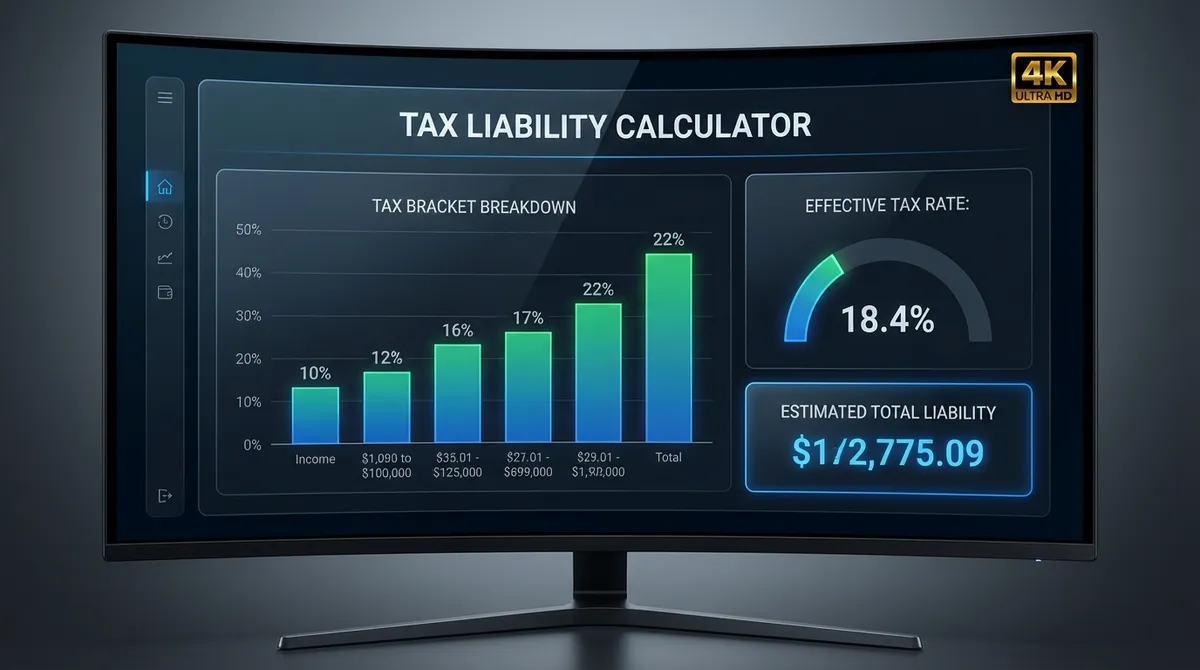
Tax Liability Calculator: Estimate Your Total Tax Burden for 2025
Calculate your total tax liability for 2025 including federal income tax, state tax, and effective rates. Accurate tax planning tool with detailed breakdowns and expert guidance.
Tax Liability Calculator: Estimate Your Total Tax Burden for 2025
Calculate federal and state tax liability for 2025
How to Use Tax Liability Calculator
Select Filing Status
Choose your federal tax filing status (Single, Married Jointly, Married Separately, or Head of Household) as this determines your tax brackets and standard deduction
Enter Income Details
Input your annual gross income, pre-tax deductions (401k, health insurance), and any federal withholding already paid to calculate your net tax position
Add State Tax Information
Enter your estimated state tax rate (0% for no state income tax states up to 13.3% for California) and any additional itemized or standard deductions
Review Tax Liability Breakdown
Analyze your federal tax, state tax, total tax liability, effective rates, and after-tax income. Use the insights for tax planning and W-4 adjustments
Key Features
Accurate federal tax calculations using 2025 brackets
State tax estimation with custom rates
Detailed breakdowns of taxable income and deductions
Effective tax rate analysis
Tax withholding analysis
Mobile-friendly and privacy-first
Comprehensive tax planning guidance
What Is Tax Liability and Why It Matters in 2025?
Tax liability represents the total amount of tax you owe to federal, state, and local governments based on your taxable income and financial activities. Unlike withholding amounts or estimated payments—which are prepayments toward your tax bill—your tax liability is the final calculated amount you're legally obligated to pay. Understanding your tax liability is crucial for accurate financial planning, avoiding underpayment penalties, and ensuring you're neither overpaying throughout the year nor facing an unexpected tax bill come April 15th.
In 2025, with updated tax brackets reflecting inflation adjustments and the expiration of certain temporary provisions, accurately calculating your tax liability has become more important than ever. Whether you're an employee reviewing your W-4 withholdings, a freelancer making quarterly estimated payments, or planning major financial decisions like retirement withdrawals or investment sales, knowing your total tax liability provides the foundation for sound financial strategy and compliance.
Key Statistic: The average American pays approximately 22-24% of their income in total taxes, including federal income tax, state income tax, payroll taxes (FICA), and local taxes. However, your actual tax liability can vary dramatically based on income level, filing status, deductions, and state of residence. For example, a single filer earning $75,000 might owe $12,000 in federal income tax (16% effective rate) plus state taxes, while the same income for a married couple filing jointly could result in only $8,500 federal liability (11% effective rate) due to more favorable brackets and double the standard deduction.
How Tax Liability Calculations Work: From Gross Income to Final Tax Bill
Calculating your total tax liability involves multiple steps, each applying specific rules and adjustments that transform your gross income into your final tax obligation. Understanding this progression helps you identify tax planning opportunities and ensures accuracy in your calculations.
Step 1: Determine Gross Income and Adjusted Gross Income (AGI)
Your journey begins with gross income—all income from all sources, including wages, salaries, business income, interest, dividends, capital gains, rental income, and retirement distributions. From this total, you subtract specific "above-the-line" deductions to arrive at Adjusted Gross Income (AGI). Common above-the-line deductions include:
- •Traditional 401(k) and IRA contributions: Reduce taxable income dollar-for-dollar up to annual limits ($23,000 for 401(k)s, $7,000 for IRAs in 2025, plus $7,500 catch-up for those 50+)
- •Health Savings Account (HSA) contributions: Triple tax advantage—deductible, grows tax-free, tax-free withdrawals for qualified medical expenses
- •Self-employment tax deduction: Deduct half of self-employment tax as an above-the-line adjustment
- •Student loan interest: Up to $2,500 deduction subject to income phaseouts
Step 2: Subtract Standard or Itemized Deductions
After calculating AGI, you subtract either the standard deduction or your total itemized deductions, whichever is greater:
2025 Standard Deduction Amounts:
- • Single: $14,600
- • Married Filing Jointly: $29,200
- • Married Filing Separately: $14,600
- • Head of Household: $21,900
Itemized deductions include state and local taxes (SALT, capped at $10,000), mortgage interest, charitable contributions, and medical expenses exceeding 7.5% of AGI. With the high standard deduction, only about 10% of taxpayers benefit from itemizing in 2025.
Step 3: Apply Federal Tax Brackets
Your federal income tax liability is calculated using progressive tax brackets—the system where different portions of your income are taxed at increasing rates. Here are the 2025 federal tax brackets:
2025 Federal Tax Brackets
Single Filers:
- • 10%: $0 - $11,000
- • 12%: $11,001 - $44,725
- • 22%: $44,726 - $95,375
- • 24%: $95,376 - $182,050
- • 32%: $182,051 - $231,250
- • 35%: $231,251 - $578,125
- • 37%: $578,126+
Married Filing Jointly:
- • 10%: $0 - $22,000
- • 12%: $22,001 - $89,450
- • 22%: $89,451 - $190,750
- • 24%: $190,751 - $364,200
- • 32%: $364,201 - $462,500
- • 35%: $462,501 - $693,750
- • 37%: $693,751+
Example: A single filer with $75,000 taxable income pays 10% on the first $11,000 ($1,100), 12% on the next $33,725 ($4,047), and 22% on the remaining $30,275 ($6,661), totaling $11,808 in federal income tax—an effective rate of 15.7%, not 22%.
Step 4: Add State and Local Tax Liabilities
State income tax liability varies dramatically by location. Currently, nine states have no income tax (Alaska, Florida, Nevada, New Hampshire, South Dakota, Tennessee, Texas, Washington, Wyoming), while others have progressive systems with top rates exceeding 13% (California, New York, New Jersey). Our calculator uses an estimated state tax rate you provide, but actual liability depends on your specific state's brackets, deductions, and credits.
Real-World Example: The Johnson Family's Tax Planning
Meet Mark and Sarah Johnson, a married couple with two children, ages 8 and 10. Mark earns $85,000 as an engineer, while Sarah earns $45,000 as a teacher. They contribute $12,000 annually to their 401(k)s and have $3,000 in pre-tax health insurance premiums. They live in a state with a 5% income tax rate and have $15,000 in itemized deductions (mortgage interest, property taxes, and charitable giving).
• Combined Gross Income: $130,000
• 401(k) Contributions: -$12,000
• Health Insurance: -$3,000
• Adjusted Gross Income: $115,000
• Itemized Deductions: -$15,000
• Taxable Income: $100,000
• Federal Tax: $13,260 (10.2% effective rate)
• State Tax (5%): $6,500
• Total Tax Liability: $19,760
• After-Tax Income: $110,240
• Total Effective Rate: 15.2%
• Plus Child Tax Credit: -$4,000
Tax Planning Optimization: After using our calculator, the Johnsons discover they could increase their 401(k) contributions to $19,000 (the 2025 limit for those under 50), reducing their taxable income to $93,000. This saves them $2,310 in federal taxes while building retirement savings. They also learn about the Child Tax Credit ($2,000 per child under 17), which directly reduces their tax liability by $4,000, making their net federal tax just $9,260 instead of $13,260.
Key Insight: Marginal vs. Effective Rates
The Johnsons are in the 12% marginal tax bracket, meaning each additional dollar of income is taxed at 12%. However, their effective federal tax rate is only 10.2% due to progressive brackets and their effective total tax rate is just 15.2% including state taxes. Understanding this difference is crucial for tax planning decisions.
Common Mistakes and How to Avoid Them
Mistake #1: Confusing Withholding with Actual Tax Liability
Many taxpayers believe the amount withheld from their paycheck is their tax liability. In reality, withholding is just an estimate. Your actual liability is determined when you file your tax return, comparing total tax owed against what was withheld.
Solution: Use our calculator to estimate your total tax liability, then adjust your W-4 to withhold approximately that amount throughout the year. Aim to neither significantly overpay (giving an interest-free loan) nor underpay (risking penalties).
Mistake #2: Ignoring State Tax Liability
State income taxes can add 0-13.3% (California's top rate) to your total tax burden. Many tax calculators focus only on federal tax, leaving you with an incomplete picture.
Solution: Our calculator includes state tax estimation. Research your specific state's brackets, as some have unique rules (e.g., New Hampshire taxes only interest and dividends, Washington has no income tax but high sales tax).
Mistake #3: Not Accounting for All Income Sources
Tax liability includes all taxable income: wages, self-employment income, interest, dividends, capital gains, retirement distributions, rental income, and even unemployment benefits.
Solution: Gather all Form W-2s, 1099s (INT, DIV, B, R, MISC), K-1s for partnerships/S-corps, and records of any other income before calculating. Use the annual income field in our calculator to include all sources.
Mistake #4: Misunderstanding Standard vs. Itemized Deductions
Since the Tax Cuts and Jobs Act of 2017 nearly doubled the standard deduction, itemizing only makes sense if your total itemized deductions exceed the standard amount.
Solution: Track potential itemized deductions throughout the year (mortgage interest, property taxes, charitable contributions, medical expenses). Use our calculator to test both scenarios and choose the larger deduction.
Advanced Tax Liability Factors
Alternative Minimum Tax (AMT)
High-income earners with significant deductions may trigger the AMT, a parallel tax system designed to ensure everyone pays a minimum amount. AMT disallows certain deductions (state taxes, property taxes, miscellaneous itemized deductions) and applies a flat 26% or 28% rate. Our calculator doesn't include AMT calculations, so if you have income above $200,000 and substantial deductions, consult a tax professional or use specialized AMT calculation tools.
Self-Employment Tax
Self-employed individuals pay both the employer and employee portions of Social Security and Medicare taxes—15.3% on net business income up to $168,600 (Social Security wage base for 2025), plus 2.9% Medicare tax on all net income, plus an additional 0.9% Medicare surtax on income above $200,000 (single) or $250,000 (married joint). This tax is calculated on Schedule SE and added to your income tax liability.
Net Investment Income Tax (NIIT)
High-income taxpayers (over $200,000 single, $250,000 married joint) pay an additional 3.8% tax on investment income including interest, dividends, capital gains, rental income, and passive business income. This is calculated on Form 8960 and added to your total tax liability.
Capital Gains and Qualified Dividends
Long-term capital gains and qualified dividends receive preferential tax rates: 0% for income in the 10-12% brackets, 15% for most taxpayers, and 20% for high earners in the top tax bracket. Our calculator assumes ordinary income rates, so if you have significant investment income, your actual liability may be lower than calculated.
When to Consult a Tax Professional
Complex Situations Requiring Professional Help
- • Multiple state tax returns (remote workers, business owners)
- • Self-employment income over $100,000
- • Rental property ownership and depreciation
- • Significant investment portfolio with complex transactions
- • Business ownership (S-corp, partnership, C-corp)
- • Recent major life changes (marriage, divorce, inheritance)
- • Foreign income or foreign tax credits
- • AMT triggers or complex deduction situations
- • Cryptocurrency transactions and DeFi activities
- • Estate or trust income
Benefits of Professional Tax Planning
- • Maximize deductions and credits you might miss
- • Optimize business structure for tax efficiency
- • Strategic timing of income and deductions
- • Retirement plan optimization and contribution strategies
- • Multi-year tax planning and projection
- • Audit support and representation
- • Complex tax law interpretation and application
- • Estate and gift tax planning
Proactive Tax Planning Strategies for 2025
Maximize Retirement Contributions
Contribute the maximum to 401(k) plans ($23,000 for under 50, $30,500 for 50+ with $7,500 catch-up), traditional IRAs ($7,000, $8,000 for 50+), and HSAs ($4,150 individual, $8,300 family, plus $1,000 catch-up for 55+). These reduce AGI, lowering both federal and state tax liability while building wealth.
Optimize Your W-4 Withholding
Use our calculator to estimate annual tax liability, then complete Form W-4 to withhold roughly that amount. Too much withholding means an interest-free loan to the government; too little risks underpayment penalties. Aim for a small refund or balance due under $1,000.
Bunch Itemized Deductions
If your itemized deductions are close to the standard deduction, consider "bunching"—concentrating two years of charitable giving and medical expenses into one tax year to exceed the standard deduction, then taking the standard deduction the next year.
Harvest Capital Gains and Losses
In low-income years, realize capital gains to take advantage of the 0% capital gains bracket. In high-income years, harvest capital losses to offset gains and up to $3,000 of ordinary income annually (excess losses carry forward indefinitely).
Timing Strategy: Income Smoothing
If you have control over when you receive income (bonuses, business income, retirement distributions), spread it across years to stay in lower tax brackets. For example, if you're near the top of the 12% bracket, deferring $5,000 of income to next year could save $1,100 in taxes (22% bracket difference).
About the Author
Jurica Šinko
Finance Expert, CPA, MBA with 15+ years in corporate finance and investment management
Connect with JuricaFrequently Asked Questions
What is the difference between tax withholding and tax liability?
Tax withholding is the amount your employer deducts from your paycheck and sends to the government as prepayment toward your tax bill. Tax liability is the total amount you actually owe based on your entire year's income and deductions. At tax filing time, you reconcile these: if you withheld more than your liability, you get a refund; if you withheld less, you owe additional tax. Understanding your actual tax liability helps you adjust withholding to avoid giving an interest-free loan or facing penalties.
How accurate is this tax liability calculator for 2025?
Our calculator uses the official 2025 federal tax brackets, standard deduction amounts, and progressive tax calculations for all four filing statuses. Federal calculations are highly accurate for wage income. State tax accuracy depends on the rate you enter; we recommend checking your specific state's brackets. The calculator doesn't include credits (Child Tax Credit, Education Credits), AMT, self-employment tax, or NIIT, so complex situations may require additional calculations.
Does this calculator include tax credits like the Child Tax Credit?
No, this calculator focuses on core tax liability calculation using income and deductions. Tax credits directly reduce your tax liability dollar-for-dollar. For 2025, the Child Tax Credit is up to $2,000 per qualifying child under 17. After calculating your tax liability with our tool, subtract eligible credits to determine your final tax bill. Other common credits include Education Credits ($2,500), Child and Dependent Care Credit (20-35% of expenses), and Saver's Credit (10-50% of retirement contributions).
Why is my effective tax rate lower than my tax bracket?
Your tax bracket (marginal rate) applies only to your last dollar of income, while your effective rate is total tax divided by total income. Due to progressive brackets, standard deduction, and other factors, your effective rate is always lower. For example, a single filer in the 22% bracket with $75,000 taxable income might pay only 15.7% effective federal rate because the first $44,725 is taxed at 10-12%. This distinction is crucial for tax planning decisions.
How do I use this calculator to adjust my W-4 withholding?
First, calculate your total estimated tax liability for the year using this tool. Then, divide by your number of pay periods (26 for biweekly, 12 for monthly). Compare this to your current withholding per paycheck shown on your pay stub. If you're withholding too much (getting large refunds), submit a new W-4 with fewer allowances or a lower additional amount. If withholding too little (owing taxes), increase allowances or add a specific dollar amount in Step 4(c). Recalculate quarterly and adjust for major life changes.
What states have no income tax, and how does that affect my total liability?
Nine states have no income tax: Alaska, Florida, Nevada, New Hampshire (no wage tax, but taxes investment income), South Dakota, Tennessee, Texas, Washington, and Wyoming. If you live in these states, enter 0% for state tax rate. However, these states often have higher property taxes, sales taxes, or other fees. States with the highest income tax rates include California (13.3% top rate), New York (10.9%), New Jersey (10.75%), and Hawaii (11%). Your state tax rate significantly impacts total tax liability.
Should I itemize deductions or take the standard deduction?
Itemize only if your total itemized deductions exceed the standard deduction ($14,600 single, $29,200 married joint in 2025). Common itemized deductions include mortgage interest, state and local taxes (SALT, capped at $10,000), charitable contributions, and medical expenses exceeding 7.5% of AGI. Our calculator's "other deductions" field can simulate itemized deductions. For most taxpayers, especially with the SALT cap, the standard deduction provides greater tax savings. Track expenses throughout the year and calculate both scenarios.
How does tax liability affect self-employed individuals?
Self-employed individuals must calculate and pay quarterly estimated taxes since no employer withholds taxes. Use our calculator to estimate annual liability, then divide by 4 and pay estimated taxes by April 15, June 15, September 15, and January 15. Self-employment tax adds 15.3% on net business income (Social Security and Medicare). However, you can deduct half of self-employment tax and may qualify for the 20% Qualified Business Income (QBI) deduction. If net income exceeds $400, you must file Schedule SE and pay self-employment tax.
Related Calculators
Explore more tools in Tax & Payroll
ADP Paycheck Calculator | Free Salary & Hourly Estimator
Estimate your net pay with our ADP paycheck calculator. Calculate federal, state, and local withholdings for both salary and hourly employees accurately.
After Tax Income Calculator | Calculate Net Income
Determine your actual earnings with our after tax income calculator. Convert gross salary into net income by accounting for federal, state, and local taxes.
AGI Calculator: Calculate Adjusted Gross Income Accurately (2025 Tax Year)
Free AGI calculator for 2025 tax year. Calculate Adjusted Gross Income accurately with above-the-line deductions. Determine tax credits, ACA subsidies, and IRA eligibility.
Alabama Paycheck Calculator: Calculate Your AL Take-Home Pay
Free Alabama paycheck calculator for 2025. Calculate your take-home pay after federal, state, and local taxes. Accurate AL payroll calculations.
Arizona Paycheck Calculator: Calculate Your AZ Take-Home Pay
Free Arizona paycheck calculator for 2025. Calculate your take-home pay after federal, state, and FICA taxes. Accurate AZ payroll calculations with flat 2.5% state tax rate.
Arizona Income Tax Calculator 2025 | AZ Tax Estimate
Calculate your AZ liability with our 2025 Arizona income tax calculator. Uses the current AZ flat tax rate for accurate estimation. Free AZ tax calculator.